


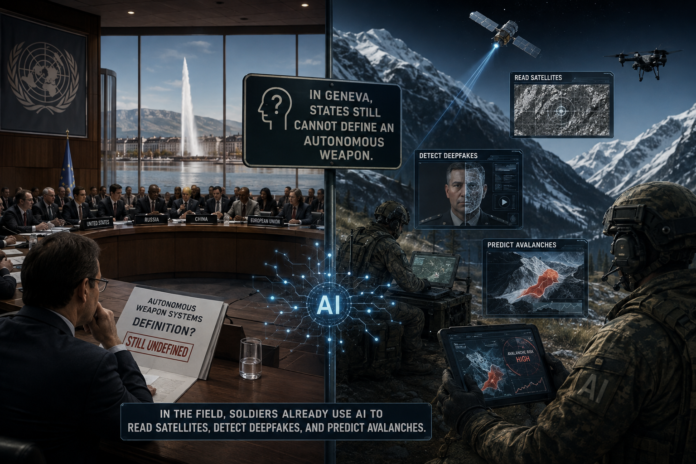
While the diplomats in Geneva were debating what exactly counts as an autonomous weapon, people on the ground were already putting AI to work for all kinds of things. They use it to forecast avalanches, detect deepfakes, condense intelligence briefs, and also run decision-support systems in places that are, frankly, offline. The distance between these two versions of reality is no longer theoretical, or at minimum not the way people used to say it, like.. It is the central strategic fact of the mid-2020s.
The Stockholm International Peace Research Institute’s Yearbook 2026 chapter on artificial intelligence and international peace and security, written by Laura Bruun, Jules Palayer and Vincent Boulanin, offers a meticulous account of how the international community wrestled with AI governance in 2025. Its greatest strength is structural clarity. The authors separate military AI from civilian AI, then show how both domains are being shaped less by technical consensus than by geopolitical rivalry. On military systems, more than a decade of talks under the Convention on Certain Conventional Weapons hasn’t managed to deliver even one shared definition of what counts as autonomous weapon systems, or a clear agreement on the right level of human involvement when it comes to targeting. Backing is now building for a two-tier plan, banning some systems outright and regulating the rest under international humanitarian law, but the big military powers stay deadlocked, still.

The Stockholm International Peace Research Institute’s Yearbook 2026 chapter on artificial intelligence and international peace and security, written by Laura Bruun, Jules Palayer and Vincent Boulanin, offers a meticulous account of how the international community wrestled with AI governance in 2025
In the meantime, the whole conversation has widened beyond Geneva, reaching the UN General Assembly and Security Council too, which suggests that there is growing recognition that AI is not just a tech problem but a broader international security concern. The Secretary-General’s first report on AI in the military domain, while it usefully stretches the view beyond lethal autonomy, also covers intelligence, logistics, cybersecurity, command and control, and peacekeeping, and it flags both potential efficiency gains and the real risks like faster decision timelines, accidental escalation and weakened human control.
Civilian governance efforts, the Independent International Scientific Panel on AI, the Global Dialogue on AI Governance, the Paris AI Action Summit, the EU AI Act, China’s Global AI Governance Action Plan, and the US AI Action Plan, all point to what looks like the same kind of divergence. Like, one pattern keeps showing up, even if the wording differs. The European Union prioritises regulation and transparency. China pairs multilateral language with capacity building that, kinda quietly, expands its influence. The United States emphasises technological leadership and competitive deregulation. The result is not emerging global norms but an arena of great-power competition in which universal rules become harder to achieve.
These diplomatic processes are not irrelevant, but they are lagging. The real action is happening inside national defence establishments that treat AI as an immediate force multiplier rather than a future ethical dilemma. India’s Headquarters Integrated Defence Staff policy paper on artificial intelligence in the military domain and the Indian Army’s recent public demonstrations illustrate the point with unusual clarity.
So, the framework sort of takes a whole-of-government plus whole-of-ecosystem angle; it kind of drifts across intelligence, surveillance, logistics, predictive maintenance, those autonomous systems, cyber defence, training, and command support also. It really leans into responsible, trustworthy AI, with some human oversight in the loop, real accountability, and sticking to humanitarian norms. And at the same time, it keeps pushing hard on data infrastructure, secure networks, homegrown platforms, and capacity building, all under the banner of Aatmanirbharata, which is basically self-reliance.

On military systems, more than a decade of talks under the Convention on Certain Conventional Weapons hasn’t managed to deliver even one shared definition of what counts as autonomous weapon systems, or a clear agreement on the right level of human involvement when it comes to targeting
The concrete systems now being fielded or showcased make the abstract debate concrete. An AI-based satellite imagery analysis tool flags changes faster than human analysts. “AI-in-a-Box” provides portable edge computing for remote or contested environments. Ekam AI offers a fully indigenous, secure platform that keeps sensitive data off foreign clouds. PRAKSHEPAN forecasts landslides, floods, and avalanches days ahead by blending multi-agency info with terrain intelligence and a sort of pattern vibe. Other tools sit alongside it, like facial identification, deepfake detection, driver drowsiness monitoring, vehicle tracking, pre-emptive mobile safety, and machine-learning-based web application firewalls. At the same time, parallel roadmaps push for large language model text summarisers, conversational bots, voice-to-text pipelines, and near-real-time fusion of drone, satellite, aircraft, and ground-sensor streams by 2026-27. There’s also an AI task force under the Directorate General of Information Systems; it’s set up to nudge execution across training, data sharing, upkeep, integration, research, and procurement.
These developments expose five interlocking problems that the diplomatic track has not adequately confronted.

First is the governance-diffusion gap. While states argue over “context-appropriate human control and judgment”, a more realistic concept than rigid “human-in-the-loop” requirements, India and other militaries are already deploying AI for tactical awareness, logistics, and decision support. International humanitarian law is becoming reactive. The effective rules are being written in national procurement frameworks and capability roadmaps. States are voting with their budgets on what constitutes acceptable use.
The real action is happening inside national defence establishments that treat AI as an immediate force multiplier. India’s Headquarters Integrated Defence Staff policy paper on artificial intelligence in the military domain and the Indian Army’s recent public demonstrations illustrate the point with unusual clarity
Second comes the sovereign AI paradox, sort of. Building local, native platforms like Ekam AI is a sensible response to geopolitical friction and supply chain fragility. But then, if every big power builds non-interoperable, tightly state-run AI ecosystems, the technical basis for shared checking, combined threat review, and real arms control starts to fade out. Self-reliance, when chased as a strategic requirement, can end up hardening the same divergence that SIPRI keeps documenting.
Third is the dual-use dystopia. Tools such as PRAKSHEPAN and satellite imagery analysis are presented as serving both military ground awareness and civilian disaster management. In practice, climate and terrain intelligence are being securitised as operational variables. Mastery of military climatology confers tactical advantage in border regions. When a military controls the most capable predictive systems in a contested area, dual-use language can mask a military-first logic and create new forms of leverage over civilian populations.
Fourth is the human-machine bureaucracy. The most immediate transformation may not be autonomous lethal systems but the cognitive infrastructure of command. LLM-based summarisers, sensor-fusion platforms, and decision-support tools compress information and accelerate tempo. SIPRI correctly warns that shorter decision timelines can raise escalation risks. Organisationally, AI can reduce the friction and deliberation that sometimes prevent miscalculation. Militaries risk building machine-speed bureaucracies that make action easier without necessarily making it wiser.
The Indian Army’s emphasis on indigenous innovation and dual-use systems is understandable given regional security challenges and the lessons of recent conflicts. The problem is structural. National diffusion is outrunning international rule-making, and the resulting fragmentation is not temporary. It is cumulative
Fifth is the inclusion illusion. Formal mechanisms that give “every country a seat at the table” and geographically balanced scientific panels look progressive. Yet the UN only got 49 submissions on military AI in that particular process, and it was fewer than the previous year on lethal autonomous weapons, plus quite a few developing states don’t really have the technical know-how, the compute infrastructure, or the regulatory bandwidth needed to shape the end result. Capacity building isn’t some kind of neutral thing; it tends to be a kind of channel for influence, even if it looks benign on the surface. True influence flows from the ability to generate proprietary data, models, and operational experience. Seats at the table without epistemic parity remain largely symbolic.
None of this means India’s approach is wrong. The HQ IDS framework is forward-looking, ethically aware, and strategically coherent. The Army’s emphasis on indigenous innovation and dual-use systems is understandable given regional security challenges and the lessons of recent conflicts. The problem is structural. National diffusion is outrunning international rule-making, and the resulting fragmentation is not temporary. It is cumulative.
The SIPRI chapter is valuable precisely because it documents the institutional landscape without pretending consensus exists. Its limitations – under-attention to battlefield realities, private-sector power, and Global South capacity constraints – are real but secondary to its core achievement: showing that AI governance has become another theatre of great-power rivalry. India’s experience supplies the missing operational dimension. Diplomats will continue to meet in Geneva and New York. Soldiers will continue to field systems that change how wars are planned, sensed, and decided. Until the two tempos are brought into closer alignment, the rules will remain aspirational, and the technology will continue to set the facts on the ground.

The writer is an expert on geopolitics, national security, and counter-terrorism; and he regularly contributes his subject thought-leadership and academic commentary with several publications in newspapers, journals, and periodicals. He works with investigative agencies, regulatory bodies, financial institutions and enterprises, providing strategic and regulatory advisory. The views expressed are personal and do not necessarily carry the views of Raksha Anirveda





