


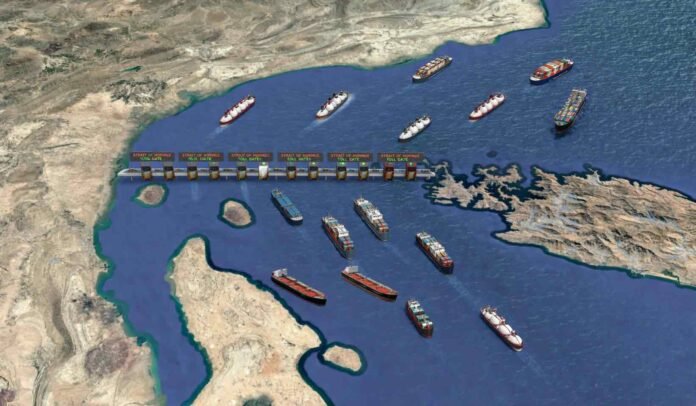
Around one-fifth of the world’s oil supply passes through the Strait of Hormuz, making it strategically the most important maritime chokepoint on the planet. For decades, its significance has rested on a simple principle: every nation depends on the uninterrupted flow of commerce through this narrow waterway. Today, however, Hormuz is emerging as a test case not merely for regional security but for the future of freedom of navigation itself. As the 60-day negotiating window between the United States and Iran shifts attention from military confrontation to diplomacy, a new legal and strategic question has come to the fore: can an international strait become a source of compulsory transit revenue?
Recent incidents involving commercial shipping and retaliatory actions by both Washington and Tehran have underscored that maritime security remains closely intertwined with negotiations over Iran’s nuclear programme. While the United States seeks to restore stability in the Strait and negotiate an agreement that strengthens the safeguards of the 2015 Joint Comprehensive Plan of Action, particularly regarding Iran’s stockpile of highly enriched uranium, Tehran appears to have recognised that developments in Hormuz provide valuable diplomatic leverage in the wider negotiations.

Iran and Oman have established a Joint Strait of Hormuz Maritime Transit Committee to examine the future administration of navigation through the Strait, including the feasibility of introducing transit-related service charges. The committee is studying the implications and mechanisms for maritime safety, traffic management and cost sharing
It is against this backdrop that Iran and Oman have established a Joint Strait of Hormuz Maritime Transit Committee to examine the future administration of navigation through the Strait, including the feasibility of introducing transit-related service charges. The committee, which held its inaugural meeting in Muscat on June 29, 2026, is studying the legal, economic and navigational implications of such proposals, including mechanisms for maritime safety, traffic management and cost sharing. Both countries have publicly emphasised cooperation and adherence to international law. Yet their strategic priorities appear to differ. Iran has shown interest in expanding its administrative role over the Strait and recovering the costs of maritime services, whereas Oman has consistently underlined the importance of preserving freedom of navigation and maintaining international confidence in the Strait as a stable sea lane.
The committee’s deliberations therefore raise a question that extends well beyond the Gulf. Under the United Nations Convention on the Law of the Sea, ships enjoy the right of transit passage through international straits. Coastal states may levy non-discriminatory charges for specific services actually rendered, such as pilotage, vessel traffic management, pollution control or emergency response. However, imposing compulsory tolls merely for exercising the right of passage would be difficult to reconcile with the Convention’s guarantee of transit passage, and would almost certainly invite sustained international scrutiny.
None of the world’s principal natural maritime chokepoints, including the Strait of Malacca, Bab el-Mandeb, the Strait of Gibraltar, the Danish Straits, the Dover Strait, the Taiwan Strait and the Mozambique Channel, levies compulsory transit tolls simply for passage
State practice reinforces this distinction. None of the world’s principal natural maritime chokepoints, including the Strait of Hormuz, the Strait of Malacca, Bab el-Mandeb, the Strait of Gibraltar, the Danish Straits, the Dover Strait, the Taiwan Strait and the Mozambique Channel, levies compulsory transit tolls simply for passage. Ships may pay for specific maritime services where these are provided, but not for the exercise of the right of transit itself. Even the Turkish Straits, governed by the 1936 Montreux Convention, impose only limited charges linked to designated maritime services. The position is fundamentally different in the Suez Canal, the Panama Canal and the Kiel Canal, which are artificial waterways under the sovereign administration of their respective states and therefore lawfully levy canal transit charges. Preserving this distinction between natural international straits and man-made canals has long been one of the foundations of the global maritime trading system.
Any unilateral attempt to impose compulsory transit tolls in Hormuz would therefore encounter substantial diplomatic, legal and commercial resistance. The six Gulf Cooperation Council states have a shared interest in preserving uninterrupted maritime access for their hydrocarbon exports, although the intensity of their responses would differ. Saudi Arabia, the United Arab Emirates and Qatar would be expected to oppose any measure that raises shipping costs or enhances Iran’s strategic leverage over regional energy flows. Kuwait and Bahrain are also likely to support the established principle of freedom of navigation, while Oman has consistently favoured solutions that remain within the framework of international law. Opposition would extend well beyond the Gulf. The United States, the European Union, the United Kingdom, India, China, Japan and South Korea, together with the global shipping industry, would be concerned not merely about Hormuz but about the precedent such a measure could establish for other strategic waterways. Once the principle of charging for transit through a natural international strait is accepted, similar claims elsewhere cannot be ruled out.

If compulsory transit tolls were ever proposed in the Strait of Hormuz, India’s response should combine strategic restraint with legal consistency. It should engage constructively with Iran while working closely with Oman, the Gulf Cooperation Council states and other major maritime users to uphold established principles of international maritime law
For India, the issue is neither abstract nor distant. A substantial proportion of its crude oil and LNG imports, as well as its trade with Europe and West Asia, passes through the Strait of Hormuz. Equally important, India has consistently championed a rules-based maritime order founded on freedom of navigation and respect for international law. If compulsory transit tolls were ever proposed, New Delhi’s response should combine strategic restraint with legal consistency. It should engage constructively with Iran while working closely with Oman, the Gulf Cooperation Council states and other major maritime users to uphold established principles of international maritime law. At the same time, diversification of energy sources, strengthening strategic petroleum reserves and expanding alternative transport corridors would reduce India’s long-term vulnerability. The future of Hormuz is therefore not merely a question of Gulf geopolitics. It is a question of whether international maritime commons will continue to be governed by predictable legal norms or increasingly become instruments of geopolitical bargaining. For India, preserving that distinction is not only a legal imperative but a strategic necessity.

The writer commanded 15 Punjab in Lebanon under United Nations Flag, commanded 27 Sector as DIG in Churachandpur and was Brigadier Operational Logistics in HQ Western Command. He is currently an analyst on geopolitics, international and defence affairs. The views expressed are personal and do not necessarily carry the views of Raksha Anirveda






