


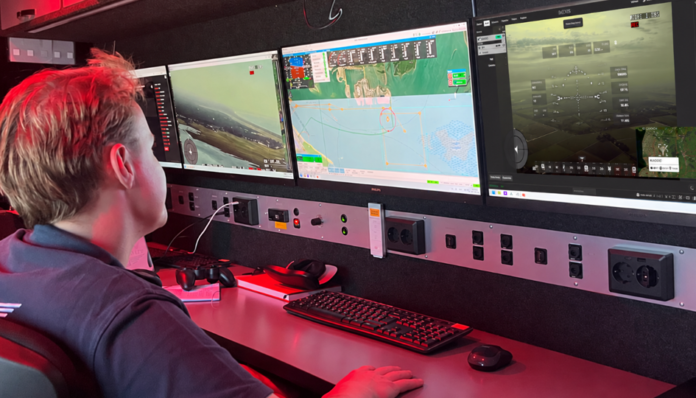
Dordrecht, the Netherlands – High Eye has successfully integrated Intelic’s NEXUS command-and-control software into its Airboxer unmanned helicopter. The integration has been validated during flight operations, including a mission lasting more than four hours. It strengthens the Airboxer’s modular software architecture, supports the integration of different mission payloads and communication systems, and provides a foundation for interoperability with wider unmanned systems.
The integration also demonstrates High Eye’s capabilities in software engineering and systems integration. Alongside developing and manufacturing the Airboxer aircraft, the company engineers the software interfaces and control architecture required to connect flight systems, sensors, communications equipment and external command-and-control environments into a complete unmanned aircraft system.

A Common Software Architecture for Different Missions
Intelic NEXUS is a command-and-control software solution designed to connect unmanned vehicles, payloads and operator systems through a common software environment. It supports established communication protocols (MAVLink), and allows different systems to exchange information without requiring dedicated interfaces for every combination of equipment.
High Eye has integrated NEXUS into its Mission Control Centre (MCC) architecture to standardise how mission equipment connects to the Airboxer and its operator systems. This addresses a practical challenge in unmanned aviation. Different customers require different aircraft configurations, often involving a combination of specialised sensors, datalinks and command systems.
Traditionally, introducing new equipment can require additional software development, changes to operator interfaces and separate integration and validation work. By establishing a unified software layer, High Eye aims to reduce this configuration-specific development effort. Individual components can be adapted or replaced with less impact on the rest of the system, provided they meet the required interface, electrical and operational specifications.
The architecture is designed to support the Airboxer’s existing and developing mission configurations, including:

- Maritime surveillance: EO/IR cameras and Automatic Identification System (AIS) receivers for vessel detection, identification and monitoring.
- Infrastructure inspection and mapping: LiDAR sensors for power line inspections, terrain mapping, coastal surveys and geospatial data collection.
- Search and rescue: EO/IR payloads and specialised equipment such as Lifeseeker for locating missing persons through mobile phone signals.
- Defence and security: EO/IR, radar, magnetometers and other mission-specific equipment supporting intelligence, surveillance and reconnaissance, mine detection and laser target designation.
- Communications: Configurable radio and datalink systems, including Silvus and Kongsberg solutions, supplemented by cellular and satellite communications options.
The objective is to enable different mission configurations while maintaining a consistent underlying control environment, instead of having to develop separate software architecture for each application.
Validated During Extended Flight Operations
The NEXUS integration has moved beyond ground testing and has been used by High Eye operators during actual flight operations, including a mission exceeding four hours. The integration builds on the Airboxer’s demonstrated long-endurance capabilities. In September 2026, the aircraft completed a flight lasting 4 hours, 30 minutes and 30 seconds in a maritime configuration equipped with mission equipment, flotation provisions and extended-range fuel tanks.

Combining this endurance with a modular mission architecture allows High Eye to support applications requiring prolonged airborne surveillance, data collection and operation within larger sensor networks.
Expanding High Eye’s Software Engineering and Integration Capabilities
The NEXUS integration forms part of High Eye’s broader development of its in-house software engineering and systems integration capabilities. While the Airboxer provides the physical flight platform, its operational functionality increasingly depends on the software connecting aircraft systems, mission equipment, communications networks and operator interfaces.
High Eye develops and integrates the interfaces and system architecture needed to bring these components together. This includes adapting third-party technologies to the Airboxer’s operating environment, managing interactions between different subsystems and developing configurations for specific customer requirements.
The integration of NEXUS is an example of this approach. Rather than developing every software component independently, High Eye combines its own engineering work with established third-party solutions. This allows the company to concentrate development resources on aircraft-specific functionality, mission integration and interoperability.
A more standardised architecture also provides a basis for reusing integration work across different Airboxer configurations. Once an interface has been developed and validated, it can potentially support future integrations without repeating the complete development process.
Connecting the Airboxer to Wider Unmanned Systems
An additional objective of the NEXUS integration is to support interoperability between the Airboxer and other unmanned systems. Through its common software architecture, NEXUS provides a means of connecting the Airboxer to wider unmanned-system environments. This can support the exchange of aircraft status, mission information and payload data through compatible interfaces.
Such connectivity is particularly relevant to operations in which different unmanned assets contribute to a shared operational picture. An Airboxer conducting airborne surveillance, for example, could provide sensor information to a wider command system that also receives data from surface-based or maritime assets.
The NEXUS integration establishes the architectural basis for these applications. Specific multi-platform functions and third-party system connections will require further integration and operational validation.
Modularity Throughout the Aircraft’s Service Life
For High Eye, modularity extends beyond the ability to install different payloads on the aircraft. It also concerns the software, communications and control systems required to operate those payloads.
Separating these elements wherever technically possible reduces the dependencies between individual components. A change in sensor equipment should not necessarily require a redesign of the operator interface, just as a change in communications equipment should not automatically affect the complete mission-control architecture.
This approach is intended to deliver practical benefits in three areas: reduced engineering effort when integrating new equipment, more consistent operator workflows across different configurations, and greater flexibility to incorporate new technologies during the aircraft’s service life.
By maintaining control over the integration architecture, High Eye can develop the Airboxer as a configurable unmanned system rather than a collection of fixed hardware combinations.
The successful integration of Intelic NEXUS represents a further step in that development. It brings together High Eye’s aircraft engineering, software integration and mission-system capabilities within a common architecture, supporting the continued development of the Airboxer as a modular, long-endurance VTOL platform.






