


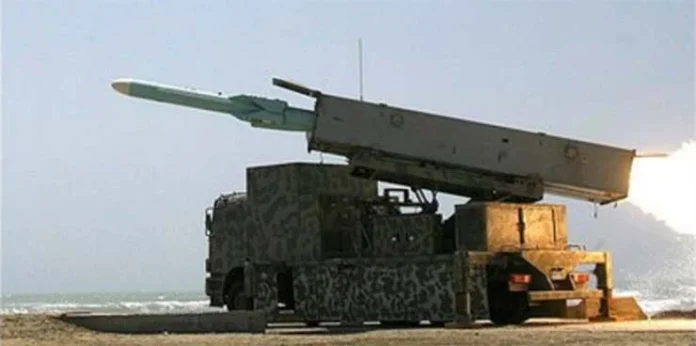
Tel Aviv: The Hezbollah terror organisation, Iran’s main proxy operating from Lebanon has deployed anti-ship missiles made by Iran, Pakistan, China and Russia. Hezbollah possesses dozens of missiles designated to attack naval targets.
According to the Israeli Alma Research Centre, the missiles are the Chinese-made C-802, Iranian-made Nour, and Pakistani-made Nasr. “The Russian advanced Yakhont missile is also probably in Hezbollah’s possession,” says Tal Beeri, head of the centre’s research unit.

“Several of these missiles for immediate use are stored adjacent to the Lebanese coast to be launched from launch sites prepared and mapped by Hezbollah. These missiles array was on alert during the last summer before Israel activated the Karish rig,” Tal Beeri added. The Karish rig is operated by Israel to pump natural gas from the bottom of the Mediterranean.
‘Nour’ is an anti-ship missile with a 120-220 km range. The ‘Nour’ is considered an upgraded version of the Chinese C-802 missile.
‘Nasr’ is a missile capable of destroying targets of up to 3000 tons, with a speed close to the speed of sound. The Russian ‘Yakhont’ (P-800 Oniks supersonic cruise missile) has a range of up to 300 kilometres and a speed of up to 2.6 Mach.
It is highly likely that ‘Ghadir’ and ‘Khalij Fars’ anti-ship missiles were also transferred to Hezbollah by the Iranians. The C-802 missile was used in 2006 against an Israeli ship. The missile’s speed is 0.9 Mach, with a range of 120 km and a warhead of 165 kg.

The ‘Ghadir’, is an anti-ship cruise missile, designed and manufactured by Iranian experts at the Aerospace Industries Organization of the Iranian Ministry of Defence. It was unveiled on August 24, 2014, at an exhibition held by the Iranian Ministry of Defence, sponsored by Iranian President Hassan Rouhani.
The missile has a range of 300 km. It can be launched from other previous missiles’ platforms, thus making it easier to operate. The ‘Ghadir’ has systems that make detecting radar and conducting electronic warfare against it difficult. In September 2020, the missile was seen in the Iranian army’s joint training exercise, “Zolfaghar 99.” During the exercise, the missile was reportedly launched against targets at more than 200 km, successfully destroying them.

Another missile is the ‘Khalij Fars’. This missile belongs to the Iranian family of ‘Hermes’ missiles. This anti-ship coastal missile can destroy stationary and moving targets at sea at a distance of 300-400 km (an upgraded version can reach up to 700 km). The missile was first introduced on September 22, 2011. It is characterised by its high accuracy in hitting targets within a few meters.
‘Khalij Fars’ reportedly has a velocity of three times the speed of sound (similar to the Russian Yakhont). This speed makes it very challenging to detect on radar, thus making it very difficult to intercept. The missile is 8 meters long, 0.60 meters in diameter, and is equipped with a 650 kg warhead. The missile was designed and manufactured by the IRGC.

-The writer is an Israel-based freelance journalist. The views expressed are of the writer and do not necessarily reflect the views of Raksha Anirveda





