


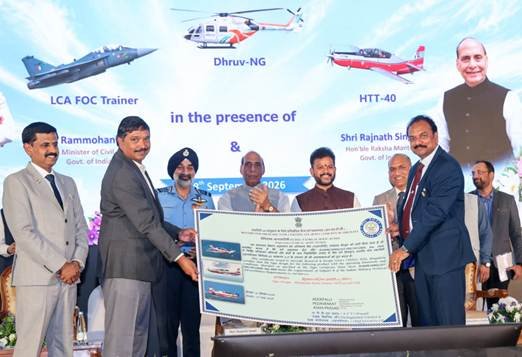
Hindustan Aeronautics Limited (HAL) held a handover ceremony at its Bengaluru facility, on Friday, 18 September 2026, presided over by Defence Minister Rajnath Singh and Civil Aviation Minister K Ram Mohan Naidu. The delivered platforms were displayed at the venue, and Rajnath Singh was seen sitting inside the Dhruv NG helicopter during the event.
Key officials in attendance included Air Chief Marshal AP Singh, Defence Production Secretary Sanjeev Kumar, Civil Aviation Secretary Samir Kumar Sinha, and HAL CMD Ravi K. In all, three platforms were handed over to the IAF and Pawan Hans Limited. Two LCA Tejas FOC Twin-Seater Trainers, completing the twin-seater deliveries under the Final Operational Clearance (FOC) contract and 1 HTT-40 Basic Trainer “Ankur”, out of the 70 ordered were handed over to the IAF, while 4 Dhruv Next Generation (NG) helicopters were handed to Pawan Hans Limited. It is the first civil-certified Dhruv NG helicopter; part of a larger order of 10 helicopters worth over ₹1,800 crore.

HTT-40 “Ankur” is a fully aerobatic tandem-seat turboprop trainer designed by HAL’s Aircraft Research and Design Centre. It features an air-conditioned cockpit, modern avionics, hot refuelling, quick pilot changeover, and zero-zero ejection seats. Powered by a Honeywell turboprop engine, it reaches speeds up to 450 km/h with a 1,000 km range. It is designed for foundational pilot training including aerobatics, instrument flying, formation flying, and night navigation.
Dhruv NG is the civil-certified version of HAL’s Advanced Light Helicopter (ALH) Dhruv. It received Type Certification from the DGCA and is a 5.5-tonne, light twin-engine, multi-role helicopter. It is designed for VIP/VVIP transport, passenger and utility roles, HEMS (helicopter emergency medical services), air ambulance, offshore operations, law enforcement, disaster relief, and search & rescue.
It can carry up to 14 passengers or 4–6 VVIP executive seats and has a maximum altitude threshold of 6,000 metres, making it suited for high-altitude operations including Himalayan routes. HAL CMD Ravi K called the delivery a “historic day” for the organisation.
Rajnath Singh called the event “not merely a formal handing-over ceremony” but “an important milestone in the direction of our progress towards India’s indigenous aerospace capability, technological self-confidence and self-reliance.”

He highlighted that the day marked three simultaneous milestones – the DGCA-certified Dhruv NG entering civil aviation, the final batch of LCA FOC Trainers going to the IAF, and the first HTT-40 series-production aircraft being delivered.
He said India is “moving rapidly towards Aatmanirbhar Bharat,” contrasting the current situation with nearly a decade ago when “projects in the defence sector were being carried out at a very slow pace” and India was heavily dependent on imports.

Rajnath Singh stressed that “the development of a strong aerospace industry should not be limited to merely fulfilling defence requirements” and called for an ecosystem addressing both civil and military aviation.
He challenged young scientists, engineers, designers, test pilots, and technicians to “create technologies that do not exist today” and give India a leading position in the global aerospace landscape in the coming decade. Importantly, he urged that the public and private sectors should be seen as “complementary to each other” rather than competitors.
Rajnath Singh further warned that “delays in crucial defence requirements create gaps in our capability” and could render indigenous technologies obsolete. On the HTT-40, he said “our dependence on foreign countries in this matter will now come to an end.”
For the fighter-training segment, the LCA FOC twin-seater will provide the IAF with an indigenous platform for advanced instruction on the Tejas family. The aircraft’s induction comes as HAL expands its production infrastructure for the LCA Mk-1A, including an additional production line at Nashik.
The Dhruv NG handover to Pawan Hans could open a larger market for Indian-built helicopters in civilian aviation. With certification from the Directorate General of Civil Aviation, the helicopter can support offshore operations, air ambulance services, VIP transportation and pilgrimage routes. Its entry into the Pawan Hans fleet could help establish a domestic alternative in sectors that have traditionally relied on imported helicopters.
The event also carries an industrial message. Earlier, HAL’s Chairman and Managing Director (CMD), Ravi K told media that HAL cannot build the country’s aerospace industry alone and that private companies must become integral to the broader ecosystem.
The comments reflect the growing policy focus on distributing design, manufacturing, testing and supply-chain responsibilities across public-sector institutions, established companies and start-ups.
The shift reflects a broader change in New Delhi’s approach to defence production. For decades, large public-sector organisations and government laboratories carried most of the responsibility for designing and manufacturing military equipment.
The expanding complexity of modern warfare – and the need to produce aircraft, drones, engines, sensors, avionics and electronic systems at greater speed – has made a single-institution model increasingly inadequate.
Policy initiatives such as Make in India, iDEX, ADITI, the Technology Development Fund and the Defence Industrial Corridors are intended to bring private companies, start-ups, academic institutions and established public-sector organisations into a common innovation and production network.
Aerospace is at the centre of this mindset change because aircraft programmes demand specialised expertise across hundreds of components and technologies. Private firms can contribute capital, quicker product development cycles and niche capabilities in areas such as composites, propulsion, artificial intelligence, unmanned systems, precision machining and defence electronics. Their participation is also becoming economically significant:
India’s defence ecosystem now includes hundreds of licensed companies and thousands of micro, small and medium enterprises, while private manufacturers have emerged as major contributors to defence exports.
This does not reduce HAL’s importance; instead, it changes its role from being the country’s primary aerospace manufacturer to becoming an anchor institution within a wider industrial network. HAL can provide system-integration expertise, certification support, production experience and access to military programmes, while private companies can expand the supplier base and introduce competition in design and manufacturing.
A stronger public-private partnership could help India shorten development timelines, improve availability of spares and maintenance services, and build products suitable for both domestic procurement and export markets.
The success of this model will depend on predictable orders, transparent procurement, access to testing facilities, intellectual-property clarity and timely payments. Private firms are more likely to invest in high-risk aerospace research when they can see a credible path from prototype development to certification and large-scale acquisition. For the IAF and other services, a broader industrial base could also improve resilience by reducing dependence on a limited number of suppliers.
The Bengaluru handover therefore carries significance beyond the three aircraft involved. It demonstrates the continuing importance of HAL while underlining the need for an ecosystem in which public-sector expertise and private-sector innovation operate together. India’s ambition to become a major aerospace and defence power will depend not only on producing indigenous platforms, but also on building the industrial depth required to design, manufacture, upgrade and export them at scale.
Private-sector participation is particularly important in precision manufacturing, avionics, components, maintenance and specialised engineering. A wider supplier base can help HAL increase production, improve delivery schedules and develop export-ready platforms. It can also give smaller firms access to demanding aerospace programmes, helping them build capabilities that can later serve global customers.
The government has placed increasing emphasis on indigenous design, development and manufacturing in both defence and civil aviation. The combined delivery of trainers and helicopters is intended to show that Indian industry is progressing beyond research and prototypes toward certified, operational products.
For HAL, the immediate challenge will be consistent execution: completing deliveries, maintaining quality, resolving supply-chain bottlenecks and supporting the platforms after induction. If those priorities are sustained, the Bengaluru handover could mark not only a ceremonial milestone but also a broader shift toward a more collaborative and self-reliant Indian aerospace industry.






