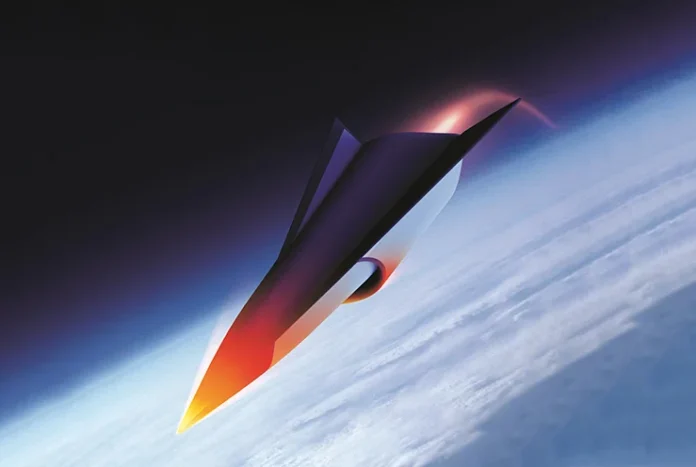
NISKAYUNA, New York. GE Aerospace lifted the curtain on its comprehensive hypersonics program at its Research Center in Niskayuna, demonstrating what is believed to be a world-first hypersonic dual-mode ramjet (DMRJ) rig test with rotating detonation combustion (RDC) in a supersonic flow stream. This could help enable high-speed, long-range flight with increased efficiency. The milestone and overall portfolio of programs position GE Aerospace to pursue multiple opportunities in the hypersonic sector as it prepares to launch as a standalone company in Q2 of 2024.
The successful high-speed propulsion DMRJ demonstration is part of a comprehensive portfolio of technology programs GE Aerospace is developing and scaling to advance hypersonic capabilities, including high-temperature materials and high-temperature electronics. These technologies are the product of more than a decade’s worth of direct hypersonic-related efforts advanced by GE Aerospace Research and several decades of developments for its GE Aerospace engine business in key areas like high-temperature ceramic matrix composites (CMCs), silicon carbide power electronics, additive technologies, and advanced thermal management.

“As the aerospace sector sets its sight on the future of hypersonics, GE Aerospace is well positioned with the right capabilities, experience, and scale to be a leader in driving new developments for our customers,” said Amy Gowder, President and CEO, GE Aerospace, Defense & Systems. “The highly successful demonstration of a DMRJ with RDC is an outgrowth of our 10+ years of RDC work, including the strategic acquisition of Innoveering that has brought leading technologies and experience in hypersonic propulsion and ramjets.”
A typical air-breathing DMRJ propulsion system can only begin operating when the vehicle achieves supersonic speeds of greater than Mach 3. GE Aerospace engineers are working on a rotating detonation-enabled dual mode ramjet that is capable of operating at lower Mach numbers, enabling the flight vehicle to operate more efficiently and achieve longer range.
The acquisition of Innoveering last year gave GE Aerospace dual mode ramjet engine capabilities that were rapidly augmented with GE Aerospace Research’s decade’s long work in RDC and several decades of GE Aerospace experience in high Mach research and engine development programs. RDC enables higher thrust generation more efficiently, at an overall smaller engine size and weight, by combusting the fuel through detonation waves instead of a standard combustion system that powers traditional jet engines today.
“The successful development, integration, and demonstration of GE’s unique technologies and capabilities will position us to provide differentiating hypersonic propulsion systems for our customers now and well into the future,” said Mark Rettig, Vice President & General Manager, Edison Works Business & Technology Development, GE Aerospace. “We have assembled the right expertise, with the right capabilities, and invested strategically to ensure we are aligned very closely with the needs of our customers. The significant results we have had to date give us confidence that we are moving in the right direction.”

Rettig added that the team has moved very fast, noting it took just 12 months from start to finish for the DMRJ with RDC demonstration. The team is on track with its goal to demonstrate a full DMRJ with RDC at scale next year.
The development of high-speed ramjet propulsion capabilities is a key anchor point of other key advancements in hypersonic technologies, including:

High-Temperature Materials: GE Aerospace is the only aerospace OEM using ceramic matrix composites in the high pressure turbines on commercial aircraft. These decades of materials innovation in superalloys have delivered higher temperature capabilities and durability that have enabled commercial engines to operate more efficiently over time.
High-Temperature Electronics: GE Aerospace researchers recently demonstrated the first believed Silicon Carbide (SiC) MOSFETs that can operate at temperatures exceeding 800 degrees C, along with other recent advancements in SiC technology that have created scalable 600C- capable electronics to control and monitor hypersonic vehicles in extreme high temperature operating environments. GE Aerospace has amassed a leading IP portfolio in SiC over two decades and already offers SiC- based electrical power products with power levels from kilowatts to megawatts for harsh environments in aerospace, industrial, and military applications.