


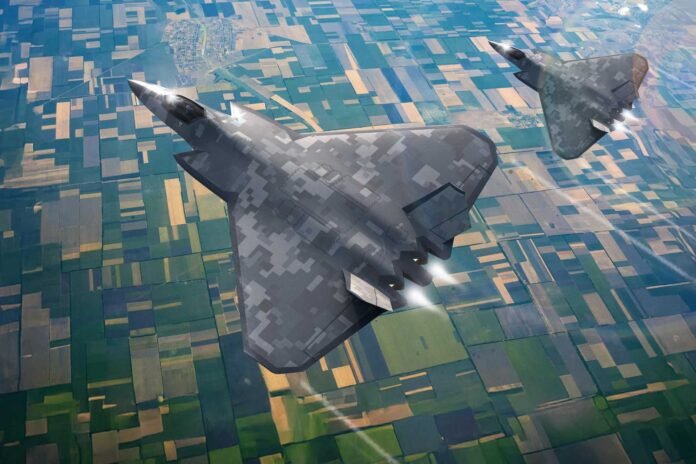
The Global Combat Air Programme (GCAP), the trilateral effort by the United Kingdom, Italy and Japan to build a sixth-generation stealth fighter, has taken a major financial and technical step forward.
On July 3, 2026, the GCAP Agency awarded industrial joint venture Edgewing a £4.6 billion contract – roughly $6.14 billion or €5.37 billion – to carry out the next 18 months of development work, moving the programme from initial establishment into full-scale aircraft definition and engineering.

The contract replaces a smaller, temporary £686 million bridge agreement signed in April 2026, which had been designed only to keep engineering work moving while political approval of UK funding remained pending. It also follows closely on the heels of Britain’s own £8.6 billion funding commitment to GCAP over the next four years, approved under its Defence Investment Plan.
According to Army Recognition’s reporting on the announcement, the new package gives engineering teams across all three partner nations the long-term funding certainty they have lacked since the programme entered its international phase.
Over the coming 18 months, engineers are expected to freeze the aircraft’s principal configuration, agree common operational requirements among the three partner air forces, validate the airframe’s structural design, integrate propulsion and mission systems, mature software architecture, and complete the engineering baseline needed before prototype manufacturing begins.
GCAP aims to field an operational aircraft by 2035, replacing the British and Italian Eurofighter Typhoon fleets as well as Japan’s Mitsubishi F-2. Unlike earlier multinational European fighter efforts, which split responsibility among separate national contractors, GCAP has consolidated engineering authority within a single company.

Edgewing is jointly owned in equal one-third shares by BAE Systems, Leonardo, and Japan Aircraft Industrial Enhancement Co, and is building engineering teams in all three countries while holding overall responsibility for the aircraft’s design, certification and airworthiness.
The aircraft’s design has evolved substantially since the programme was announced in December 2022, shifting from an early cranked-delta concept to a larger tailless-delta configuration offering more internal volume.

BAE Systems has indicated the jet will be three to four metres longer than the Typhoon, translating into greater fuel capacity, larger weapons bays and more space for onboard systems – reflecting the heavy electrical and computing demands of powering radar, sensors, electronic warfare equipment and AI-assisted systems simultaneously while maintaining a low radar signature.
Rather than functioning purely as a standalone fighter, GCAP’s aircraft is being designed as a networked node within a broader combat system, expected to operate alongside F-35s, Typhoons, and autonomous “loyal wingman” drones, while also serving as an airborne command hub capable of coordinating other military assets.
Separate multinational consortia are developing supporting systems in parallel: one group is building the aircraft’s integrated sensor and electronic-warfare architecture, while a Rolls-Royce, Avio Aero and IHI partnership is developing a propulsion system built to deliver both greater thrust and substantially more onboard electrical power.
Britain’s current funding commitment is reported to sustain about 4,500 jobs domestically and involve roughly 600 UK suppliers, with Italy and Japan investing separately through their own aerospace sectors.
While GCAP remains limited to its three founding members, several countries – including Saudi Arabia, which has sought entry since 2023, along with Canada, Germany, Australia, India, Poland and Sweden – have expressed varying degrees of interest in joining, though any expansion would require unanimous consent from the UK, Italy and Japan.
Programme officials say meeting the 2035 target will depend on sustained funding, disciplined design management and continued industrial coordination across all three nations through the coming stages of development.






