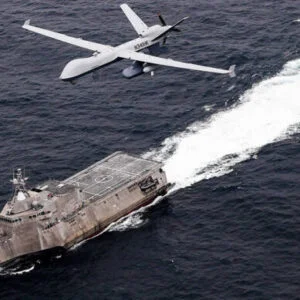
SAN DIEGO. General Atomics Aeronautical Systems, Inc. (GA-ASI) participated in US Pacific Fleet’s (PACFLT) Unmanned Integrated Battle Problem ‘21 (UxS IBP 21), April 21-26, 2021. The UxS IBP 21 integrated manned and unmanned capabilities into the most challenging operational scenarios to generate Did war fighting advantages. The exercise aimed to directly inform warfighters, warfare centers, and developers to further incorporate unmanned capabilities in day-to-day Fleet operations and battle plans.
During UxS IBP 21, a GA-ASI MQ-9A Block 5 Unmanned Aircraft System (UAS) acted as a surrogate for the MQ-9B SeaGuardian and was able to demonstrate for the first time: successful Link connectivity with US Navy surface ships and aircraft; cooperative anti-submarine warfare (ASW) operations, to include the first successful high-altitude sonobuoy drop from a UAS; Automatic Identification System (AIS) correlation with a US Navy P-8 Poseidon and MH-60R Seahawk; exchange of Link 16 data over Global Command and Control System – Maritime (GCCS-M) from a UAS; and long-range over-the-horizon targeting from a UAS to a US Navy Destroyer.

“Our partnership and collaboration with the US Navy during this exercise has been extremely beneficial and helped set the stage for a revolutionary change in how the US Navy and our foreign partners address the increasing challenges and complexities for accomplishing distributed maritime operations,” said J.R. Reid, GA-ASI Vice President for DoD Strategic Development. “We successfully demonstrated several groundbreaking capabilities for the first time, and we look forward to leveraging this momentum to continue to develop and test more advanced capabilities that provide immense value to the warfighter, both domestically and abroad.”
GA-ASI has expanded the traditional role of the MQ-9 for its US Government and foreign customers to support maritime intelligence, surveillance, and reconnaissance (ISR) missions, including ASW, with the development of the expeditionary MQ-9B SeaGuardian that can safely operate in adverse weather and non-segregated airspace.