


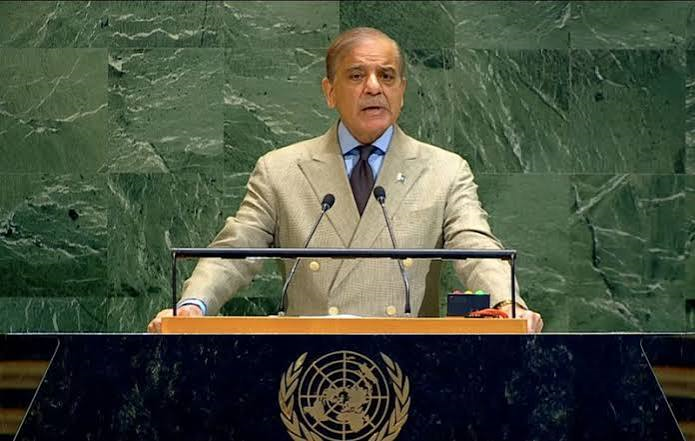
Last week, Shehbaz Sharif walked up to the green-marble podium in New York and told the world that Kashmir “has and always will be Pakistan’s jugular vein.” That same week, India’s External Affairs Minister was doing something far less theatrical: launching a coalition to protect merchant sailors after Indian seafarers died in attacks on Gulf shipping, co-chairing the launch of free trade negotiations with the Gulf Cooperation Council, and signing the UN Convention against Cybercrime. One delegation came to New York to relitigate 1948. The other came to shape 2048. That contrast is the real story of this year’s General Assembly, and it should cure anyone of reading Pakistan’s UN speeches as negotiating positions.
They are not negotiating positions. They are liturgy.

For six decades, Pakistani leaders have followed the same order of service. First, invoke Kashmir’s ‘self-determination’ and wave the UN resolutions of the late 1940s. Second, indict India for mistreating Kashmiris. Third, with a statesman’s sigh, offer ‘dialogue’. The words change. The sequence never does.
Zulfikar Ali Bhutto set the template in 1965, weeks after a war Pakistan started and lost. He called it a war of self-defence, demanded a UN force of Asian, African and Latin American contingents to supervise a plebiscite, and declared this the United Nations’ last chance on Kashmir. Swaran Singh replied that the rulers of Rawalpindi had simply tried to grab Indian territory. Sixty-one years later, Rawalpindi still rules.
For six decades, Pakistani leaders have followed the same order of service: invoke Kashmir’s ‘self-determination’ and wave the UN resolutions of the late 1940s; indict India for mistreating Kashmiris; then offer ‘dialogue’. The words change. The sequence never does
Nawaz Sharif used the rostrum in 1998 to justify Pakistan’s nuclear tests; Kargil followed within a year. In 2015, he unveiled a four-step peace plan featuring the demilitarisation of Kashmir and withdrawal from Siachen. Prime Minister Modi answered with a personal gesture, landing in Lahore that December for a family wedding. Pakistan’s answer came at Pathankot and then Uri. Less than two weeks after Uri, Sharif was back at the UN hailing an ‘indigenous uprising’ in the Valley and demanding a UN fact-finding mission.
Imran Khan in 2019 took roughly fifty minutes of a fifteen-minute slot, dismissed the Balakot strikes as having killed about ten trees, and predicted a ‘bloodbath’ in Kashmir. The bloodbath never came. Kashmir went to the polls instead.

What every one of these performances omits is the Simla Agreement of 1972, signed by the same Zulfikar Ali Bhutto, which committed both countries to settle their differences bilaterally, without third-party mediation. Resolution 47 of 1948 was practically superseded the day that ink dried. Pakistan invokes the UN when it wants an audience and forgets the Simla Agreement when it wants a referee.
This year’s edition added new props. Sharif warned that any attempt to ‘stop, impede or divert’ Pakistan’s share of the Indus waters “will be treated as an act of war.” He blamed an “RSS-driven Hindutva ideology” for Islamophobia, a remarkable charge from a state whose blasphemy laws terrorise its own minorities. And he credited Donald Trump with saving “hundreds of millions of lives” during last May’s four-day conflict, a year after Pakistan nominated the American president for the Nobel Peace Prize.

India’s replies this year were pitch-perfect. First Secretary Petal Gahlot told the Assembly: “They claim to uphold security during the day; they actually carry out terrorism at night”
Strip away the flattery and consider the facts. Terrorists murdered 26 civilians at Pahalgam on April 22, 2025. On May 7, Operation Sindoor struck terror infrastructure in Pakistan and Pakistan-occupied Jammu and Kashmir. The cessation of hostilities came through direct contact between the two militaries, not a telephone call from Washington. And India placed the Indus Waters Treaty in abeyance with a condition that could not be clearer: it stays suspended until Pakistan credibly and irrevocably ends cross-border terrorism.
The ‘act of war’ threat is bluster, written for a domestic audience and a foreign patron. A country that watched its airbases struck within four days last May is in no position to wage a war over water that it cannot win. The treaty’s revival lies entirely in Rawalpindi’s hands. It has only to stop exporting killers.
India’s replies this year were pitch-perfect. First Secretary Petal Gahlot told the Assembly: “They claim to uphold security during the day; they actually carry out terrorism at night.” She called Pakistan “a regime of the army, by the army, and for the army,” pointed to its 27th Amendment and the lifelong immunity granted to its ‘real ruler’, and invited delegates to ask the people of Rawalakot in Pakistan-occupied Jammu and Kashmir about killings and the denial of basic rights. Jaishankar followed from the podium: “a serial practitioner of terrorism misrepresented facts before this Assembly… Our right to defend ourselves against terrorism will be exercised.”
At the Asia Society, Jaishankar said that when a partner lacks “understanding or appreciation or empathy” for India’s concern about terrorism, “that creates a problem.” It was a rare public rebuke of an administration that has walked away from Pakistan’s terror record while courting its Field Marshal
Good. But answering the liturgy, however sharply, still plays on Pakistan’s stage. The contests that will shape India’s security are being fought elsewhere.
Start at sea. Days before his speech, an Indian sailor died when the bulk carrier MV Cape Dove was attacked in the Gulf of Oman; ten days earlier, an Indian crewman went missing after the tanker Alpha was struck in the Strait of Hormuz. Indian seafarers have become collateral in wars that are not ours. The Group of Friends on Safety and Security of Shipping and Seafarers, launched with Liberia and 23 partners, pairs the world’s largest ship registry with one of its biggest sources of crews. That is coalition-building with real stakes.
Then the economic grey zone. Jaishankar warned of the “weaponisation of everything”: finance, market access, supply chains and technology turned into leverage. He named a “4F crisis” of food, fuel, fertiliser and finance squeezing the Global South. None of this is abstract for India. Washington has imposed an extra 10 per cent Section 301 duty on Indian goods and passed sanctions legislation that menaces buyers of Russian oil, even as its officials insist the trade deal is “90 per cent-plus” done and Marco Rubio prepares to visit New Delhi in October.
Jaishankar demanded text-based negotiations on Security Council reform, observing that without a text there is no negotiation, only “gaining time”
The most important thing Jaishankar said in New York was not in his UN speech. At the Asia Society, he said that when a partner lacks “understanding or appreciation or empathy” for India’s concern about terrorism, “that creates a problem.” It was a rare public rebuke of an administration that has walked away from Pakistan’s terror record while courting its Field Marshal. The lesson is old but newly urgent: India cannot outsource its security concerns to partners who will not prioritise them. Washington is transactional. So is everyone else. India must be too.
That is why the long game matters most. Jaishankar demanded text-based negotiations on Security Council reform, observing that without a text there is no negotiation, only “gaining time.” The G4 met on the sidelines. India co-chaired the first summit of Partners for Multilateralism with the European Union, Australia, Brazil, Canada, Barbados and Kenya. Russia’s Sergey Lavrov named India and Brazil as candidates for permanent seats; The institutions Pakistan still tries to weaponise against India are slowly being rebuilt with India at the table.
The prescription, then, is simple. Stop dignifying Pakistan’s annual sermon with defensive diplomacy. Reply briefly, factually and with contempt where it is earned, as Gahlot did, and then return to the real work: protecting sailors, securing energy, closing trade deals on Indian terms, and prying open a Security Council frozen in 1945.
Pakistan will return to the podium next September with the same script. India should spend the year making sure fewer people in the hall are listening.
The writer is an expert on geopolitics, national security, and counter-terrorism; and he regularly contributes his subject thought-leadership and academic commentary with several publications in newspapers, journals, and periodicals. He works with investigative agencies, regulatory bodies, financial institutions and enterprises, providing strategic and regulatory advisory. The views expressed are personal and do not necessarily carry the views of Raksha Anirveda





