


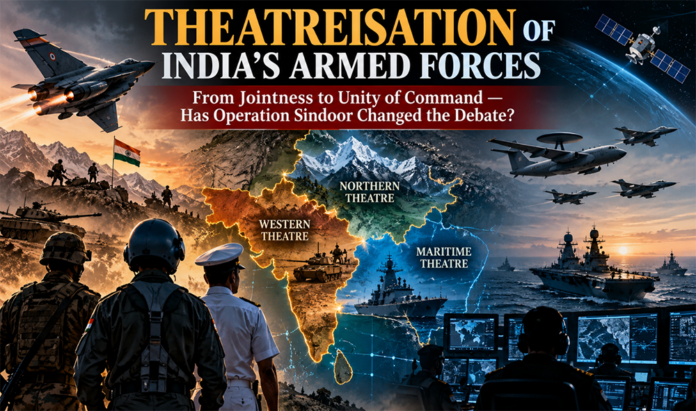
India stands at the threshold of the most consequential restructuring of its armed forces since Independence. The proposed Integrated Theatre Commands (ITCs) seek to reorganise the Indian military from a predominantly service-centric system to one in which operational forces of the Army, Navy and Air Force are placed under unified theatre commanders.
The idea is neither new nor revolutionary. The United States has operated a mature combatant-command system for decades, China reorganised the PLA into five theatre commands in 2016, and NATO operates through joint operational commands and theatre components. The central lesson from these experiences, however, is equally important: Theatreisation succeeds not because a new organisational chart is created, but because command authority, force allocation, doctrine, communications, intelligence and logistics are genuinely integrated.

For India, the question is therefore not whether Theatreisation is desirable in principle. It is whether the proposed structure is the right structure for India’s geography, two-front contingency, limited air assets, maritime ambitions and emerging multi-domain warfare environment, and here, Operation Sindoor has complicated rather than settled the debate.
What Exactly is Theatreisation?
Theatreisation essentially means organising military forces around the operational problem rather than the individual Service. Under the traditional Indian system, the Army, Navy and Air Force largely plan, train and command themselves. During a major conflict, coordination is achieved through mechanisms involving the three Service Chiefs, the CDS and operational commanders. An integrated theatre command changes this architecture.
A theatre commander would have operational control over forces allocated from all three Services within a defined geographical or functional theatre. The Services would retain responsibility for raising, training, equipping and sustaining forces, while operational employment would increasingly rest with the theatre commander. This is a fundamental distinction between ‘coordination’ and ‘unity of command’.
As the CDS has put it, theatre commands are intended to separate operational functions from the traditional ‘Raise-Train-Sustain’ responsibilities of the Service. The objective is simple: when war begins, the commander should not have to negotiate with three separate Service headquarters before employing the capabilities required for the campaign.

The military logic is compelling. Modern warfare does not respect Service boundaries. A single operation may simultaneously require fighter aircraft, air defence, long-range missiles, drones, satellites, cyber capabilities, naval assets, Army formations, electronic warfare and special forces. The question is: who commands the entire operation? That is the central purpose of Theatreisation.
Why did India Need Theatreisation?
The roots go back to the 1999 Kargil War. Kargil exposed weaknesses in intelligence, surveillance, air-land coordination, operational planning and inter-Service coordination. The subsequent Kargil Review Committee and Group of Ministers reforms initiated a long process of strengthening jointness. HQ Integrated Defence Staff was created, and the Andaman & Nicobar Command became India’s first tri-Service command.

The Shekatkar Committee subsequently examined restructuring and combat capability, while the creation of the Chief of Defence Staff in 2019 provided the institutional mechanism to push integration further. The logic became even stronger with the changing threat environment.
India is no longer preparing for a single-domain war. It faces: China in the north and east, Pakistan in the west, the Indian Ocean maritime theatre, cyber threats, space competition, drones, missiles, information warfare and increasingly autonomous systems. A two-front contingency presents an additional complication.
The same air force may be required simultaneously in Ladakh, Jammu and Kashmir, Punjab, Rajasthan, the maritime theatre and the deep strike battle. The same satellite, airborne early-warning aircraft, tanker, electronic warfare platform or long-range missile may be required in more than one theatre. Consequently, a rigid geographic allocation of scarce capabilities can become counterproductive. That is precisely where the Indian debate becomes more sophisticated than simply asking whether Theatreisation is ‘good’ or ‘bad’.
What Does the International Experience Tell us?
The United States: unity of command, but not abolition of the Services. The American system is perhaps the most important example. The United States developed unified commands during the Second World War. A theatre commander was given command over forces irrespective of Service. The post-war system eventually evolved into today’s combatant-command architecture.
Modern warfare does not respect Service boundaries. A single operation may simultaneously require fighter aircraft, air defence, long-range missiles, drones, satellites, cyber capabilities, naval assets, Army formations, electronic warfare and special forces. The question is: who commands the entire operation? That is the central purpose of Theatreisation
The critical lesson came through painful experience. The Goldwater-Nichols Act of 1986 strengthened joint command after years of inter-Service rivalry and operational shortcomings. It established a clear chain of command from the President through the Secretary of Defence to the combatant commander, while Service chiefs retained responsibility for organising, training and equipping their forces. This separation is crucial. The Services generate combat power; the theatre commands employ it.
The United States therefore did not eliminate the Army, Navy, Air Force or Marine Corps. It strengthened their specialised identities while placing operational employment under joint commanders. The American experience also demonstrates that Theatreisation is not a one-time structural reform. Joint education, interoperability, common communications, intelligence networks, doctrine and career structures have to reinforce it.
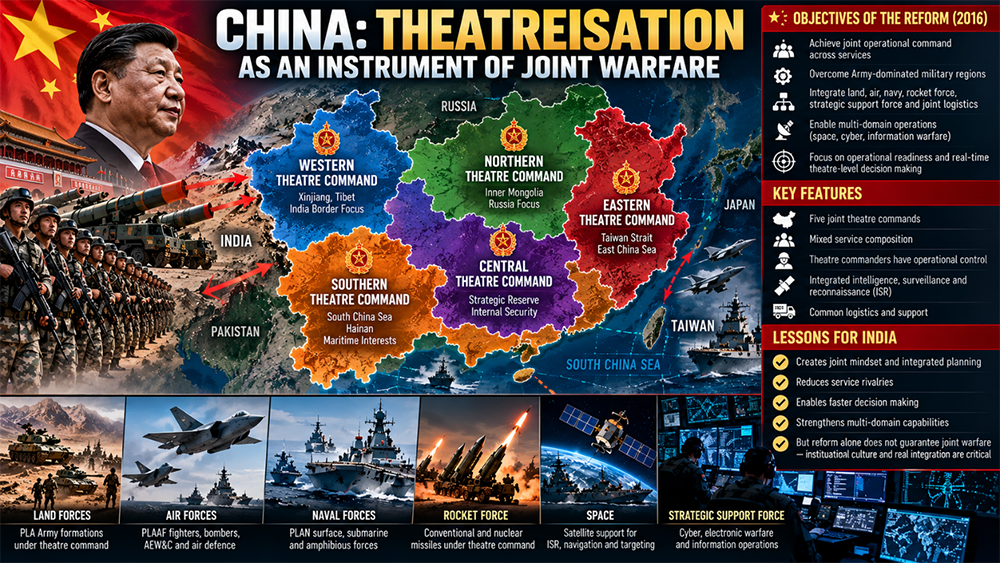
China: Theatreisation as an Instrument of Joint Warfare
China offers India an especially relevant example. In 2016, the PLA replaced seven military regions with five joint theatre commands. The objective was to overcome the traditionally Army-dominated structure and create a force capable of conducting integrated operations across land, air, maritime, missile, space and information domains.
China’s Western Theatre Command is particularly relevant to India because it integrates forces oriented towards India’s northern and western approaches. The Chinese reform attempted to solve a problem similar to India’s: the services previously retained substantial operational authority, making genuinely joint operations difficult.
However, China also illustrates an important warning. Creating theatre headquarters does not automatically create joint warfare capability. China has had to overcome inter-Service rivalry, institutional resistance and the traditional dominance of the ground forces.
NATO and Britain: Integration Without Excessive Geographical Rigidity
NATO offers another model. Its operational architecture includes joint commands and theatre components covering land, maritime, air and space, special operations, cyber and logistics. The objective is not merely geographic command but the creation of a joint effects-based operational system. The British model similarly demonstrates the value of a permanent joint operational headquarters. The lesson for India is clear: There is no universal Theatreisation template. India should borrow principles, not structures.
What is India’s Proposed Model?
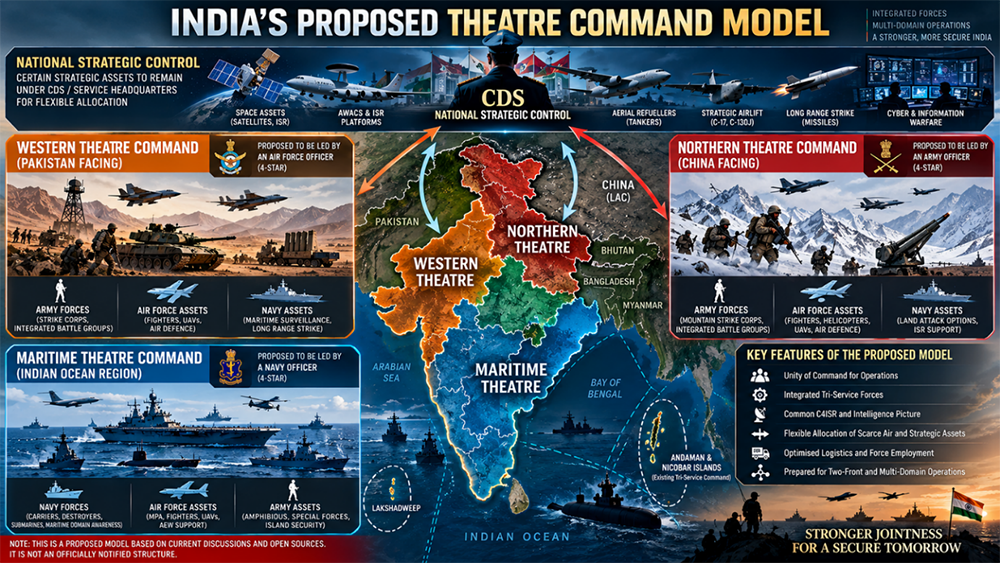
The model currently under consideration reportedly envisages three principal theatres:
Northern Theatre Command — primarily China-facing.
Western Theatre Command — primarily Pakistan-facing.
Maritime Theatre Command — covering India’s maritime interests.
Recent reporting indicates that the proposed structure could have four-star theatre commanders, with the Northern, Western and Maritime commands potentially led respectively by officers from different Services. The proposal has reportedly progressed substantially, with strategic air assets such as tankers, transport aircraft, AEW&C and certain space-related capabilities expected to remain under Air Headquarters rather than being permanently tied to individual theatres. That is an important compromise.
It recognises one of the IAF’s fundamental objections: air power is inherently flexible and should not be unnecessarily imprisoned within geographical boundaries.
Why was the IAF Apprehensive?
The IAF’s reservations have never fundamentally been about jointness. That distinction is important.
The Air Force has repeatedly supported greater integration and demonstrated substantial jointness during operations and exercises. Its concern is about how Theatreisation could affect the employment of limited air power. India has a relatively small fighter fleet compared with the geographical and operational demands imposed upon it. Unlike the Army, which can allocate formations relatively geographically, aircraft can rapidly move hundreds or thousands of kilometres.
The Air Force has repeatedly supported greater integration and demonstrated substantial jointness during operations and exercises. Its concern is about how Theatreisation could affect the employment of limited air power
An aircraft deployed against Pakistan today may be required against China tomorrow. A tanker, AWACS or strategic transport aircraft may support several theatres. The IAF therefore fears that distributing scarce aircraft among theatre commanders could create sub-optimal allocation of combat power.
There is another concern: command fragmentation. Suppose a Western Theatre Commander controls a portion of the fighter fleet, while the Northern Theatre Commander controls another portion. If intelligence suddenly indicates a major Chinese escalation, who reallocates aircraft? The answer must be immediate.
The fear is that theatreisation could create multiple operational demands competing for the same scarce national air assets. The IAF has also argued that India’s geography and threat structure are fundamentally different from those of the United States or China. Air Chief Marshal AP Singh cautioned in 2025: “We cannot pick theatre command structures from the US or China.”
He argued for a step-by-step approach rather than a simultaneous restructuring of the entire military, warning against disrupting existing arrangements and potentially lengthening the OODA loop. That concern deserves serious consideration. A theatre command is useful only if it makes the decision cycle faster, not slower.
Then Came Operation Sindoor
Operation Sindoor has become the most important empirical test of the Theatreisation argument. India conducted a highly coordinated operation involving the Army, Air Force and Navy, alongside intelligence, air defence, cyber, space and information capabilities. The Defence Ministry has described it as a calibrated, tri-Service operation and highlighted the integration of multiple domains.
The most significant observation is that jointness worked without fully implemented theatre commands. That is the strongest argument being advanced by critics of rapid Theatreisation.
Air Chief Marshal AP Singh subsequently said that the three Service Chiefs and CDS achieved excellent coordination and joint planning during Operation Sindoor, arguing in 2025 that: “For now, we don’t need any new structure.” The IAF’s position is therefore essentially: If the existing leadership can achieve joint effects, why introduce a disruptive restructuring before learning exactly what Sindoor has taught us? This is not an unreasonable argument, but there is a counterargument.
There is another concern: command fragmentation. Suppose a Western Theatre Commander controls a portion of the fighter fleet, while the Northern Theatre Commander controls another portion. If intelligence suddenly indicates a major Chinese escalation, who reallocates aircraft? The answer must be immediate
Operation Sindoor demonstrated the value of jointness, not necessarily the superiority of the existing command architecture. An ad hoc system can work exceptionally well when experienced commanders, a clear political objective and strong personal relationships compensate for structural deficiencies. The question is whether the same efficiency can be guaranteed in a long-duration, two-front, high-intensity war. That is where Theatreisation still has a powerful case.
What did Operation Sindoor Actually Teach us?
The first lesson is that jointness is indispensable. The second is that jointness must be supported by a common operational picture. The third is that air defence, drones, missiles, electronic warfare, cyber and space cannot be treated as independent Service capabilities. The fourth is that modern warfare is increasingly about networks and effects rather than platforms. The former CDS, General Anil Chauhan, subsequently described Operation Sindoor as India’s first genuinely multi-domain operation and emphasised that cyberspace and information warfare had formed part of the operational framework. The fifth lesson is particularly important: centralised control of scarce strategic capabilities may be preferable to rigid theatre allocation.
Operation Sindoor demonstrated that national-level capabilities may need to be dynamically allocated according to the evolving operational situation. The sixth lesson is that the air battle cannot be separated from the land and missile battle. The seventh is that integrated air defence is increasingly a national capability rather than an individual-Service capability.
The Defence Ministry has highlighted the role of integrated command-and-control and layered air defence during the Pakistani drone and missile attacks.
Did Operation Sindoor strengthen or weaken the case for Theatreisation? It did both. It strengthened the case for integration. It weakened the argument for mechanically imposing a rigid geographical structure.
This distinction should determine India’s next step. Operation Sindoor demonstrated that the three Services can operate together effectively. But it also showed that modern warfare requires rapid national-level redistribution of capabilities. Therefore, India should not create theatres merely to divide assets. It should create theatres to unify operational command while retaining flexibility of national resources.
Will Theatreisation give India the ‘Added Punch’?
Potentially, yes — but Theatreisation itself does not create combat power. It creates the architecture through which existing combat power can be used more effectively.
The IAF’s position is essentially: If the existing leadership can achieve joint effects, why introduce a disruptive restructuring before learning exactly what Operation Sindoor has taught us?
Its greatest advantages would be: One commander, one operational plan, one intelligence picture, one prioritisation mechanism and one campaign design. It could reduce duplication, improve logistics, simplify operational planning and enable integrated targeting. It could also improve India’s transition from peacetime to wartime.
China’s model offers one important lesson here: permanent theatre commands allow commanders to prepare continuously for their assigned contingencies rather than constructing an operational headquarters after a crisis begins.
Theatreisation can therefore give India greater speed, coherence, and campaign-level focus, but it will not solve India’s fighter shortage, missile shortage, ISR gaps, or air-defence deficiencies. A four-star theatre commander without adequate combat power is merely a four-star headquarters. Theatreisation is an organisational multiplier, not a substitute for capability.
What Should India do now?
India should avoid both extremes. It should neither abandon Theatreisation because Operation Sindoor worked without it, nor rush into a rigid three-theatre structure simply because Theatreisation has become an institutional objective. A phased implementation is preferable.
Theatreisation can give India greater speed, coherence, and campaign-level focus, but it will not solve India’s fighter shortage, missile shortage, ISR gaps, or air-defence deficiencies. A four-star theatre commander without adequate combat power is merely a four-star headquarters
The first phase should institutionalise a powerful Joint Operations Headquarters under the CDS, with a permanent tri-Service planning and operational staff. The second should establish common C4ISR, intelligence fusion, targeting and communications architecture. The third should progressively assign operational forces to theatre commanders while keeping certain strategic assets — tankers, AWACS, strategic transport, space assets, long-range strike systems and selected reserves — under national control. The fourth should conduct major exercises designed specifically to test simultaneous two-front contingencies. The fifth should establish clear rules for transfer and reallocation of air assets between theatres.
The theatre commander should therefore have operational control — but the nation must retain the ability to surge combat power from one theatre to another.
The Larger Issue: Jointness must Become a Warfighting Culture
The CDS has rightly spoken of developing a ‘Joint Culture’ rather than simply creating organisational structures. He has argued that India needs to move from ‘Jointness 1.0’ – better coordination – to ‘Jointness 2.0’, a genuine joint culture. This is perhaps the most important part of the entire reform.
A theatre command staffed by officers who continue to think primarily as Army, Navy or Air Force officers will merely reproduce Service rivalries at another level. India needs joint doctrine, joint planning, joint targeting, joint logistics, joint communications, joint intelligence and — most importantly — joint career incentives. The American experience after Goldwater-Nichols demonstrates that jointness became durable only when joint experience became integral to senior military careers.
The CDS has rightly spoken of developing a ‘Joint Culture’ rather than simply creating organisational structures. A theatre command staffed by officers who continue to think primarily as Army, Navy or Air Force officers will merely reproduce Service rivalries at another level
Conclusion
India should proceed with Theatreisation, but it must be driven by operational evidence rather than organisational ambition. The appointment of Air Marshal Ashutosh Dixit, following Air Chief Marshal A P Singh’s call to reassess the structure and sequencing of theatre commands, creates an opportunity to bridge the gap between the objective of jointness and the IAF’s requirement for flexible employment of air power.
As of October 9, 2026, the appointment of the new Air Chief is officially confirmed, but a final government approval and implementation timeline for the proposed Integrated Theatre Commands have not been publicly established in the sources reviewed.
The way ahead should combine phased implementation, permanent joint planning, integrated intelligence and targeting, common command-and-control networks, and clearly defined authority for reallocating strategic assets across theatres. Exercises simulating a simultaneous two-front conflict should validate the proposed arrangements before they are fully implemented.
Ultimately, Theatreisation must deliver measurable improvements in decision speed, concentration of combat power, logistics and operational effectiveness. Operation Sindoor has provided valuable evidence, while the forthcoming leadership transition offers an opportunity to incorporate those lessons into the final design.
India needs neither Theatreisation at any cost nor indefinite postponement. It needs unity of command without rigidity, joint operational control without unnecessary bureaucracy, and Service specialisation without institutional silos. That is how Theatreisation can become a genuine warfighting multiplier rather than merely another reorganisation of military headquarters.
-The author retired as Major General, Army Ordnance Corps, Central Command, after 37 years of service. A management doctorate and expert on defence modernisation, he is the author of four books, including the Amazon bestseller “Breaking the Chinese Myth,” and a frequent media commentator. He is affiliated with several leading defence and strategic studies institutions in New Delhi. The views expressed are of the writer and do not necessarily reflect the views of Raksha Anirveda





