


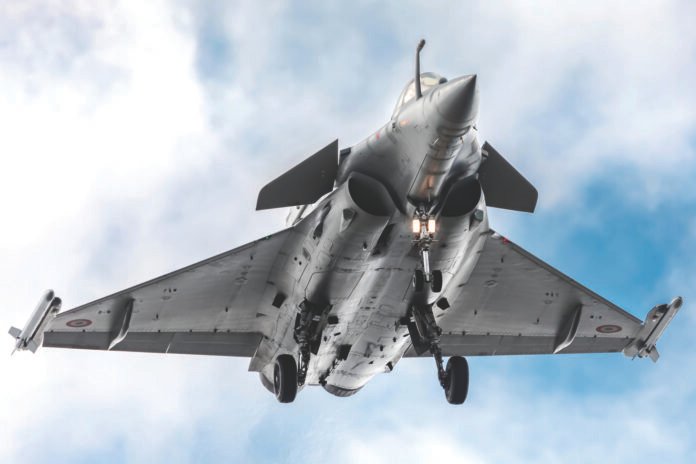
Paris. France is preparing to pursue a domestically led next-generation combat aircraft while accelerating work on an upgraded Rafale, according to plans outlined by French Air and Space Force Chief of Staff Gen. Jérôme Bellanger and reported by Les Echos. The twin-track strategy follows the breakdown of the crewed-fighter element of the multinational Future Combat Air System (FCAS) programme.
The planned future aircraft is referred to as the ACF, short for avion de combat du futur, or “future combat aircraft.” France expects to begin a new phase of work leading toward a demonstrator in 2027, with development of an operational version scheduled to start in 2029. Those milestones do not mean a prototype will fly in 2027: Dassault Aviation chief executive Éric Trappier has said a demonstrator’s first flight could come around 2031 or 2032.

The Rafale F5, dubbed the “Super Rafale”, is intended to preserve and extend French combat-air capabilities while the successor aircraft is developed. France is expected to launch its development phase in December 2026. Planned upgrades include a more powerful engine, advanced sensors and artificial-intelligence-enabled systems, as well as a high-speed missile associated with France’s airborne nuclear deterrent. The aircraft is also being developed with crewed-uncrewed cooperation in mind.
The F5’s planned technologies are not all at the same development stage. France has already begun testing artificial-intelligence algorithms aboard a Rafale, while the HypAIRion programme is using two modified Mirage 2000s as flying laboratories. The aim is to test AI applications and support a first coordinated flight involving a Rafale and an accompanying drone in 2028. Such systems are intended to help crewed aircraft detect threats and coordinate with uncrewed platforms.
France’s decision to press ahead nationally follows persistent industrial and political disagreements within FCAS, developed with Germany and Spain. Disputes over leadership, work-sharing and design authority complicated the fighter’s progress; national requirements also differed.
France needed a future aircraft able to support carrier operations and its nuclear mission, while those requirements did not align in the same way with German and Spanish priorities. The fighter pillar’s breakdown does not necessarily mean every FCAS component is abandoned: reporting says wider systems work, including the “combat cloud”, may continue.

The financial and technical hurdles are substantial. France’s proposed 2027 defence budget reportedly includes up to €3 billion in procurement authorisations for the Rafale F5 and €2.7 billion for the ACF. These are planned authorisations, not proof that the full amounts have been approved or spent; both programmes depend on parliamentary budget decisions. Separate reporting on the proposed budget says France wants to raise contractual commitments for the next-generation programme from €1.2 billion in 2026 to €2.74 billion in 2027.
The fighter programme also raises questions about how France will replace the industrial and financial contributions previously expected from partners. Paris intends to preserve technologies developed during FCAS and has work under way on a new engine and aircraft architecture. Safran retained technical leadership for engine design and integration in the former programme, while its Turenne 2 research is intended to develop technologies beyond the upgrade potential of the Rafale’s current M88 engine.

France also plans to expand its fighter fleet from approximately 170 aircraft to at least 230 by 2035, according to the report. General Bellanger said the current fleet is being used at a rate more than 15% above normal, underscoring the pressure on existing forces as new systems remain years away. The challenge is to sustain readiness while funding two major programmes and avoiding delays.
The plans now set out a demanding sequence: advance Rafale F5, demonstrate technologies for the ACF and begin operational-aircraft development by 2029. Whether France can preserve its intended schedule and afford the programmes at the planned scale will depend on technical progress, industrial capacity and annual budget decisions. The immediate test will be turning the proposed milestones into funded development work.






