


The Series A will fund Fortastra’s next spacecraft, expand engineering and manufacturing capacity, and advance autonomous operations, the company said on October 8. First In led the round, with participation from Upfront Ventures, Space Capital, Rsquared, Side Door Ventures, ATX Ventures and other new and existing investors. Financial terms beyond the amount raised were not disclosed.
The Torrance-based company is developing a spacecraft that can move near satellites, assess activity around them and respond to potential threats. Fortastra says the long-term goal is persistent security coverage across multiple orbits, rather than relying only on systems assigned to protect individual spacecraft. The company has not publicly detailed the defensive payloads or response mechanisms its vehicles may carry.

The fundraising follows a significant early milestone: Fortastra’s first two prototype spacecraft, called Watchdog V0, launched on October 1, aboard SpaceX’s Transporter-18 rideshare mission from Vandenberg Space Force Base. The launch marked the startup’s first spacecraft reaching orbit. The prototypes are intended to validate the company’s approach, while the Series A supports the transition from early demonstrations toward a more capable operational system.
Fortastra says its planned spacecraft will combine relative navigation, perception and autonomous manoeuvring. These capabilities are central to rendezvous and proximity operations-the ability to navigate close to another object in orbit. The company’s funding announcement says investment will support flight software, guidance, navigation and control, and a perception system able to interpret what a spacecraft encounters. Such capabilities could enable a vehicle to approach an object and assess its behaviour, but proximity itself does not establish hostile intent.
Chief executive Mike Smayda has described the concept as moving from a “bodyguard” model towards “zone defence”: deploying many spacecrafts across different orbital regimes to provide broader coverage. He has spoken of a long-term ambition to field hundreds or potentially thousands of vehicles. That is a strategic vision, not a confirmed procurement order or deployment plan. Smayda has not disclosed the company’s valuation, and the current raise does not specify how many satellites will be built.
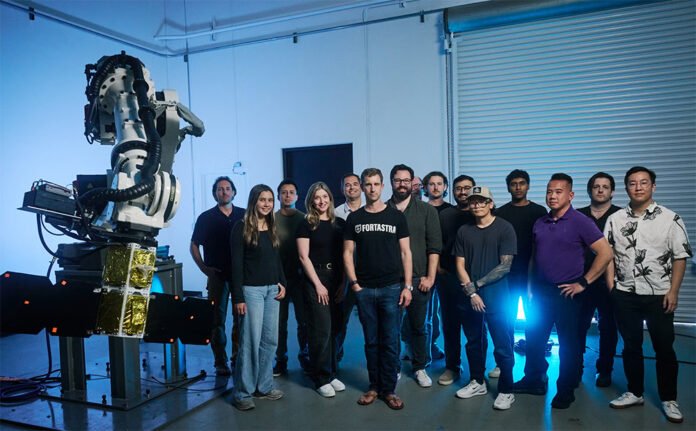
Fortastra’s immediate plan is more modest. The company has 18 employees, and its workforce is expected to more than double over the next year to 18 months, SpaceNews reported. Payload reported that the next spacecraft could launch as early as the first quarter of 2028. Fortastra’s funding announcement says it will develop its next spacecraft and build production architecture in parallel, aiming to shorten the time from design to flight.

The round also reflects investor interest in commercial systems that could complement government-built space capabilities. Governments and private operators depend on satellites for communications, navigation, intelligence and other services, while spacecraft in orbit can be difficult to repair or protect. Fortastra argues that lower-cost, scalable systems could offer an additional layer of resilience. Whether that model proves affordable and operationally effective will depend on flight testing, manufacturing rates and government demand.
The company is not starting from scratch. Its Series A announcement cites initial government contracts and a memorandum of understanding with manufacturer Hadrian concerning precision machining and additive manufacturing for national-security spacecraft programmes. Fortastra says it will use the new capital to expand its engineering and operations teams, strengthen manufacturing and advance autonomy.

The funding provides runway to move from prototype operations toward a larger security platform, but key details remain undisclosed: the spacecraft’s specific capabilities, unit cost, customer commitments and eventual fleet size. For now, Watchdog V0’s arrival in orbit gives Fortastra an initial testbed, while the Series A funds its attempt to turn orbital proximity operations into a scalable service.






