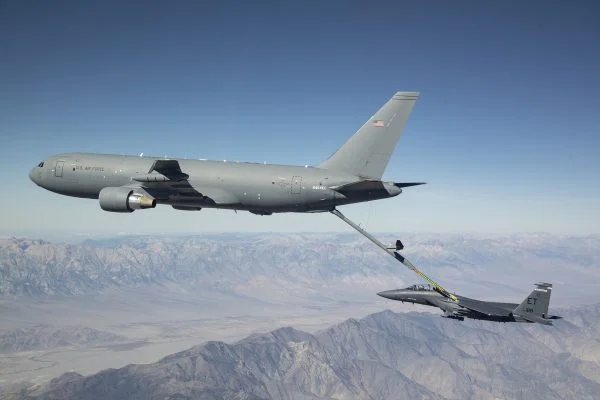
Washington: Boeing must pay another $151 million out of its own pocket for the KC-46 program, but this time the charge isn’t associated with technical problems that have plagued the tanker’s development.

The company announced its second-quarter earnings on July 29, stating the KC-46 charge was “primarily driven by additional fixed-cost allocation resulting from lower commercial airplane production volume due to COVID-19.”
In short, because Boeing’s commercial plane production has slowed down, it’s costing more to produce the KC-46, a derivative of the Boeing 767 airliner that is manufactured on the 767 production line in Everett, Washington, and converted into a military tanker.
Greg Smith, Boeing’s chief financial officer, said with the ramp down of production on some commercial airliners, certain fixed costs have been transferred to other programs.
KC-46 delivery to Seymour Johnson was delayed after debris was found in fuel tank and this is the latest in a series of debris-related problems that has held up Boeing’s delivery of the Air Force’s newest tanker.

“That’s essentially what took place with tanker,” Smith told reporters during a media roundtable. “It was notable on tanker because of the margin that we’re booking on, and therefore turned it into a reach-forward loss. There was impact on some of the other [commercial derivative] programs, but it was not really material at all.”
Boeing is locked into paying any costs associated with the KC-46 that exceed the $4.9 billion firm fixed-price ceiling on its 2011 contract with the US Air Force.

The latest charge means Boeing will have spent more than $4.7 billion in company funds on the KC-46 program — almost equivalent to the Air Force’s own investment in the program.
But Smith pointed to the lack of performance-related losses for the KC-46 this quarter as a sign that the program is progressing. “We’ve still got a lot of work to do, but [we’re] making good progress,” he said.
Despite the tanker charge, Boeing’s earnings for its defence and space sector were a bright spot for the company, which continues to grapple with financial distress caused by the Coronavirus pandemic’s impact on the travel industry and the ongoing grounding of the 737 Max.
Boeing Defence, Space & Security logged $7 billion in new orders this quarter, including an award for three additional MQ-25 tanker drones for the US Navy and 24 AH-64E Apache helicopters for Morocco.
During a call with investors, Boeing CEO Dave Calhoun said the defence market remains healthy and that recent contracts “underscore the strength of our offerings.”