


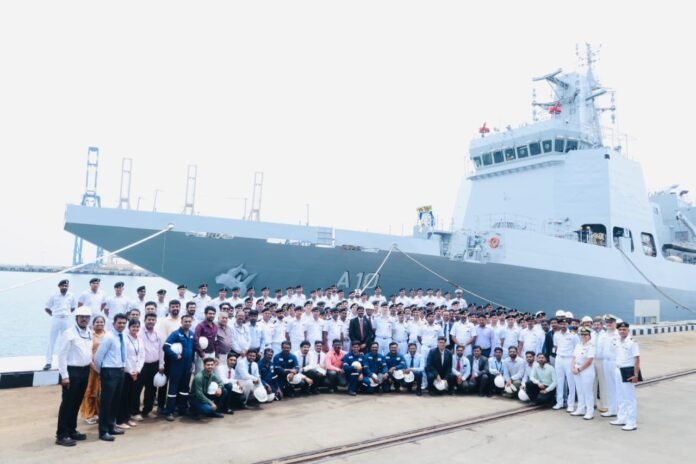
New Delhi. The Indian Navy is preparing to commission INS Samarthak, its first multi-purpose vessel, and INS Mangrol, a shallow-water anti-submarine warfare craft, in a move aimed at expanding specialised maritime capabilities without diverting frontline warships from operational duties.
The planned inductions come as India confronts a more contested underwater environment. Pakistan is expanding its submarine fleet with Chinese-built Hangor-class vessels, while China’s growing naval presence and research activity in the Indian Ocean has increased scrutiny of seabed mapping, hydrographic surveys and oceanographic data collection.

Pakistan recently test-fired an anti-ship cruise missile from PNS Hangor, the first of eight Chinese-origin submarines being acquired by Islamabad. The class is equipped with air-independent propulsion, allowing submarines to remain underwater for longer periods and making detection more difficult.
INS Samarthak, built by Larsen & Toubro, is the first of two multi-purpose vessels ordered by the Navy. It was delivered at the company’s Kattupalli shipyard near Chennai on August 27, 2026. The vessel reportedly incorporates more than 75 per cent indigenous content under a contract signed in 2022.
Its principal role will be to test and evaluate weapons and sensors, including torpedoes, anti-submarine systems and other indigenous technologies. The ship will be capable of launching and recovering underwater targets, supporting live-fire exercises and operating unmanned surface, aerial and underwater systems.
A dedicated trials platform is expected to reduce the need to use destroyers, frigates and other frontline vessels for developmental testing. That will allow combat ships to remain available for patrols, deterrence missions and operational deployments.

Samarthak will also perform maritime surveillance, offshore patrols, towing, salvage and pollution-response duties. Its additional responsibilities will include humanitarian assistance and disaster relief, logistics support for island territories and assistance during emergencies at sea. The 107-metre vessel has reported accommodation for more than 100 personnel and a range of approximately 4,500 nautical miles.
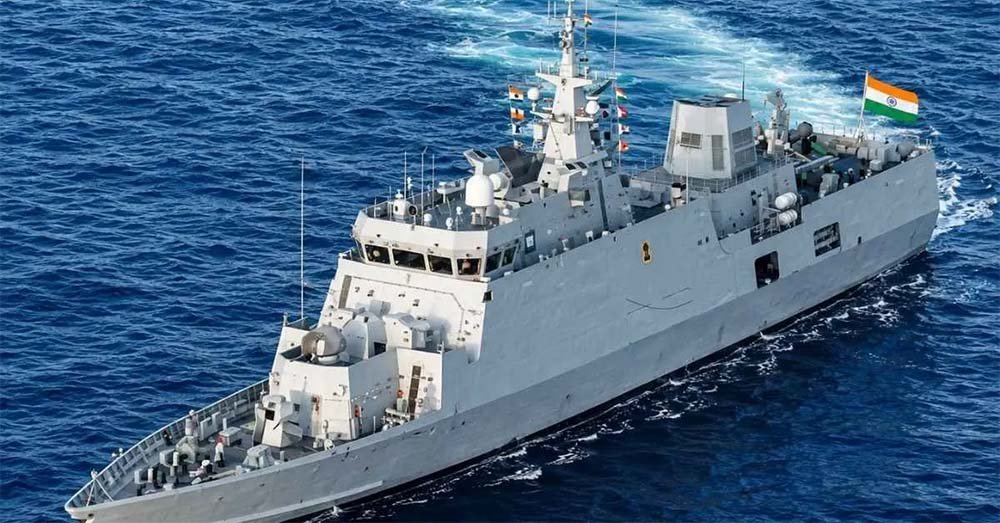
INS Mangrol, meanwhile, belongs to the Mahe class of anti-submarine warfare shallow-water craft being built by Cochin Shipyard Limited. It will be the seventh of 16 vessels planned for the Navy.

Designed for operations close to the coast and around harbours, naval bases and high-value assets, Mangrol carries indigenous underwater sensors, lightweight torpedoes, anti-submarine rockets and torpedo-decoy launchers. The craft can also lay mines. The class is fitted with hull-mounted and variable-depth sonar systems intended to detect, track and classify underwater contacts in difficult littoral environments.
The vessels are particularly suited to shallow waters, where seabed conditions, shipping traffic and coastal geography can complicate submarine detection. Their deployment is expected to strengthen protection for naval installations, commercial ports and major surface ships operating near India’s coastline.
The inductions form part of a wider naval expansion programme. The Navy is working to commission 18 warships during 2026, reportedly its highest annual total, while planning to increase its fleet from around 145 warships to approximately 200 over the next decade.
However, the additions do not resolve India’s shortage of air-independent-propulsion submarines. The Navy currently operates no indigenous AIP-equipped submarine. Six boats planned under Project-75i are expected to receive AIP systems from the outset, but the programme is still awaiting final security clearance and the first vessel could take at least seven years to enter service after a contract is signed.
INS Khanderi, a Kalvari-class submarine, is expected to become the first Indian Navy submarine fitted with the Defence Research and Development Organisation’s fuel-cell-based AIP system. Its system is projected to become operational around mid-2028.
Against that backdrop, Samarthak and Mangrol offer near-term improvements. One will accelerate weapons development and trials; the other will add a dedicated coastal capability for detecting and countering submarines. Together, they signal a broader shift towards specialised platforms, indigenous technology and layered underwater surveillance.






