


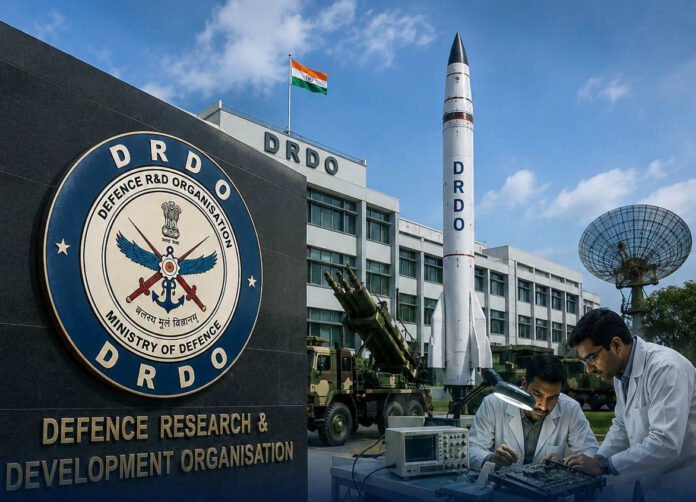
The Defence Research and Development Organisation (DRDO) must reduce the number of projects it undertakes and concentrate its resources on a smaller set of strategically important technologies, according to the defence secretary.
The proposed restructuring is aimed at improving delivery timelines, strengthening accountability and enabling India’s private defence industry to participate more deeply in research, development and production. The move reflects a broader government effort to shift DRDO away from activities that industry can perform more efficiently, allowing the organisation to focus on advanced and high-risk technologies.

Under the emerging approach, DRDO’s project portfolio could be limited to about 10 priority programmes. The objective is to ensure that scientific and financial resources are not spread too thinly across numerous initiatives, many of which face delays, changing requirements or difficulties in transitioning from laboratory development to military deployment.
The proposal also seeks to expand the role of private companies beyond manufacturing. Industry participation could cover design, systems integration, testing, certification, production and long-term maintenance. Such involvement would give companies greater ownership of defence programmes and help build domestic capability in areas traditionally dominated by government laboratories and public-sector undertakings.
The reform comes as India attempts to accelerate military modernisation while reducing dependence on imports. Government policy has increasingly promoted domestic design and production through initiatives including Make in India, the iDEX innovation programme, the Technology Development Fund and positive indigenisation lists.
The private sector’s role has already expanded through development-cum-production partnerships, technology transfers and access to government testing infrastructure. DRDO says it has created mechanisms for transferring technologies to Indian companies, supporting start-ups and allowing industry to use selected test facilities. Its industry-support programme also targets micro, small and medium enterprises developing defence and dual-use technologies.

Official data indicates that the scale of this ecosystem is growing. The government has said DRDO sanctioned 148 new research and development projects during the three years to 2025, while 70 projects under the defence acquisition procedure’s Make categories received in-principle approval during the same period. Defence research allocations also rose from an actual expenditure of ₹20,585.78 crore in 2022-23 to ₹24,696.94 crore in 2024-25.
However, greater private participation will require clearer project ownership and more predictable procurement. Companies are unlikely to invest heavily in defence technologies if requirements change frequently, trials are delayed or production orders remain uncertain. A smaller DRDO portfolio could make it easier to establish measurable milestones and identify responsible partners for each programme.

The model would also require the armed forces to define realistic and achievable technical requirements. Earlier defence-policy debates have highlighted how excessively ambitious service specifications can discourage domestic companies and delay procurement. Industry, users and research institutions will therefore need to be involved earlier in the design of requirements.
Recent DRDO initiatives point in that direction. The organisation has invited Indian companies to participate as development-cum-production partners for selected missile and guided-weapons programmes. Under such arrangements, firms may be involved in development, integration, qualification and subsequent production, rather than merely assembling systems after DRDO completes the design.
The transition will not eliminate DRDO’s role. Instead, it would reposition the organisation as a technology developer, standards-setter and national research institution, while private companies provide scale, manufacturing speed and commercial innovation.
For India, the success of the plan will depend on execution. A focused DRDO, dependable procurement pipeline and competitive industrial base could shorten the journey from laboratory prototype to operational equipment. If coordination remains weak, however, reducing projects alone may not resolve the delays that have affected several defence programmes.
The proposed reform therefore represents more than an organisational change. It signals an attempt to create a clearer division of labour: DRDO would focus on critical technologies, the armed forces would articulate practical operational needs, and private industry would help convert innovation into deployable military capability.






