


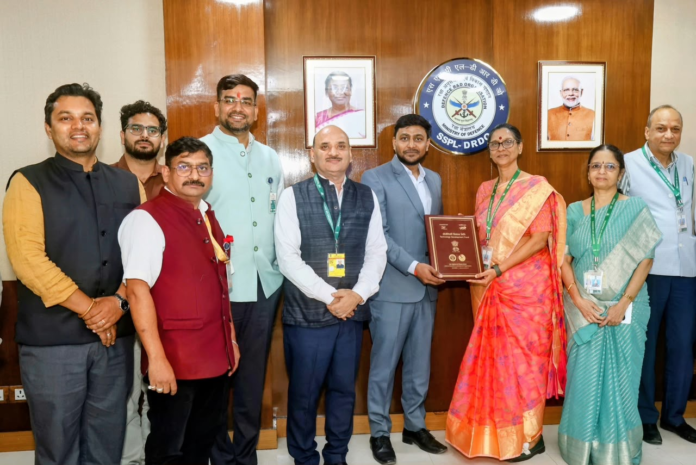
The Defence Research and Development Organisation (DRDO) has signed its first high-value deep-tech project agreement with a startup under the Technology Development Fund (TDF) scheme, marking a new phase in India’s effort to build strategic technologies through industry partnerships.
The agreement was signed in New Delhi between the Director of the TDF and Zero mK India Private Limited, an Alwar-based startup. The project involves the indigenous development of a 20 millikelvin (mK) dilution refrigerator for quantum applications.

A dilution refrigerator is a specialised cryogenic system used to achieve temperatures close to absolute zero. At 20 mK – approximately 0.02 kelvin – the system can provide the ultra-cold environment required to operate and test several quantum computing platforms, superconducting circuits, quantum sensors and other advanced devices.
Such equipment is essential because many quantum systems are highly sensitive to heat and environmental disturbances. Superconducting quantum processors, for example, need extremely low temperatures to preserve the physical states used for computation. Indigenous access to this infrastructure could help Indian laboratories, defence institutions, universities and technology companies conduct research without relying entirely on imported systems.
The agreement is the first high-value project approved under a ₹500 crore corpus sanctioned for deep-tech and cutting-edge technologies. The corpus was approved by Defence Minister Rajnath Singh to support ambitious projects with strategic and defence applications.
The Ministry of Defence said the project aligns with the National Quantum Mission and will contribute to India’s development of advanced cryogenics, quantum technologies and other strategic capabilities. It is also expected to reduce dependence on imported cryogenic infrastructure and strengthen the country’s emerging quantum-technology ecosystem.

Rajnath Singh congratulated DRDO, Zero mK India and other stakeholders involved in the initiative. He said the partnership could establish an important precedent for future collaboration between the defence research organisation and Indian companies working in emerging technology fields.
The project will be monitored, mentored and technically supported by the Solid State Physics Laboratory (SSPL), a DRDO facility. The laboratory’s director and team will oversee the programme, while senior officials from DRDO’s technology-management and microelectronics divisions will be associated with its implementation.

The agreement reflects a broader change in the way defence research is being organised. Instead of relying exclusively on government laboratories to design, develop and manufacture new systems, the government is increasingly seeking partnerships with startups, micro, small and medium enterprises and established private firms.
The TDF scheme is a central instrument in that effort. It supports industry-led development of defence and dual-use technologies, with particular emphasis on raising technologies from early research or prototype stages towards products that can meet military requirements. The scheme can provide grants-in-aid covering up to 90% of eligible project costs, subject to a ceiling of ₹50 crore, according to programme information.
For startups, participation offers access not only to funding but also to DRDO laboratories, scientists, testing facilities and potential defence customers. For the government, the model can bring private-sector speed and specialised expertise into areas where conventional procurement and research processes may be too slow.
The project’s success, however, will depend on more than producing a working refrigerator. The system must achieve stable 20 mK performance, operate reliably over extended periods and meet the demanding requirements of quantum research and strategic applications. It must also be supported by a domestic supply chain for compressors, cryogenic components, electronics, sensors and maintenance.
If the programme meets its objectives, India could gain an important foundation for quantum computing, secure communications, precision sensing and advanced defence research. The DRDO-Zero mK agreement therefore represents not only a technology contract, but also a test of India’s strategy to convert startup innovation into sovereign strategic capability.






