


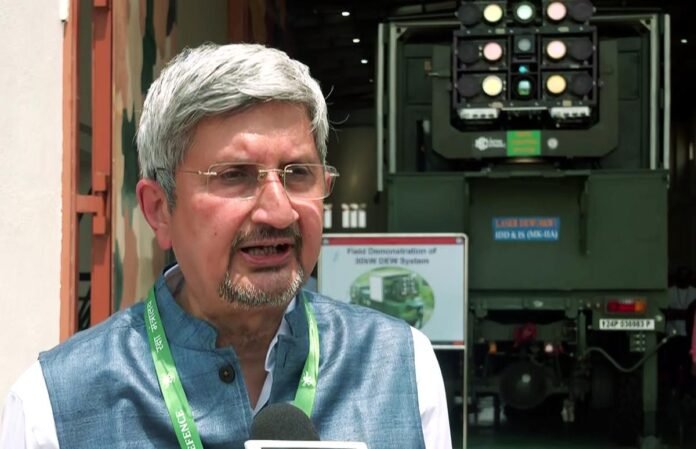
New Delhi: Defence Research and Development Organisation (DRDO) Chairman, Samir V. Kamat, has issued a stark call for enhanced investment in defence R&D to prepare for the evolving landscape of future warfare.
Speaking at the 40th Air Chief Marshal PC Lal (Retd) Memorial Lecture organised by the Air Force Association, Kamat underscored the urgent need to bolster the nation’s research and development budget amid rapid technological transformations across land, air, sea, space, cyber, and information domains.

Kamat highlighted the glaring disparity in R&D spending, noting that India allocates just 0.65 per cent of its overall budget to R&D, far below the over 2 per cent committed by competitors. Within the defence sector specifically, India’s R&D constitutes only 5.75 per cent of the defence budget, compared to more than 10 per cent in the United States. This shortfall, he argued, hinders India’s ambitions to emerge as a technology leader.
Paying tribute to Air Chief Marshal PC Lal, who led the Indian Air Force during the 1971 war, Kamat credited his legacy with shaping modern air power capabilities. The lecture served as a platform to emphasise how such historical leadership must inspire current efforts towards self-reliance under initiatives like Aatmanirbhar Bharat and Make in India, with the goal of achieving developed nation status by 2047.
The DRDO chief candidly outlined key challenges impeding progress, including limited control over supply chains, a scarcity of specialised talent, and insufficient civil-military fusion—a gap exacerbated by past sanctions. He also pointed to bureaucratic hurdles in the ease of conducting R&D, calling for systemic reforms to foster innovation.
To overcome these obstacles, Kamat advocated greater industry participation in design and development, alongside contributions from start-ups and MSMEs. He stressed the vital role of academia in basic and applied research on emerging technologies, coupled with the establishment of advanced test facilities and infrastructure. Capacity building, he added, remains a critical priority.

DRDO’s ongoing initiatives reflect proactive steps in this direction. The organisation has executed over 2,000 Technology Transfer Agreements (ToTs) and hosts the Dare to Dream Innovation contest to spur private sector involvement. Since 2022, more than 600 industries have utilised DRDO facilities for innovation, demonstrating growing collaboration.
Educational outreach forms another pillar of DRDO’s strategy. The DRDO-MOE Collaborative Programme engages PhD scholars on defence technologies, with 39 students already active at IITs and NITs. Complementary efforts include elective courses in B.Tech programmes, postgraduate and diploma courses aimed at skilling youth for defence R&D roles.

Looking ahead to next-generation capabilities, Kamat detailed focus areas such as underwater domain awareness, space situational awareness, intelligence, surveillance, and reconnaissance (ISR), man-unmanned teaming (MUM-T), cyber defence, secure communications, networking, and AI-enabled command and control. These align with Operation Sudarshan Chakra, as referenced by Prime Minister Modi in his recent Red Fort address, and extend to ballistic and hypersonic missile defence.
In the near term, spanning the next one to three years, DRDO anticipates inducting several advanced systems.
These include the Anant Shastra surface-to-air missile, Guided Pinaka, advanced lightweight torpedo, trawl assembly, infantry floating bridge, extended-range anti-submarine rocket, very short-range air defence system, vertical launch short-range surface-to-air missile, Dhruvastra anti-tank missile, naval anti-ship missile (Short Range), and RudraM-II air-to-surface missile.
Kamat exemplified DRDO’s practical advancements by referencing the successful test-firing of the Anti-Tank Guided Missile (ATGM) Nag MK-II from a light tank developed by the Combat Vehicles Research and Development Establishment (CVRDE). Such milestones underscore the organisation’s commitment to indigenous innovation.
Concluding on an optimistic note, the DRDO chief described the path forward as both challenging and exciting. He expressed confidence that strategic investments and collaborations would deliver Aatmanirbharta and technological leadership by 2047, particularly in critical domains like missile systems, armoured vehicles, military bridging, artillery, guns and ammunition, light combat aircraft, helicopters, ships, submarines, airborne early warning and control (AEW&C), radars, electronic warfare (EW) systems, sonars, and torpedoes.
This vision positions enhanced R&D not merely as an expenditure but as a foundational investment in India’s defence sovereignty and global standing.






