

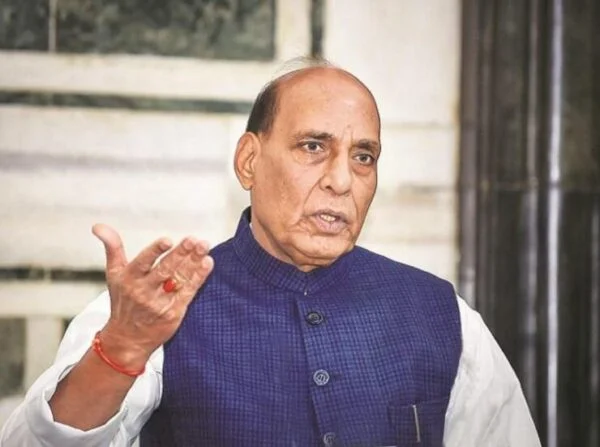
Addressing the Indian Navy’s fifth Swavlamban seminar in New Delhi, Singh said the first phase of defence self-reliance had “earned good marks” and the country must now aim for top-end, state-of-the-art outcomes. He urged a roadmap identifying priority technologies and timelines, and said innovators would be “impact players” in the next phase.
The minister’s call for “Aatmanirbharta 2.0” focused on more than increasing domestic production. The next stage, he said, should deliver high-quality systems that are affordable, globally competitive and more closely aligned with operational requirements. Singh also stressed the importance of reducing vulnerabilities in critical supply chains and investing in research and development.

Other officials placed the emphasis on execution. Chief of the Naval Staff Admiral Krishna Swaminathan called for accelerating the conversion of innovation into naval capability, with artificial intelligence and autonomous systems among the technologies that could strengthen the force. Vice Admiral Ajay Kochhar, Vice Chief of the Naval Staff, urged a shorter “innovation to integration” cycle, warning that rapid technological change can make an advantage short-lived. Defence Production Secretary Sanjeev Kumar called for stakeholders to work together to advance self-reliance.
Kochhar also identified speed, scale, sophistication and spiral development as principles for technology absorption. Spiral development means refining systems through trials, user feedback and successive upgrades. More than 4,000 proposals have been received under the Navy’s iDEX challenges, with around 150 start-ups and MSMEs participating. Projects worth more than ₹3,500 crore have received Acceptance of Necessity, while contracts exceeding ₹1,900 crore have been concluded, according to officials’ figures reported ahead of the seminar.
Companies in defence, aerospace and marine technology used Swavlamban 2026 to present their work and announce developments, reflecting the range of businesses engaging with the Indian Navy’s innovation agenda.
EyeROV, a Kochi-based marine robotics company, develops remotely operated and autonomous underwater systems. At the event, it highlighted its work in underwater robotics. In October, the company said it had delivered two TROUT military-grade remotely operated vehicles to the Indian Navy, as part of an order for five systems. The vehicle is designed for underwater inspection and related naval tasks and was developed through the iDEX programme.

C14 announced the launch of Tandav, an autonomous, modular unmanned surface vessel. The company also displayed Tandav alongside AquaScan, an AI-based vision device intended for divers. C14 indicated Navy interest in AquaScan, though that does not amount to a purchase or contract award. The distinction highlights the stages between demonstrating a technology, receiving interest from a potential user and securing procurement.
The event also drew attention from the aerospace sector. Ashish Saraf, who leads Pratt & Whitney in India, shared commentary on the occasion. Pratt & Whitney is an RTX business, with engineering, supply-chain, customer-service, operations and digital-transformation activities in India. Saraf’s comments added an aerospace-industry perspective to the event.

The Navy’s fifth Swavlamban seminar was held at New Delhi’s Manekshaw Centre on October 26-27 under the theme “Strength & Power through Innovation and Indigenisation.” Organised by the Indian Navy with the Defence Innovation Organisation and the Society of Indian Defence Manufacturers, it brought together the armed forces, start-ups, small and medium-sized enterprises, academia, investors and established industry. Its purpose was to connect operational needs with Indian technologies and help move promising solutions towards deployment.
Other reported displays illustrated the breadth of technologies under consideration. Sagar Defence presented work on autonomous and unmanned systems, including swarm boats; Zen Technologies showed an autonomous surface-vessel prototype; and GalaxEye described satellite-based maritime monitoring capabilities. Together, these examples span surface, underwater and space-based systems, showing how maritime awareness and operations can draw on technologies developed by firms with different capabilities and specialisms.
The seminar’s central test is whether demonstrations and industry engagement translate into dependable, supportable capability. Vice Admiral Ajay Kochhar identified scale, sophistication, speed and spiral development as priorities for technology absorption. Spiral development involves testing systems, incorporating user feedback and improving them iteratively. It can help take a prototype towards operational use, provided companies can meet validation, manufacturing and sustainment requirements.
Swavlamban’s model links the Navy’s operational challenges with solutions developed by industry. Companies can bring forward technologies, receive feedback and pursue trials; the services can assess whether a system meets real operational requirements. That process is especially relevant for newer technologies such as autonomous platforms, which must demonstrate reliability, safety and effective performance in demanding maritime conditions.
The range of systems highlighted at the event-from EyeROV’s underwater robotics to C14’s surface vessel and satellite-based maritime monitoring-reflects the expanding scope of defence innovation. It also underscores that visibility at a seminar is only an early step. Testing, integration, procurement and long-term support will determine whether these technologies become practical additions to naval capability.