


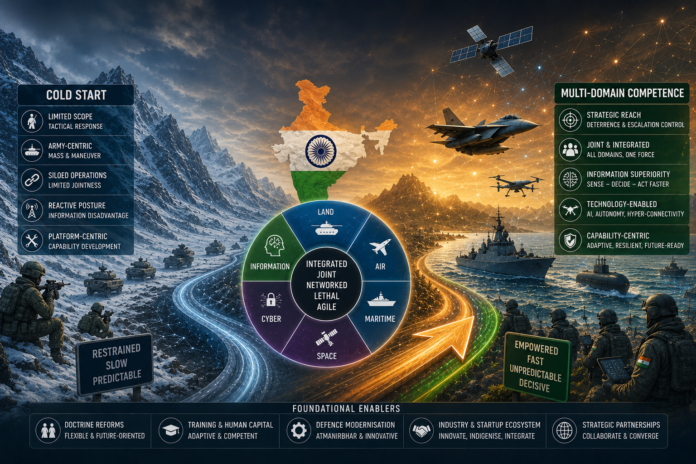
India’s quest for a credible and politically usable military response to Pakistan-sponsored terrorism has undergone a marked evolution since the 2001–02 crisis following Op Parakram. The Cold Start Doctrine (CSD) emerged in its aftermath to overcome mobilisation delays and enable swift, limited conventional offensives below Pakistan’s presumed nuclear thresholds.
Two decades later, however, Cold Start remains more conceptual than executable. In practice, India’s responses have shifted towards precision, politically calibrated actions, most notably the 2019 Balakot airstrike and 2025 Op Sindoor. These operations demonstrated operational agility and resolve but also exposed enduring gaps: target ambiguity, disputed battle damage assessment, escalation risks, limitations in information warfare and the difficulty of achieving lasting strategic effects.

Concurrently, global conflicts from the Russia-Ukraine War to the Iran war have underscored the decisive impact of persistent ISR, drone warfare, precision fires and narrative control. The strategic lesson is clear: India must move beyond episodic punitive strikes to a formally articulated doctrine integrating military power with non-kinetic instruments of statecraft, what we term the Integrated Multi-Domain Compellence & Denial Doctrine (IMDCD).
Cold Start: Conceptual Strengths and Structural Limits
Cold Start arose from a compelling premise: India needed the ability to strike swiftly and impose conventional costs on Pakistan before escalation thresholds were breached. Its key features included:
- Rapid mobilisation within 48–72 hours.
- Multiple shallow thrusts across sectors.
- Limited territorial objectives.
- Destruction of enemy reserves.
- Deterrence through denial and punishment.
While conceptually innovative, several limitations emerged:
Political Non-Sanction: Cold Start was never formally ratified at the highest political level. Without Cabinet endorsement, it remained a contingency concept rather than a fully usable instrument of state policy.

Army-Centric Design: The doctrine was predominantly land-focused. Air, maritime, cyber and space capabilities were treated as supporting arms rather than coequal domains; a structural imbalance untenable in modern warfare.
Escalation Compression: Pakistan’s development of tactical nuclear systems lowered perceived nuclear thresholds, constraining manoeuvre space.

Crisis Non-Application: Cold Start was never operationalised during crises such as Mumbai (2008), Uri (2016) or Pulwama (2019), with India relying instead on precision, limited responses.
Lesson: Cold Start was operationally bold but politically brittle and strategically constrained.
Beyond Balakot and Op Sindoor: Precision Without Strategic Coherence
The Balakot strike in 2019 marked a watershed moment. India demonstrated the ability to conduct cross-border air operations against terrorist infrastructure. It showcased political resolve and tactical flexibility but highlighted key limitations:
- Terrorist infrastructure is mobile, deniable and rapidly regenerable.
- Battle damage assessment remained contested internationally and domestically.
- Civilian proximity constrained target selection.
- Retaliation risks escalated conflict towards state-on-state dynamics.
- Strategic outcomes remained unclear.
Op Sindoor (2025) expanded on this model, leveraging deeper ISR integration, long-range precision fires and coordinated messaging. Yet the fundamental challenge persisted. Punitive strikes against proxies impose symbolic costs but do not structurally disrupt the ecosystem sustaining terrorism; its recruitment, financing, and logistical networks remain largely intact.
Global conflicts from the Russia-Ukraine War to the Iran war have underscored the decisive impact of persistent ISR, drone warfare, precision fires and narrative control. The strategic lesson is clear: India must move beyond punitive strikes to an articulated doctrine integrating military power with non-kinetic instruments of statecraft
This reveals the doctrinal gap: episodic strikes are inadequate if the aim is to impose deterrence; systemic disruption is required.
Lessons from Contemporary Conflicts
Recent global conflicts have reshaped modern warfare in ways directly relevant to India’s strategic calculus. There are lessons which must be factored into any new doctrine:
Transparency of the Battlefield: The Russia-Ukraine War has demonstrated that persistent ISR — satellites, drones and open-source intelligence have made concealment increasingly difficult. Surprise is fleeting; survivability depends on dispersion and deception.
Drone and Precision Strike Revolution: Low-cost UAVs, loitering munitions, and precision artillery have altered cost equations. High-value platforms are increasingly vulnerable, and massed armour, central to Cold Start, is exposed.
Information and Narrative Warfare: Ukraine, Israel-Hamas War and the Iran War all underscore that narrative dominance shapes international legitimacy. Tactical success without narrative control risks strategic dilution.
Escalation Under the Nuclear Shadow: Despite intense conventional conflict, nuclear thresholds have held, suggesting space exists for calibrated operations, provided escalation is managed deliberately.
Civil-Military Fusion and Economic Warfare: Sanctions, supply chains and economic resilience have emerged as critical components of warfare, expanding the battlespace beyond kinetic domains.
The Strategic Dilemma: Punishment vs. Disruption
A central challenge confronting Indian planners is whether to expand targeting from terrorist infrastructure to Pakistani military assets. While this may enhance deterrence clarity, it risks escalation compression, diplomatic costs and reduced manoeuvre space.
More fundamentally, it raises a deeper issue: Is punishment sufficient to deter Pak strategy built on deniable, low-cost proxy warfare?
Experience suggests it is not. What is required is a shift from episodic punishment to systemic disruption. The solution lies in persistent, multi-domain compellence.
Integrated Multi-Domain Compellence & Denial Doctrine (IMDCD)
IMDCD transcends sequential escalation and embraces simultaneous pressure across domains, integrating military and non-kinetic instruments of statecraft under the nuclear shadow. Its core principles are:
System Disruption as the Core Objective: IMDCD shifts the focus from imposing cost to rendering the adversary’s proxy ecosystem ineffective. This includes targeting his:
- Recruitment pipelines.
- Financial networks.
- Communication systems.
- Cross-border logistics.
The objective is not episodic punishment but sustained degradation of the ecosystem itself.
Parallel Pressure Axes Instead of Sequential Escalation: Rather than a tiered escalation ladder, IMDCD operates through simultaneous pressure across multiple domains:
- Covert and deniable operations.
- Persistent disruption of facilitation networks and logistical nodes below overt escalation thresholds.
- Selective, high-visibility strikes designed for strategic messaging rather than attrition.
- Information and narrative dominance by real-time evidence dissemination, narrative shaping and diplomatic synchronisation.
- Disruption of illicit funding channels and calibrated economic pressure.
- Naval signalling and exploitation of vulnerabilities beyond the land domain.
Escalation Geometry, Not Escalation Ladder: Escalation is reconceptualised as multi-directional rather than linear. India retains the ability to escalate across domains i.e. cyber, economic, covert and maritime without necessarily increasing kinetic intensity. This reduces predictability and complicates Pakistan’s response planning.
A Continuous Contested Framework: IMDCD is a shift from episodic, crisis-driven responses to a posture of sustained and calibrated pressure on Pakistan, across multiple domains. Rather than allowing periods of strategic pause in which the adversary can regroup, the operational environment is kept under constant friction through persistent intelligence-led disruption, deniable sub-threshold actions, financial targeting, narrative shaping and calibrated military signalling. The emphasis is on continuity over intensity i.e. maintaining a steady, low-visibility squeeze that degrades capability, constrains intent and imposes cumulative cost without breaching escalation thresholds. In effect, deterrence is no longer anchored in the threat of punitive retaliation alone but in the certainty that Pakistan’s ecosystem will remain perpetually contested, denied space and denied respite.
Nuclear Threshold Management: The doctrine explicitly integrates nuclear realities by:
- Avoiding early targeting of core military formations.
- Focusing on peripheral and enabling systems.
- Preserving escalation space and signalling clarity.
This ensures calibrated coercion without triggering destabilising thresholds.
IMDCD is a shift from a crisis-driven response to a posture of sustained and calibrated pressure on Pakistan, across multiple domains. Rather than allowing periods of strategic pause in which the adversary can regroup, the operational environment is kept under constant friction through persistent intelligence-led disruption
Strategic Messaging is a Core Pillar: Narrative dominance must be formalised as an operational requirement to include:
- Pre-planned communication frameworks.
- Rapid and credible battle damage transparency.
- Coordinated diplomatic engagement.
This ensures that tactical actions translate into strategic outcomes.
Institutional Integration: The Critical Enabler
For the IMDCD to move beyond conceptual articulation, institutional transformation is not optional; it is foundational. India’s principal challenge is no longer doctrinal imagination but organisational alignment. Without deep structural reform, even the most sophisticated doctrine will remain episodic, reactive and sub-optimal in execution.
At present, India’s national security architecture remains partially integrated and service-segmented, with coordination often dependent on crisis-driven improvisation rather than institutionalised synergy. IMDCD, by contrast, demands persistent, real-time, multi-domain orchestration, which can only be achieved through the following critical reforms:
Establishment of a Permanent Multi-Domain Operations Command: A dedicated, standing Multi-Domain Operations Command (MDOC) is essential to synchronise operations across land, air, maritime, cyber and space domains. This command should function as the central node for cross-domain effects, enabling simultaneous pressure across covert, kinetic, informational and economic axes. Crucially, it must be permanently staffed and active in peacetime, ensuring continuity, learning and preparedness. Without such a structure, multi-domain operations will remain ad hoc and sequential rather than integrated and parallel, undermining the very logic of IMDCD.
Integrated ISR and Data Fusion Architecture: Modern conflict is increasingly information-dominant. The ability to sense, process and act faster than the adversary is decisive. India must establish a National ISR Fusion Grid integrating:
- Space-based assets.
- UAV and tactical ISR platforms.
- Signals and cyber intelligence.
- Open-source intelligence (OSINT).
This architecture must enable real-time data fusion, AI-assisted analytics and direct linkage to decision-makers and shooters. Seamless connectivity between intelligence agencies and military commands is essential to eliminate delays and stovepiping. In the absence of such integration, precision operations risk becoming intelligence-limited rather than capability-limited.
Real-Time Political-Military Decision Architecture: IMDCD requires continuous calibration, not episodic decision-making. There is a need for continuous integration of national leadership, military commanders, intelligence and diplomacy to enable rapid decision-making. This is critical because escalation management under the nuclear shadow cannot be delegated or delayed. Decision latency directly translates into strategic risk.
For the IMDCD to move beyond conceptual articulation, institutional transformation is foundational. India’s principal challenge is no longer doctrinal imagination but organisational alignment. Without deep structural reform, even the most sophisticated doctrine will remain episodic, reactive and sub-optimal in execution
Integrated Cyber, Space and Information Warfare Commands: Non-kinetic domains must be elevated from supporting roles to coequal operational theatres. These must be fully integrated into operational planning, not treated as adjunct capabilities. The battlespace is now cognitive as much as physical. Without dominance in these domains, kinetic success risks strategic nullification.
Institutionalised Strategic Communication Framework: Narrative is no longer post-facto; it is simultaneous with operations. A National Strategic Communications Authority must be established and responsible for:
- Real-time dissemination of credible information.
- Pre-emptive narrative shaping.
- Counter-disinformation operations.
The experience of recent conflicts demonstrates that perception often determines legitimacy, coalition support and escalation outcomes.
Theatre Command Reforms and Joint Force Structuring: The transition to integrated theatre commands is essential. This reform is critical to ensure that operations are joint by design, not coordination by exception.
A doctrine without institutional readiness is ineffectual. Cold Start failed not for lack of conceptual merit, but due to political non-integration and structural unreadiness. IMDCD risks the same unless supported by permanent structures, real-time integration and whole-of-state coordination
Culture, Training and Doctrinal Convergence: Structural reform must be accompanied by cultural transformation. Without doctrinal convergence at the human level, institutional reforms risk remaining mechanical rather than operationally effective
A doctrine without institutional readiness is ineffectual. Cold Start failed not for lack of conceptual merit, but due to political non-integration and structural unreadiness. IMDCD risks the same unless supported by permanent structures, real-time integration and whole-of-state coordination.
Conclusion: Towards Credible Compellence
India’s strategic environment demands a doctrine that is flexible, credible and politically usable under nuclear constraints. Cold Start was an important first step; Balakot and Op Sindoor demonstrated tactical evolution but doctrinal incompleteness.
IMDCD offers a more adaptable framework that leverages technological advances, integrates multiple instruments of power and enables calibrated responses across domains. Its success depends not on episodic action but on internal reforms followed by persistent, precise and coordinated pressure that disrupts adversary strategies faster and smarter than they can respond.

The writer, AVSM, VSM and Bar is an Army veteran. During his distinguished military career, spanning over four decades, he has tenanted a number of command and staff appointments in counter insurgency and proxy war environment in the North East and Jammu & Kashmir. He commanded his Regiment on Siachen Glacier and Kargil and a Mountain Brigade in counter insurgency operations in Manipur and was nominated to raise an Infantry Division in Arunachal Pradesh specially tasked to counter the Chinese threat. He has also been an instructor at the School of Artillery and Indian Military Academy and served with the United Nations. He is currently President of the National Adventure Foundation, an NGO which works closely with the Ministry of Youth Affair & Sports.





