


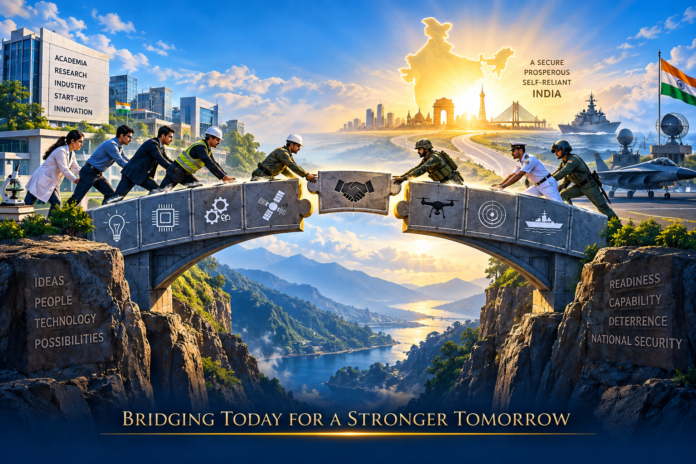
Civil-military fusion has become an increasingly important phrase in India’s strategic vocabulary. It recognises a fundamental reality of modern warfare: the technologies that determine military advantage are no longer developed exclusively inside defence laboratories. Artificial intelligence, drones, autonomous systems, semiconductors, quantum technologies, space applications, cyber capabilities, advanced materials and robotics are being created across universities, start-ups, MSMEs and the wider industrial ecosystem.
India has not been standing still. iDEX has created an institutional bridge between the armed forces and innovators, while ADITI has expanded support towards critical and strategic technologies. By February 2026, government figures reported 676 start-ups, MSMEs and individual innovators in the iDEX ecosystem, 548 contracts signed, 58 prototypes cleared for procurement and 45 procurement contracts already signed.

That is meaningful progress. Yet the strategic question has now changed. It is no longer whether India has created mechanisms for civil-military innovation. It is whether those mechanisms can move at the speed of technology and the urgency of national security.
The Implementation Sprint
The next phase therefore needs less discussion and more operating discipline.
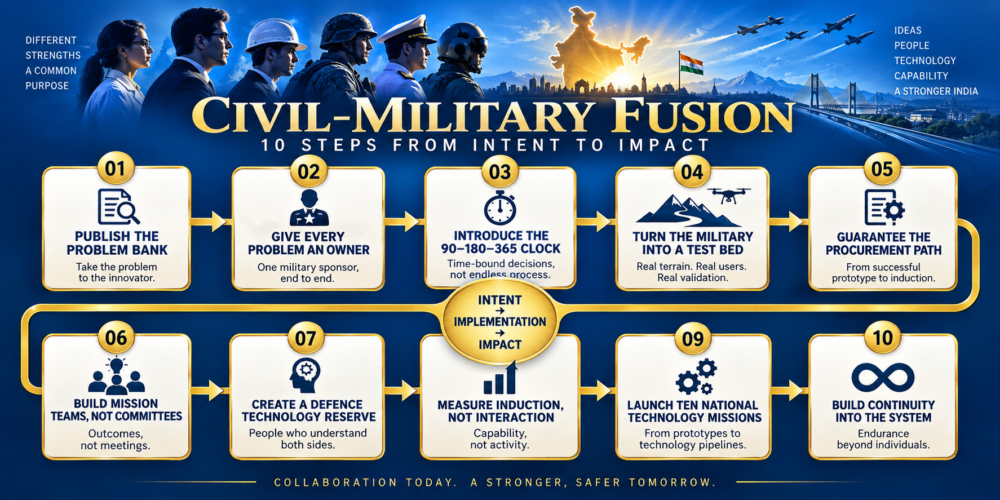
- Publish the Problem Bank. The first requirement is to make military problems visible to the country’s technological ecosystem.
India has already demonstrated the value of publishing problem statements through iDEX and ADITI. The next step is to make the process continuous and comprehensive. Take the problem to the innovator, rather than waiting for the innovator to find the problem
Instead of waiting for innovators to discover where they can contribute, the services should maintain a continuously updated National Defence Technology Problem Bank, containing clearly articulated, unclassified capability gaps. Each problem should specify the operational requirement, broad technical parameters, testing conditions, expected performance and the organisation responsible for evaluation. The list should be refreshed regularly rather than becoming another static government document. India has already demonstrated the value of publishing problem statements through iDEX and ADITI. The next step is to make the process continuous and comprehensive.
Take the problem to the innovator, rather than waiting for the innovator to find the problem.

- Give Every Problem an Owner. A problem statement without an empowered owner can quickly become an administrative exercise.
Every selected technology challenge should therefore have a designated Military Technology Sponsor — a serving officer or designated technical authority who remains responsible for the project from requirement definition through testing, feedback and induction. The sponsor need not control every stage, but someone must own the journey. The innovator should never have to discover, after months of development, that nobody has the authority to take the technology to its next stage.
The principle should be brutally simple: no orphan technology and no ownerless requirement.

- Introduce a 90–180–365 Clock. Technology does not wait for bureaucracy. A promising solution should therefore enter a visible institutional clock.
Technology does not wait for bureaucracy. A promising solution should enter a visible institutional clock. Technical screening should be completed within 90 days; it should undergo user evaluation within 180 days, and be placed on a procurement pathway within 365 days
Within 90 days, technical screening should be completed. Within 180 days, a sufficiently mature solution should undergo meaningful user evaluation. Within 365 days, the organisation should either place the successful technology on a defined procurement pathway or record why it will not proceed. This is not a demand that sophisticated military systems be developed in one year. Some technologies will inevitably require several years. The objective is to ensure that institutional decision-making does not become the longest part of technological development.
Time-bound accountability should apply to government as much as it does to the innovator.
- Turn the Military into a Test Bed. A laboratory cannot replicate a battlefield.
A drone that performs brilliantly at sea level may behave differently at high altitude. A communication system tested in a laboratory may encounter entirely different conditions in mountains. An autonomous vehicle that works on a controlled track may face another reality in a desert or operational environment. India should therefore create Defence Technology Test Corridors across representative terrains and operational environments. Selected start-ups, universities and companies should receive controlled access to these facilities under appropriate security protocols.
The armed forces possess something no laboratory can manufacture: real terrain, real users and real operational conditions. That advantage must become part of India’s innovation architecture.
- Guarantee the Procurement Path. This may be the most important reform of all.
Innovation loses momentum when a successful prototype enters another maze after completing its development journey. The procurement route should therefore be identified at the beginning, not after the technology has succeeded. Every challenge should carry a clearly understood adoption pathway. Successful technologies should move rapidly into the appropriate procurement mechanism, subject of course to operational validation, financial propriety and transparent technical evaluation. The objective is not to dilute due process. It is to eliminate avoidable procedural repetition.
India needs a Defence Technology Reserve of scientists, engineers, entrepreneurs, academics, technologists and experienced veterans who can be mobilised for defined national-security projects. Serving military personnel should have greater opportunities for attachments to universities, laboratories and technology companies
An entrepreneur should be able to understand what happens after success before committing years of effort to achieving it.
- Build Mission Teams, Not Committees. Emerging technologies rarely belong neatly to one department.
A national mission on autonomous systems, for example, may require the services of DRDO, start-ups, established industry, universities, semiconductor companies and software specialists. Bringing them together only for periodic meetings will not produce technological superiority. India should create mission teams around selected strategic technologies, with a defined military requirement, technological roadmap, budget, milestones, and empowered leadership.
The difference is fundamental. A committee discusses coordination. A mission team is responsible for an outcome.
- Create a Defence Technology Reserve. Civil-military fusion is ultimately a people problem.
India needs a Defence Technology Reserve of scientists, engineers, entrepreneurs, academics, technologists and experienced veterans who can be mobilised for defined national-security projects. At the same time, serving military personnel should have greater opportunities for structured attachments to universities, laboratories and technology companies. The purpose should not be ceremonial exposure. It should be the creation of professionals who understand both sides of the equation: the military problem and the technological possibility.
The boundary between the user and the developer must become increasingly porous.
- Measure Induction, Not Interaction. India should stop measuring civil-military fusion primarily by the number of challenges launched, workshops conducted, or start-ups engaged.
Civil-military fusion cannot depend upon one enthusiastic Service Chief, Secretary, scientist, entrepreneur or university leader. Officers retire, governments change, organisations are reorganised and priorities evolve. A system that collapses whenever its champions move on is not yet a system
The real metrics should be brutally outcome-oriented: How many prototypes reached field trials? How many passed? How many were inducted? How long did each stage take? How much indigenous capability was created? What operational problem was solved? The existing iDEX numbers demonstrate that the ecosystem is already producing procurement outcomes. The next dashboard should therefore focus increasingly on conversion rates and cycle times, not activity levels.
A hundred meetings are not a capability. One successfully inducted system is.
- Launch Ten National Technology Missions. Rather than attempting to transform the entire ecosystem simultaneously, India could begin with ten high-priority missions covering areas such as autonomous systems, counter-drone technologies, secure communications, artificial intelligence, space applications, electronic warfare, advanced materials, battlefield logistics, robotics and defence electronics. Each mission should have one leader, one integrated team, one technology roadmap, one budgetary architecture and measurable outcomes. The aim should be to create national technology pipelines, not isolated prototypes.
Once the model works in ten domains, it can expand across the wider defence ecosystem.
- Build Continuity into the System. The final challenge is endurance.
Civil-military fusion cannot depend upon one enthusiastic Service Chief, Secretary, scientist, entrepreneur or university leader. Officers retire, governments change, organisations are reorganised and priorities evolve. A system that collapses whenever its champions move on is not yet a system. Every successful programme should therefore be institutionalised through documented processes, digital tracking, defined ownership and measurable milestones. Its momentum should survive personnel changes.
That is what turns a good initiative into a national capability.
India has already built much of the architecture. The evidence of progress is visible in the expanding iDEX ecosystem, the growing participation of start-ups and MSMEs, and the increasing movement of prototypes towards procurement. The next challenge is, therefore, not conceptual. It is cultural
From Fusion to Advantage
India has already built much of the architecture. The evidence of progress is visible in the expanding iDEX ecosystem, the growing participation of start-ups and MSMEs, and the increasing movement of prototypes towards procurement.
The next challenge is therefore not conceptual. It is cultural.
The armed forces must become better at articulating problems. Industry must become more willing to design for military realities. Academia must become more connected to operational requirements. Government must become faster at making decisions. And the entire ecosystem must accept that innovation has no strategic value until it becomes capability.
Civil-military fusion should consequently be treated not as another defence initiative but as an operating system for national technological power. The objective is not to create more conferences between civilians and soldiers. It is to create a system in which a military problem can rapidly find a technological solution, a prototype can quickly reach the field, a successful solution can reach procurement, and an inducted capability can continuously evolve.
India does not need another blueprint for civil-military fusion. It needs an operating system — and the institutional discipline to keep it running.

Lt Gen Rajeev Chaudhry (Retd) writes on contemporary national and international issues, strategic implications of infrastructure development towards national power, geo-moral dimension of international relations, and leadership nuances in a changing social construct. The views expressed are of the author and do not necessarily reflect the views of Raksha Anirveda





