


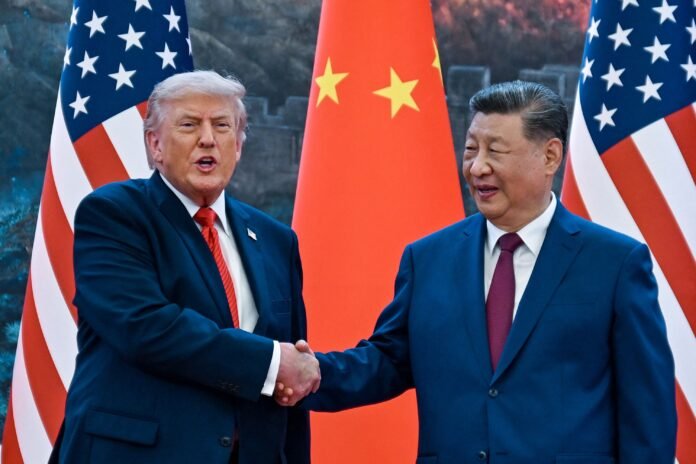
The Iran war has exposed a paradox at the heart of the emerging international order: American power can be weakened without an alternative power being ready to replace it. Washington has paid a substantial military and strategic price in the Gulf, while China has gained from the difficulties confronting its principal rival. Yet, Beijing has remained reluctant to assume the risks that would be required to shape the outcome. The result is not a post-American world, but a more uncertain and contested one.
The Gulf states have particular reasons to question the reliability of their traditional security arrangements. The war has disrupted regional economies, threatened energy flows and exposed the vulnerability of the infrastructure on which Gulf prosperity depends. They have also looked towards China, which has substantial economic and political influence in Tehran, to help bring the conflict to an end. Beijing, however, has shown little inclination to twist Iran’s arm at the cost of its own interests.

That hesitation matters. Saudi Arabia and other Gulf states are increasingly diversifying their external relationships rather than transferring dependence from Washington to Beijing. Saudi Arabia’s expanding defence and strategic ties with Turkey and Pakistan are part of this broader hedging. The calculation appears straightforward: if no outside power can reliably guarantee regional security, maintaining relationships with several major powers provides greater room for manoeuvre.
Declining American dominance in the Gulf has exposed a global leadership gap, as China benefits from US struggles but refuses to bear the burden of shaping regional security
For China, the strategic temptation to let the United States struggle in the Middle East is obvious. Beijing’s principal long-term competition remains with Washington, particularly in economic and technological capabilities and, increasingly, in military power in the Indo-Pacific. An America absorbed by a costly Middle Eastern conflict has fewer resources and less political attention available for the challenge posed by China.
The military costs are significant. Sustaining operations in the Gulf has placed additional demands on American aircraft, warships, missile-defence systems and precision munitions. The conflict has also highlighted the difficulty of rapidly replenishing sophisticated weapons once stocks are heavily drawn down. For Beijing, these are not merely operational difficulties. They provide an indication of the constraints on American power in a prolonged, high-intensity conflict.
China has also had little reason to believe that Washington’s economic pressure on Tehran would necessarily produce the desired political result. Iran has demonstrated considerable resilience under sanctions and military pressure. Its resistance reflects, among other factors, a deeply rooted determination not to accept external coercion. The comparison with North Korea is instructive, although the two countries are very different: decades of sanctions have not persuaded Pyongyang to abandon its core strategic choices.

China benefits from US distraction, yet remains caught in a tight spot: it relies heavily on Gulf energy stability and open maritime routes that Washington’s hegemony traditionally guaranteed
But Beijing’s response also reveals the limits of its ambitions. China has called for a ceasefire and negotiations and has used multilateral forums such as BRICS to advocate an end to hostilities. Xi Jinping has argued that the conflict has imposed severe losses on the people of the region and does not serve the common interests of the international community. Yet, diplomatic statements are not the same as assuming the political risks required to broker or enforce a settlement.
This restraint is partly explained by China’s economic interests. Beijing is the largest buyer of Iranian crude and has a powerful incentive to prevent an extended disruption of Gulf energy supplies. That interest has become more important as China’s economic growth slows and its dependence on external markets remains substantial. Years of building strategic petroleum reserves and diversifying suppliers have given Beijing some protection against temporary disruption. China’s practice of avoiding excessive dependence on any single supplier, including Russia, has also increased its room for manoeuvre.

But China’s energy position also exposes a fundamental contradiction. Beijing can benefit from instability that weakens Washington, yet it cannot escape the economic consequences of that instability. When Chinese buyers return to the market, they compete with Asian and European consumers for scarce supplies, contributing to upward pressure on prices. The war has also disrupted investment and economic linkages involving China and the Gulf in energy, green technology and artificial intelligence infrastructure.
Preferring indirect influence over regional stewardship, Beijing leverages technological and economic capabilities to raise American costs while avoiding the diplomatic risks of enforcing peace
The same contradiction exists at the strategic level. China wants greater autonomy from the United States, but its rise has depended heavily on the global trading system and access to Western markets and technology. It is expanding its naval capabilities, but it cannot yet guarantee the security of the maritime routes through which its energy and commercial interests flow in the Gulf. Nor does Beijing appear prepared to assume the financial, military and diplomatic burden of becoming the region’s principal security provider.
There are nevertheless signs of a more assertive Chinese role. Reports have alleged that Chinese entities provided satellite imagery that helped Iran target American positions. Such reports require caution: they do not establish that the Chinese government directed or authorised such assistance. But they illustrate a broader pattern. China can use its technological and economic capabilities to increase the costs for the United States without directly entering the conflict.
This may be the most revealing feature of China’s strategy. Beijing appears more comfortable exploiting the strategic opportunities created by American difficulties than undertaking the risks associated with resolving them. Its diplomacy can be consequential, but it remains selective and heavily conditioned by China’s own interests. That is different from possessing the capacity, willingness and legitimacy to provide an alternative international order.
The conflict accelerates the end of unipolarity, ushering in a fragmented international system where middle powers gain flexibility but navigate a far more unstable, uncertain global environment
China’s long-term objective is nevertheless clear enough. It seeks greater strength in advanced technology, artificial intelligence, critical minerals, military capabilities and economic resilience so that its dependence on others progressively declines. The goal is not necessarily to replace every American institution immediately, but to reach a position in which Chinese power cannot easily be constrained by external pressure.
The Iran war could accelerate that process by demonstrating the costs and limits of American power. But it also demonstrates why the transition will not be straightforward. China still needs stable energy markets, open trade routes and access to the global economy. A prolonged Gulf conflict threatens all three. Beijing therefore faces a strategic dilemma: it benefits from a relative weakening of American power, but it also depends on the stability of the system that American power has helped sustain.
For India, this distinction is important. The erosion of unquestioned American primacy should not be confused with the arrival of Chinese primacy. What is emerging instead is a more fragmented distribution of power in which the United States remains indispensable in some domains, China is increasingly influential in others, and middle powers have greater room to manoeuvre but also greater exposure to instability. The Iran war has therefore brought the world closer to a post-unipolar order, not yet to a post-American one.

The writer commanded 15 Punjab in Lebanon under United Nations Flag, commanded 27 Sector as DIG in Churachandpur and was Brigadier Operational Logistics in HQ Western Command. He is currently an analyst on geopolitics, international and defence affairs. The views expressed are personal and do not necessarily carry the views of Raksha Anirveda





