


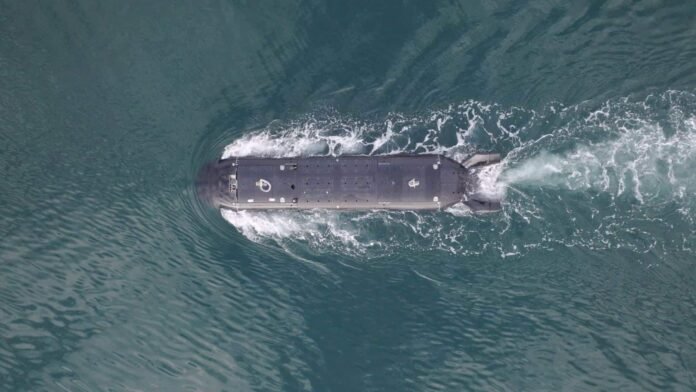
Britain’s Royal Navy has begun an extended testing programme for XV Excalibur, the largest uncrewed submarine it has ever operated, following a contract notice published on June 25 confirming a £6.68 million ($9 million) sea-trials deal signed on June 24, 2026.
The trials will run until May 2028 and were awarded directly to Plymouth-based manufacturer MSubs without competitive tender, on the grounds that the company, as Excalibur’s sole designer and builder, holds the specialised knowledge needed to operate it safely.

Measuring 12 metres long and displacing 19 metric tonnes – about 25 tonnes at full load – Excalibur is compact enough to fit inside a standard shipping container, yet it was designed from the outset to travel 1,000 miles per mission and to dive deeper than any of the Royal Navy’s crewed submarines, including its nuclear-powered Astute-class boats.
The vessel runs on battery-fed electric propulsion, with autonomy software from British firm MarineAI handling navigation and collision avoidance.
The Submarine Delivery Agency formally handed the vessel to the Royal Navy in December 2025 after completing acceptance trials, but its most striking demonstration came earlier, during the Talisman Sabre exercise in August 2025.
Royal Navy operators steered Excalibur while it was submerged in British waters entirely from a remote operations centre in Australia, more than 10,000 miles away – the first time the UK and Australia had shown this kind of long-distance interoperability under the AUKUS partnership’s advanced-capabilities pillar.

Australia has its own comparable programme, the Speartooth drone submarine effort, which has already supplied vehicles to the US Navy.
As it carries no crew, much of Excalibur’s hull is freed up for cargo. Its modular, carbon-fibre payload bay can hold up to five tonnes of equipment across roughly nine cubic metres of space, allowing sonar arrays, sensors, communications gear or other equipment to be swapped in and out between missions.

Naval officials have compared the concept to a delivery vehicle for undersea hardware rather than a fighting vessel in its own right, and both the Royal Navy and MSubs reportedly have their own payloads queued for testing over the coming months.
Excalibur also carried a quantum optical atomic clock, built by UK firm Infleqtion, on a recent voyage – reportedly the first time such a device has operated inside an underwater vessel at sea. Because GPS signals cannot reach submerged submarines, they rely on internal clocks to track position through dead reckoning; a more stable clock could let uncrewed submarines remain submerged and confident of their location for much longer stretches.
Officials stress that Excalibur remains a demonstrator rather than an operational warship, and it will not undertake combat duties. It has joined the Royal Navy’s Fleet Experimentation Squadron, and the lessons from its trials are expected to feed into Project CABOT, a Navy effort to build persistent submarine-hunting surveillance, as well as the broader Atlantic Bastion undersea-monitoring initiative launched in December 2025.
The programme’s cost reflects its experimental status: the original build contract, awarded in November 2022 and funded through the Navy’s Spearhead anti-submarine warfare initiative, was valued at £15.4 million – a fraction of the cost of a crewed attack submarine, which typically runs well over £1 billion.
The coming two years of trials will largely repeat earlier test routines on the larger hull and assess various payloads, with officials saying they intend to open future operation of the vessel to wider competition once its capabilities are better understood.






