


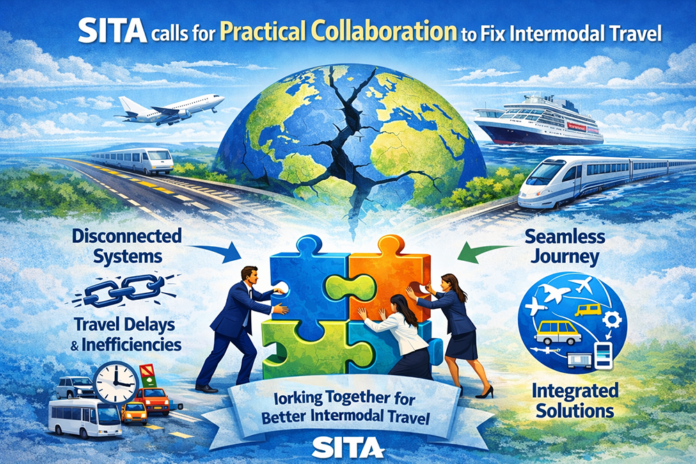
India – Intermodal travel succeeds when airports, airlines, rail operators, maritime operators, cities, and transport authorities work together to fix the points where journeys break down.
A new SITA white paper, Navigating the Seams of Seamless Travel, argues that collaboration around shared data and coordinated action is the most practical way to reduce passenger stress, cut inefficiency, and protect revenue.

Travel networks are expanding across air, rail, maritime, and urban transport. Yet the journey still breaks down at transfer points, where passengers move from one mode of transport to the next. Information is lost between operators. Accountability becomes unclear. Passengers manage missed connections and conflicting rules on their own. These gaps create operational blind spots across the entire travel system and quietly reduce revenue for operators.
From Fragmented Handovers to Coordinated Action
Fragmented transfer points increase risk as demand for intermodal travel rises in the coming decades. Disconnected systems create cascading disruption when delays occur. Limited data sharing across organisational boundaries prevents coordinated action at the moments that matter most.
The paper makes a clear case: progress does not depend on new infrastructure or another standalone platform. It depends on connecting what already exists. When operators share visibility of passenger flows, align disruption response, and provide one trusted, real-time view of the journey, passengers move with more confidence and operators make better decisions.
“Today, the journey breaks down at the handovers, and that is where value is lost for both passengers and operators,” said Benoit Verbaere, Director of Adjacent Markets at SITA. “Passengers are forced to act as their own coordinators, stitching together tickets, timetables, and rules just to reach their destination. When operators work together to provide one trusted, real-time view of the journey, stress is reduced and confidence, loyalty, and value return to the system.”

Turning Disruption into Informed Choice
A central theme of the paper is changing how disruption is handled. When connections are at risk, passengers should not be left guessing. Coordinated operators can offer clear alternatives in real time: continue the original journey, accept automatic rebooking, or switch modes, with responsibilities defined in advance. Disruption becomes managed choice, not uncertainty.
“Passengers remember how disruption is handled,” added Verbaere. “When they feel informed and supported, they come back. Intermodal collaboration is not about building another platform. It is about creating trust, governance, and shared ways of working so operators can act together when it matters.”

The paper sets out a practical framework that puts passengers at the centre of decisions. Solutions must provide clear, reliable information for different needs and levels of digital confidence and connect to existing systems through modular, interoperable design. This progress should start with focused pilots that prove value before scaling.
TravelWise Shows What is Possible
The Athens TravelWise initiative demonstrates this approach in practice. In the past, the airport, airline, port authority, and rail operator managed disruption through calls and manual processes. Today, an Intermodal Data Collaboration Platform brings together flight, train, ship, weather, and local event data into one shared operational view. Through dashboards and APIs, partners respond faster and give passengers clearer options when connections are at risk.
A Practical Path Forward
Rather than large-scale transformation programmes, the white paper calls for a staged approach focused on high-traffic corridors and major event transport networks. It invites industry stakeholders to identify one breakdown point in the journey, bring the right partners together, and use governed data sharing to turn fragmentation into coordinated, value-creating travel. This approach builds trust and delivers measurable improvements in disruption handling, operational.






