


Traditional jet engine manufacturing has long stood as one of the most complex, time-consuming and cost-prohibitive challenges across the defence industrial base. Conventional turbine construction relies on intricate casting processes, hundreds of individually machined components and sprawling, fragile supply chains. As the US Department of Defence prioritises low-cost, mass-producible uncrewed systems to counter evolving global threats, legacy engine production methods have struggled to keep pace.
Beehive Industries, a defence technology firm founded in 2020, is actively dismantling this bottleneck by designing small jet engines engineered explicitly for metal additive manufacturing (3D printing). By consolidating hundreds of discrete mechanical parts into single, unified printed components, Beehive slashes design-to-test timelines by 75% and reduces engine production costs by nearly 60% compared to legacy architectures.

The Frenzy Engine Family Enters Full-Rate Output
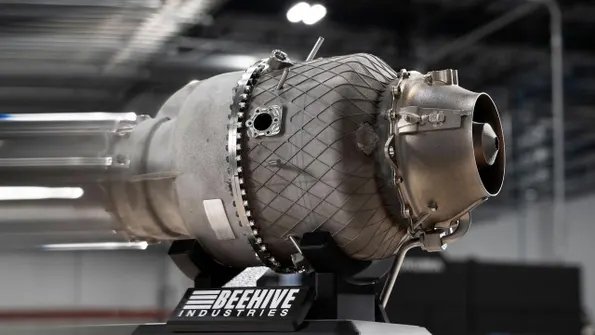
At the centre of Beehive’s industrial surge is its Frenzy family of small turbojet engines. Engineered specifically to power low-cost cruise missiles, loitering munitions and autonomous strike drones, the Frenzy series delivers thrust options ranging from 100 to 300 pounds-force (lbf).
The system reached a major milestone after completing rigorous vacuum-chamber testing simulating altitudes of 35,000 feet. This technical validation led to a $29.7 million US Air Force contract designed to accelerate vehicle integration, flight testing and final qualification for programmes like the Extended Range Attack Munition (ERAM) and Family of Affordable Mass Missiles (FAMM).
“Frenzy is entering full-rate production, and our customers need engines now,” noted Darius Ehteshami, Chief Operations and Finance Officer at Beehive. “This transition gives us immediate precision capability and operational experience to scale with confidence, at the speed the modern warfighter demands.”
Scaling Ohio Infrastructure for High-Volume Output
To transition from prototype success to industrial-scale delivery, Beehive announced a $70 million expansion in Southwest Ohio. The investment will create over 200 high-skilled manufacturing and engineering jobs in the region, establishing a dedicated ecosystem to support high-volume defence output.

This expansion follows a series of strategic moves by the company to build a vertically integrated American supply chain:
- Printer Fleet Expansion: Beehive executed the largest single purchase of EOS metal additive manufacturing printers to date, while also adding multi-unit Nikon SLM Solutions NXG 600E systems – more than doubling its overall printing capacity.
- Machine Shop Acquisitions: The company acquired Greater Cincinnati precision machining stalwarts Able Tool Corporation and Planet Products Corporation, bringing over 120 years of collective machining expertise into Beehive’s Production Machining Center of Excellence.
- Dual Centres of Excellence: Operations are structured around a high-volume machining hub in Ohio paired with an additive manufacturing center in Knoxville, Tennessee, dedicated to metal printing and post-processing.
Combined, these investments create a system capable of outputing more than 8,000 jet engines annually from a footprint far smaller than traditional manufacturing plants.

A Sustainable Model for Mass Munitions
As defence analysts emphasise the need to rapidly replenish munition stockpiles depleted by recent global conflicts, Beehive’s additive manufacturing model offers a scalable blueprint for national security. By pairing advanced 3D printing with in-house precision machining, the company ensures that America’s next generation of autonomous aerial fleets will have the propulsion required to deploy at scale.






