


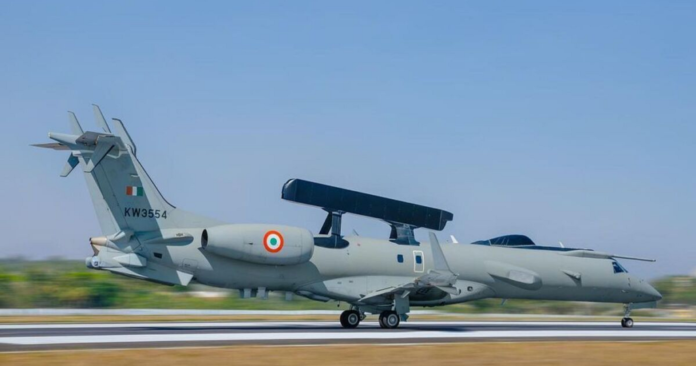
New Delhi: India’s decision to induct six additional Netra MK-1A airborne early warning and control aircraft represents a critical turning point in its pursuit of battlespace awareness along two nuclear-armed frontiers. This expansion triples the operational Embraer-based AEW&C fleet from three to nine aircraft, directly addressing a surveillance shortfall that has constrained Indian force projection since the Balakot-era engagements against Pakistan.
The most consequential upgrade lies in the transition from gallium-arsenide to gallium-nitride semiconductor technology within the dorsal AESA radar. GaN modules sustain higher power density and operate at elevated temperatures, enabling greater radar output without thermal failure. This translates into detection ranges extending from 250–300 kilometres under the MK-1 baseline to 350–450 kilometres in the MK-1A, with extended claims surpassing 475 kilometres against larger targets.

The radar’s improved jamming resistance and enhanced sensitivity to low-observable threats such as stealth aircraft, cruise missiles, and swarming drones are particularly vital given Pakistan’s reported interest in acquiring Chinese J-35A stealth fighters.
The MK-1A retains a 240-degree radar coverage arc, a limitation compared to rival systems, which explains India’s parallel pursuit of the larger Netra MK-2 program on Airbus A321 airframes. The MK-1A’s electronic warfare suite strengthens self-protection against anti-radiation missiles, while real-time data-link integration with Tejas, Su-30MKI, and ground-based networks transforms it into a distributed node within India’s emerging network-centric warfare architecture.
Approval of six additional MK-1A aircraft by the Defence Acquisition Council and Cabinet Committee on Security represents a rare tripling of fleet size within a single procurement cycle. Estimated costs of ₹9,000–12,000 crore ($1.1–1.5 billion) reflect radar development, airframe modification, and systems integration. Deliveries are expected to begin in 2027, with full integration extending into 2028. Indigenous content of 90–95 percent aligns with the Aatmanirbhar Bharat agenda, reducing dependence on the Israeli Phalcon AWACS fleet, which remains India’s only 360-degree long-range AEW&C capability.
A key unresolved issue is platform sourcing. The original MK-1 programme relied on Embraer ERJ-145 regional jets, but production has ceased, forcing reliance on used airframes. Embraer has proposed the newer Praetor 600 business jet, offering superior endurance, range, and service ceiling.

Adoption would extend station time and radar line-of-sight but requires fresh certification, introducing schedule risks. This platform dilemma remains one of the most consequential variables in the MK-1A programme.
Operational lineage strengthens the case for expansion. Netra aircraft supported surveillance during the 2019 Balakot strikes and Operation Sindoor in May 2025, where a MK-1A test-bed reportedly validated next-generation sensor performance under live electronic warfare conditions.

Final Operational Clearance for the MK-1 fleet in June 2026 freed resources for MK-1A integration and MK-2 development. While specific performance figures remain unverified, combat employment signals to Islamabad and Beijing that India’s airborne sensor architecture has matured into battlefield utility.
Strategically, the expansion narrows but does not eliminate India’s surveillance asymmetry. Pakistan’s nine to thirteen AEW&C aircraft now face a qualitative counterweight, while China’s twenty to thirty KJ-500 AWACS continue to outnumber India’s fleet.
The MK-1A’s GaN-enabled range and jam resistance allow fewer Indian aircraft to generate proportionally greater coverage, countering stealth proliferation and strengthening network-centric warfare capabilities.
Export marketing of Netra-derived technology to nations such as Vietnam and the Philippines underscores India’s intent to extend radar diplomacy as a counterweight to Chinese influence.
Nevertheless, risks remain. Airframe sourcing uncertainty, integration timelines stretching into 2028, and the unresolved ERJ-145 versus Praetor 600 debate introduce execution challenges. Even with nine Embraer-based aircraft and a future MK-2 fleet, India’s inventory remains smaller than China’s.
The Netra MK-1A expansion should therefore be seen as a meaningful but incremental strengthening of India’s airborne domain awareness, reshaping tactical decision cycles without resolving the broader structural imbalance in South Asian and Indo-Pacific air power.






