


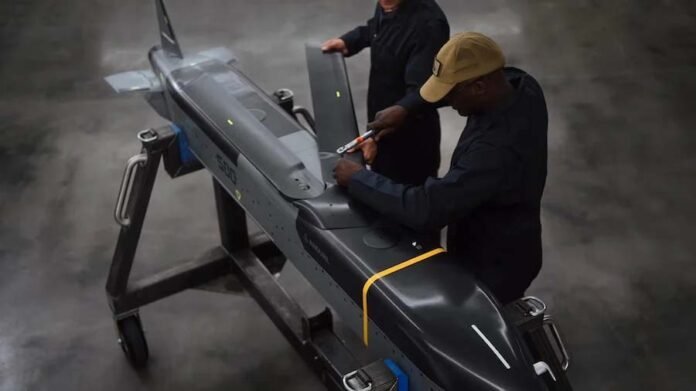
Anduril Industries has announced that its Barracuda-M cruise missile family is the first weapon, already in large-scale production, to complete independent verification under the US Air Force’s Weapon Open Systems Architecture, or WOSA, standard.
The milestone was achieved through a four-day assessment conducted by the Air Force Research Laboratory’s Munitions Open Architecture Test and Evaluation Laboratory, known as MOATEL. The test examined whether the weapon’s software and hardware architecture met WOSA requirements across 14 technical areas.

The assessment included mission autonomy, seekers, GPS, propulsion, airframe control, autopilot, guidance, navigation and the Munitions Data Bus. It also demonstrated compatibility between Anduril’s internal and external Munitions Data Bus implementations, a result designed to support quicker software upgrades and the reuse of components across weapon platforms.
The verification is significant because it was performed independently by a government laboratory rather than being based solely on the manufacturer’s own compliance assessment. Jonathan Shaver, the WOSA programme manager and its creator at AFRL’s Air Warfare Directorate, said open architecture has value only when it can be independently verified.
WOSA is part of the broader US defence push towards modular open systems. Its purpose is to establish common interfaces between major weapon subsystems, including seekers, navigation equipment, software and payloads. Instead of requiring a complete redesign when one component is replaced, an open architecture can allow individual elements to be upgraded or integrated more quickly.
That approach could help military programmes respond to changing threats and technology cycles. A missile designed around tightly integrated proprietary components may require lengthy testing and engineering whenever a new sensor, processor or guidance system is introduced. A modular weapon, by contrast, is intended to provide a more flexible route for future improvements.

Anduril said production of Barracuda is already under way, with initial customer deliveries planned for early 2027. The company expects annual output to reach several thousand systems over the next few years. It is also under contract to provide multiple Barracuda variants to customers across the US Department of War.
The Barracuda family is being developed as an affordable, mass-producible group of cruise missiles and autonomous air vehicles for different missions. Earlier testing of the Barracuda-500, selected for an Air Force and Defence Innovation Unit project, demonstrated vertical launch, autonomous navigation, target identification through Anduril’s Lattice software and terminal guidance. The programme also included plans to test autonomous teaming, simultaneous launches and in-flight communication between systems.

The new verification comes as the US military seeks to produce weapons at greater speed and scale while reducing dependence on complex, closed supply chains. Recent conflicts have highlighted the importance of affordable precision weapons, autonomous systems and the ability to replace or upgrade components quickly in response to battlefield conditions.
The result could also affect future procurement. An independently verified architecture may make it easier for government programme offices to evaluate competing technologies and integrate equipment from different suppliers. It may reduce the technical and scheduling risks associated with adding new capabilities, although operational testing, procurement decisions and field performance will remain separate questions.
Pat Morris, Anduril’s vice president of Advanced Effects, said the company’s modular design had been tested rather than merely described in principle. The verification therefore represents both a technical milestone for Barracuda and a broader test of whether open-architecture principles can move from acquisition policy into high-volume weapons production.
If deliveries begin as planned, Barracuda will become an early example of a production weapon designed to evolve through software and modular hardware rather than lengthy redesigns. For the Air Force, that flexibility could prove as important as the missile’s initial performance.






