

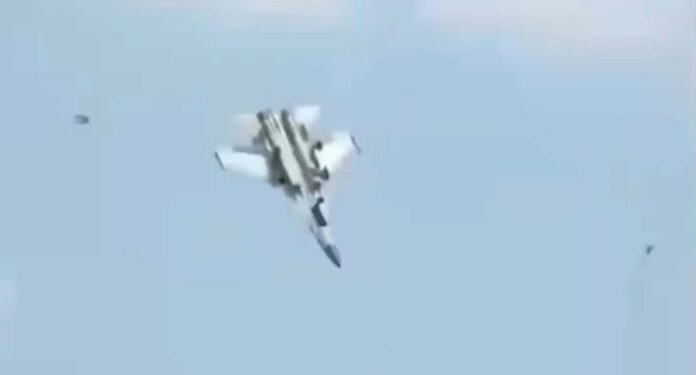
New Delhi: Two back-to-back crashes of Pakistan Air Force (PAF) aircraft—first a Chinese-made JF-17 Thunder near Kamra on May 19, 2026, followed by an FT-7PG trainer near Mianwali on May 20 – have reignited serious concerns about the reliability of Chinese-origin jets in Pakistan’s fleet.
Both incidents involved technical malfunctions, with pilots ejecting safely but sustaining injuries, and no civilian casualties reported.

The first incident occurred near the Pakistan Aeronautical Complex in Kamra, where a JF-17 Thunder fighter jet went down during a routine training mission. Reports indicate the aircraft suffered a suspected technical malfunction mid-flight.
Both pilots managed to eject before impact, though they sustained serious injuries and required immediate medical attention. Emergency response teams and local residents rushed to the site, where thick smoke was seen rising from the wreckage.
Videos circulating online captured the jet moments before the crash, followed by parachutes descending. Authorities confirmed that no civilian casualties occurred, which prevented further escalation on the ground.
The JF-17 Thunder is developed by China’s Chengdu Aircraft Corporation. It is a lightweight, single-engine multirole fighter designed for interception, ground attack, anti-ship missions, and reconnaissance.

Pakistan has marketed the JF-17 as the backbone of its air power, but this crash has added to a growing list of incidents involving Chinese-origin aircraft. Reports suggest this may be the seventh such crash in recent years, raising questions about avionics reliability, radar performance, and maintenance burdens.
Analysts argue that while the JF-17 was intended to replace ageing aircraft in Pakistan’s inventory, recurring technical failures have undermined confidence in its operational safety.

Barely a day later, on May 20, 2026, a Pakistan Air Force FT-7PG trainer aircraft crashed near Mianwali. The FT-7PG, also of Chinese origin, is used for advanced pilot training. Initial reports suggest the aircraft encountered a technical snag during a training sortie. The pilot ejected safely, though injuries were reported.
Once again, no civilian casualties occurred, but the incident has amplified concerns about the reliability of Pakistan’s China-dependent fleet. The FT-7PG, a derivative of the Chinese F-7, a derivative of the Soviet Mikoyan-Gurevich MiG-21, has long been criticised for its dated design and limited safety record. This crash adds to the perception that Pakistan’s reliance on Chinese aircraft is exposing its air force to repeated operational risks.
Together, these back-to-back crashes have sparked debate within defence circles about Pakistan’s procurement strategy. Critics argue that while Chinese aircraft offer affordability and political alignment, they come with significant trade-offs in terms of reliability and long-term sustainability.
Maintenance protocols, spare parts availability, and technical support have all been highlighted as weak points. The incidents also raise questions about Pakistan’s ability to sustain high operational readiness in a region marked by intense security competition.
Observers note that these crashes could have wider implications for Pakistan’s defence cooperation with China. With Pakistan already planning to induct advanced J-10C and J-35 stealth fighters, the safety record of existing Chinese aircraft may influence perceptions of future acquisitions.
The timing of these incidents, occurring within 24 hours of each other, has intensified scrutiny and fuelled speculation about systemic issues in Pakistan’s air fleet.






