


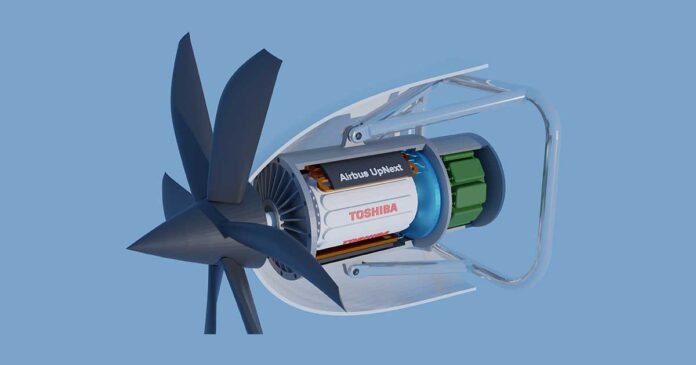
Tokyo – Airbus UpNext, a wholly-owned subsidiary of Airbus, and Toshiba Energy Systems & Solutions Corporation (Toshiba), Toshiba Group’s energy arm, will cooperate and mutualise experience on superconducting technologies for future hydrogen-powered aircraft.
In the quest to decarbonise the aviation industry, hydrogen-powered aircraft are one of the promising solutions to achieve net zero emissions by 2050. Superconducting technologies offer a unique advantage for these aircraft, using -253°C liquid hydrogen as a fuel but also to efficiently cool the electric propulsion systems. Cryogenic technology could allow for a nearly unimpaired power transmission within the electric systems of the aircraft, significantly improving their energy efficiency and performance.

“Partnering with Toshiba presents a unique opportunity to push beyond the limitations of today’s partial superconducting and conventional electrical motors. Through this collaboration, we aim to deliver a breakthrough technology that could unlock new design possibilities, in particular for Airbus’ future hydrogen-powered aircraft. This partnership represents a natural and essential step in advancing superconducting motor technology to meet the needs of the aerospace industry, ” said Grzegorz Ombach, Airbus Senior Vice President and Head of Disruptive R&T.
“Toshiba’s expertise in superconducting technology for high current flow, motor drive technology for precise current control, and advanced rotating machinery technology for stable, high-speed operation, forms a strong foundation for this partnership. We both recognize the tremendous potential of superconducting technologies in shaping the future of aircraft and driving the decarbonisation of the aviation industry. We are confident that our collaboration with Airbus will play a key role in advancing next-generation technologies for the aerospace sector,” said Tsutomu Takeuchi, Toshiba’s Corporate Officer, responsible for Power Systems business, and Director of Toshiba Energy Systems & Solutions Corporation.
The partners aim to co-develop a two-megawatt superconducting motor.
The agreement was signed in Tokyo, on the occasion of Japan Aerospace 2024, by Dr Grzegorz Ombach, Airbus Senior Vice President and Head of Disruptive R&T, and Tsutomu Takeuchi, Toshiba’s Corporate Officer, responsible for Power Systems business, and Director of Toshiba Energy Systems & Solutions Corporation. They were joined by Ludovic Ybanez, Airbus Head of Cryoprop demonstrator and Cryogenics technology, Airbus UpNext and Kensuke Suzuki, Head of New Technology, Power System Division, Toshiba Energy Systems & Solutions Corporation.

Over the past 10 years, Airbus has made efforts to derisk superconducting technologies. Recently, Airbus UpNext launched Cryoprop, a demonstrator to test a two megawatt-class superconducting electric propulsion system. Toshiba has been conducting research and development of superconducting technology applications for nearly half a century and has released its own two megawatt-class superconductivity motor prototype for mobility applications in June 2022.
The Airbus Tech Hub Japan was announced in May 2024. This initiative is designed to develop partnerships in the country to advance research, technology and innovation in aerospace and push boundaries to prepare for the next generation of aircraft. The partnership between Toshiba and Airbus is the first achievement of this ambition in Japan.

@Airbus @AirbusUpNext @Toshiba #superconductivity #hydrogen #decarbonisation #JA2024

Raksha Anirveda's editorial desk team brings in the collective experience of creative professionals - a fine mix of senior copy editors, writers, proofreaders and designers. Working as a team, they continuously create, manage, and curate content to sustain the magazine's profile and reputation in line with market trends and achieve magazine's goal.





