


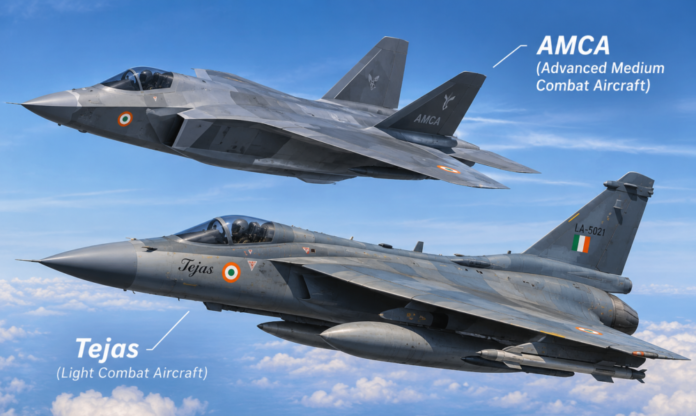
New Delhi. Air Chief Marshal Ashutosh Dixit, who took over as the Indian Air Force’s 29th Chief of the Air Staff on October 31, has placed the Tejas Light Combat Aircraft Mk-1A and Mk-2, the Advanced Medium Combat Aircraft (AMCA), and Indian weapons and sensors among the service’s “highest priority” programmes.
In his first public address as IAF chief on November 1, Dixit said restoring combat strength towards its sanctioned level would be his “foremost task”. “We will fight with Indian solutions, and we will hold them in numbers that meet our operational demands,” he said, linking domestic production to both the force’s ability to fight and its capacity to deter conflict.

Dixit’s priorities are framed by “VAYU”: Vigilance and readiness, Aatmanirbharta, Yukti, or ingenuity, and Unity of effort. He said every squadron, radar, air-defence unit and air warrior must be prepared to respond at short notice. The IAF must also adapt to warfare reshaped by drones, long-range precision weapons, space, cyber capabilities, artificial intelligence and the electromagnetic spectrum.
The emphasis on indigenous platforms comes as the IAF faces a significant gap between its current fighter force and its sanctioned strength. The service has 29 fighter squadrons against a sanctioned 42.5, according to reporting on Dixit’s priorities. His predecessor, Air Chief Marshal AP Singh, had also warned that timely aircraft induction was essential to arrest the decline.
The Tejas Mk-1A is the near-term priority, but its induction schedule has slipped. The IAF has 180 aircraft on order from state-owned Hindustan Aeronautics Limited (HAL), across two contracts. Delays in engine supply and aircraft integration have pushed back deliveries, putting pressure on plans to replenish the fighter fleet. The Mk-1A is an upgraded light combat aircraft; it is not the stealth fighter.
That distinction belongs to the AMCA, India’s planned fifth-generation stealth combat aircraft. Alongside it, the Tejas Mk-2 represents a further development of the indigenous fighter programme. Both are longer-term projects: the IAF needs the Mk-1A to arrive soon, while the Mk-2 and AMCA are intended to contribute to future combat capability.

Under “Yukti”, Dixit identified networked, AI-enabled command and control, layered counter-drone defences, responsive maintenance and force protection as areas for continuing attention. He also cited near-space as an operational domain. The priorities indicate that modernisation will involve more than buying aircraft: sensors, weapons, information systems and support infrastructure must work together to deliver combat capability.
Dixit also called for closer cooperation with the Army, Navy and national agencies, saying air power is most effective when integrated from the outset of planning. He tied this to the broader “JAI” vision-Jointness, Aatmanirbharta and Innovation-and said the IAF would plan and operate as part of a coordinated national effort.

The immediate challenge is execution: bringing aircraft into service in sufficient numbers while developing the next generation of indigenous systems. HAL’s delivery schedule, the maturation of the Mk-2 and AMCA programmes, and progress on Indian weapons and sensors will shape how quickly the IAF can convert Dixit’s priorities into operational strength.
His message balances urgency with ambition. The IAF must remain ready to respond now, while building a force equipped for the next decade. Indigenous platforms are central to that plan, but their strategic value will depend on timely delivery, reliable performance and the ability to sustain them at scale.






