


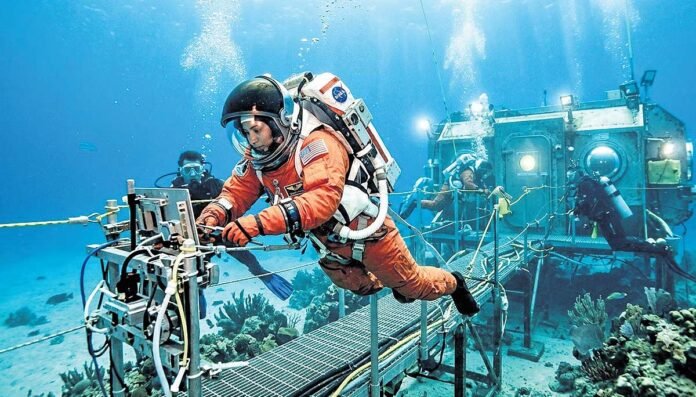
Aaka Space is preparing a two-stage underwater human-spaceflight analogue programme, beginning with a 24-hour trial in a controlled environment in Gujarat in December. A second, 72-hour mission is planned for March 2027, though its location has not been decided. The company says the project will examine how people and habitat systems perform in conditions that share some features with space missions.
The planned habitat is intended to recreate selected operational, physiological and psychological pressures associated with human spaceflight. These include isolation, confinement, restricted movement, reliance on engineered life-support systems and the need to carry out tasks in an unfamiliar environment. Researchers may also monitor human responses such as fatigue, stress, sleep patterns, cardiovascular and respiratory changes, and cognitive performance.

Underwater missions can help researchers assess how crews work together and how habitats, procedures and support systems perform during prolonged confinement. They do not, however, reproduce space in full: underwater pressure and buoyancy differ from the vacuum and microgravity of orbit. The value of an analogue lies in simulating particular challenges under controlled conditions, not in treating the environment as a complete substitute for space.
Aaka Space founder and chief executive Astha Jhala said the programme is intended to create a “high-fidelity habitat” for studying these challenges. The company previously conducted the Ladakh Human Analog Mission. It plans to work with the Indian Space Research Organisation and sign an agreement with the Indian Navy for the underwater initiative.
The project comes as India develops human-spaceflight capability through Gaganyaan and pursues plans for the Bharatiya Antariksh Station. The Union Cabinet’s 2024 approval expanded the Gaganyaan programme to include development of the station’s first module and technology-validation missions; the government’s stated vision is to establish an operational station by 2035.
The underwater work could also have relevance to Samudrayaan, India’s human deep-ocean exploration programme. Its Matsya-6000 submersible is being developed to carry three people, with life-support, navigation and communication systems designed for deep-sea operations. The Ministry of Earth Sciences has identified the National Institute of Ocean Technology as the agency developing the vehicle.

The overlap between space and ocean exploration is not new. NASA’s NEEMO programme has sent crews to live in an undersea research station, using the remote setting to simulate aspects of space exploration and test procedures. Its experience illustrates why underwater habitats can serve as research platforms: they combine isolation, operational demands and the need for careful planning.
For Aaka Space, the first trial will be a test of both the habitat and the research plan. A 24-hour deployment can provide an initial opportunity to examine life-support performance, crew routines and monitoring arrangements; the planned 72-hour phase would extend the period of confinement. The details of the crew, specific experiments and operating protocols have not been announced.

The mission’s significance will ultimately depend on what the trials measure and demonstrate. Data on human performance and habitat operation could inform future research, but results will need to be assessed before their practical contribution to astronaut training or deep-sea missions becomes clear.
If carried out as scheduled, the programme would add an underwater component to India’s growing portfolio of human-exploration research. It also reflects an increasingly collaborative landscape, where startups, public agencies and research organisations may contribute different expertise to the preparation for missions beyond familiar environments.






