


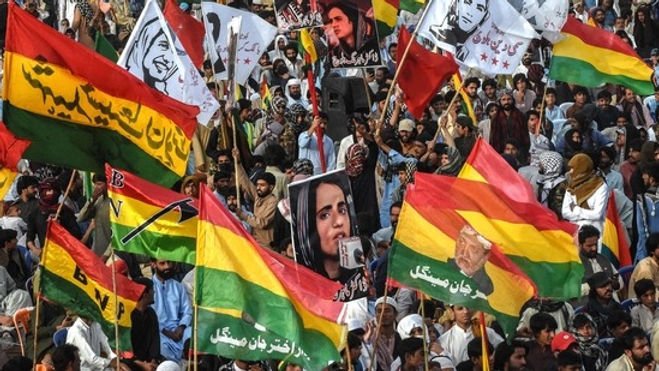
The death knell for the idea of Pakistan may be sounded not from areas outside its borders, but from the occupied part of Jammu and Kashmir and Balochistan – a reality that now appears to be haunting the country’s civilian and military leaders sitting in Islamabad and Rawalpindi.
For years, they ignored warning signs, dismissing the simmering discontent that was steadily building under the surface in both regions. Today, those neglected fault lines are becoming increasingly difficult to contain.

And it is visible in Pakistan-occupied Jammu & Kashmir (PoJK), where situation has turned from bad to worse with videos and photographs circulating on social media show people in Rawal Kot, Bagh, Muzaffarabad, Neelum Valley, Mirpur, Kotli and Bhimber challenging the might of Pakistan through protests and rallies despite facing heavy handed military crackdown.
According to media reports, more than 600 people have been arrested, dozens of people killed and hundreds injured in the Pakistani army’s crackdown against people in the region, which is under fresh wave of turbulence since the first week of the last month.
Protests have spread across towns like Muzaffarabad, Mirpur and Bagh, with reports of hundreds arrested and casualties mounting amid a harsh military response to demands for autonomy and reform in PoJK
Unofficial estimate put the death toll over 400 as military action continues unabated in PoJK, which has been hit by a fresh wave of strikes since June 9 over non-fulfilment of people’s multiple demands, including abolition of 12 reserved seats in the PoJK Legislative Assembly, greater administrative and financial autonomy, protection of civil liberties, judicial and governance reforms.
Growing calls for PoJK’s independence
Facing severe human rights abuse along with political and economic marginalisation for years, PoJK residents are also fighting against food and economic blockade that Pakistan has imposed to suppress their dissent – a situation reminiscent of East Pakistan when Islamabad had imposed unrestrained economic and food blockades, prior to the Bangladesh liberation war in 1971, in an attempt to force the population into submission.

Residents describe blockades on food, electricity and communications that observers compare to tactics used in East Pakistan before Bangladesh’s independence, fuelling growing separatist sentiment
Experts say it is very difficult to speculate how the situation will unfold in PoJK in the coming days. But people in the region allege being subjected to brute atrocities such as cut in electricity, food and drinking water supply, freeze on internet, mobile and landline services, thereby intensifying public voice for PoJK’s independence from Pakistan.
Already, in the storm of eye globally for its unprecedented human rights abuse of Baloch nationals and minorities, years of unmitigated discriminatory approach against PoJK residents have exposed Pakistan and its institutions, which are filled with religious zealots.

Stating that “the Pakistani government’s policies and institutions have become deeply sectarian,” Farahnaz Ispahani, the former member of Pakistani parliament, in her write up for Hudson Institute said, “Things have become worse in the past few decades due to a combination of factors. These include years of radicalisation of Pakistani society…in the name of Islam.”
Despite this, if Pakistan’s institutions, including its military, have become increasingly radicalised in the name of Islam, why are the people of PoJK – 99% of whom adhere to Islam, are still denied equal rights, dignity, and justice? In fact, the Pakistani establishment, with its decision makers sitting in Islamabad and Rawalpindi, has deliberately kept PoJK outside the formal constitutional framework in the name of a future plebiscite all the while exercising extensive control over the region.
The Baloch Liberation Army has claimed responsibility for major attacks on security forces in 2026, continuing a sharp rise in violence that data trackers labelled 2025 as the deadliest year yet
Result is, PoJK residents find themselves in a prolonged political and economic crisis; they feel being denied their rights for a meaningful participation in decision-making on issues affecting their political future, governance and natural resources. This has raised fundamental questions about the gap between Pakistan’s commitment to Islamic solidarity and the realities on the ground in PoJK.
Widespread resentment against Punjabi-dominated state control
Experts attribute Pakistan’s growing internal instability to the dominance of the Punjabi-dominated state apparatus and its interference in everyday affairs of the country. They argue that concentration of power in Islamabad and Rawalpindi, coupled with ongoing political and economic discrimination of people in PoJK, Balochistan and other parts of Pakistan, is the reason behind the current turbulence in the country.
Deteriorating security situation in Balochistan illustrates the depth of the crisis. On July 3, the Baloch Liberation Army (BLA), a banned separatist group, claimed responsibility for killing more than 30 Pakistan Coast Guard personnel in Jiwani in Gwadar district of Balochistan.
Analysts point to Islamabad and Rawalpindi’s concentrated authority, dominated by Punjabi elites, as a core driver of alienation in both PoJK and Balochistan
Earlier on June 28, the BLA claimed to have killed 13 Pakistani security personnel by launching coordinated strikes on two military camps in the Ziarat area. In April, BLA carried out 27 attacks in Pakistan, killing at least 42 military personnel.
These incidents speak volumes of the persistence of insurgency and deep-seated grievances that continue to fuel it. Baloch nationals have over the years complained about enforced disappearances, extra-judicial killings, state repression, political marginalisation and the exploitation of the province’s abundant natural resources by the Pakistani establishment without providing any benefit to locals.
As these grievances remain unaddressed, the insurgency has become more entrenched in Balochistan. For instance, in 2025, the BLA claimed 521 attacks and 1,060 security force fatalities. On March 11, 2025, giving challenge to the Pakistani establishment, BLA fighters hijacked Jaffar Express, a passenger train travelling from Quetta to Peshawar with at least 380 passengers on board.
Similarly on January 8, 2025, Baloch insurgents seized control of the whole of Zehri town in Khuzdar district of Balochistan for around eight hours, and set on fire multiple government buildings, including municipal committee offices and a bank.
Experts argue that without constitutional reform, equitable resource sharing and human rights protections, unrest in these regions will keep deepening rather than fade away
Data compiled by the US-based non-profit organisation, the Armed Conflict Location & Event Data Project, shows a sharp increase in Baloch insurgent’s led violence over the past five years, with incidents of fatalities rising by 60% in 2025, considered to be the deadliest year.
Experts argue that so long as the Pakistani establishment, controlled by Punjabi dominated politicians and military leaders, continues to ignore genuine demands of Baloch people and instead resort to their brutal repression, insurgency will never end in Balochistan.
They fear that growing public resentment against the establishment fuelled by Pakistan’s abhorrent discriminatory approach towards this province and its people may one day result in its secession from the country.
Overall, the ongoing unrest in POJK and years long insurgency in Balochistan point to deeper structural challenges confronting Pakistan. So long as Islamabad and Rawalpindi continue to resort to coercive measures while ignoring demands for greater political participation, equitable resource sharing, constitutional safeguards and respect for human rights, the alienation in both regions is likely to deepen further.

The writer is a senior journalist with wide experience in covering international affairs. The views expressed are of the writer and do not necessarily reflect the views of Raksha Anirveda





