


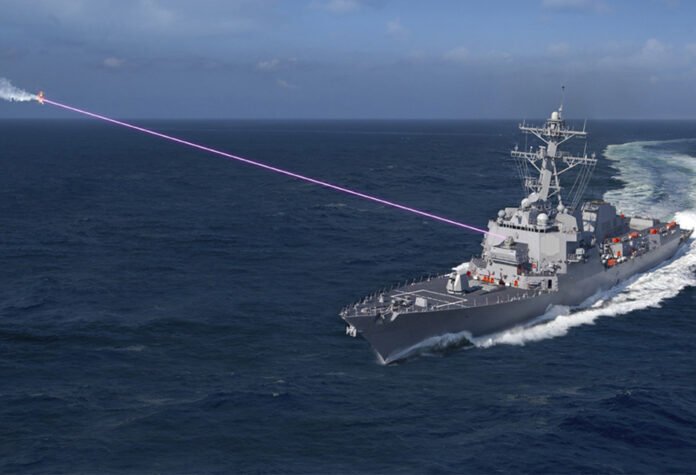
Washington: The US Navy is planning for its next-generation destroyer, currently known as the DDG(X), to feature directed-energy weapons and more capacity to carry and launch missiles.
According to a report this month from the Congressional Research Service, the service is requesting $133.5 million in research and development in its proposed fiscal 2026 budget to manufacture the DDG(X), which it hopes to procure in the early 2030s.

The design for the DDG(X) is larger than previous proposals, with the report noting that it now calls for the ship to have a displacement of 14,500 tons, representing a boost of 1,000 tons from the design put forth in the Navy’s shipbuilding plan for fiscal 2024.
The report questions how an enlarged design would be consistent with the Navy’s stated aim of transitioning to a modernised fleet featuring smaller vessels.
To modernise the fleet and cut costs, the Pentagon has been turning to autonomous vessels, and the Navy recently integrated small unmanned surface vessels into a major Baltic Sea exercise.
The DDG(X) is intended to replace what are called “Aegis destroyers,” which include the Ticonderoga-class cruisers and Arleigh Burke-class destroyers. They are known as “Aegis destroyers,” because they feature the Aegis Combat System, described by the Navy as “the first fully integrated combat system built to defend against advanced air and surface threats.”

The first version of the Aegis was operationally tested in 1973, and the first cruiser equipped with Aegis, the Ticonderoga, was commissioned in 1983. The Arleigh-Burke class came into being as a smaller destroyer featuring an updated Aegis system, with the first ship of this class commissioned in 1991.
There are still 22 Ticonderoga-class cruisers procured between fiscal 1978 and 1988 in the US fleet, including ships that entered service between 1983 and 1994.

“The Navy began retiring the remaining 22 ships in FY2022 and wants to retire all 22 by the end of FY2027,” according to the CRS report.
Like past destroyer designs, the DDG(X) will feature elements of the Aegis combat system design. The DDG(X) will have increased cruising range and hold 96 standard Vertical Launch System cells, with an ability to replace 32 of these with 12 missile launch cells.
It will also feature a power system able to support the deployment of directed energy weapons. These use electromagnetic energy to inflict damage and can include lasers, microwaves or particle beams.
The Navy also hopes that the cruisers will produce less underwater noise while at sea, and thus have “reduced vulnerability due to reduced infrared, acoustic and underwater electromagnetic signatures.”






