


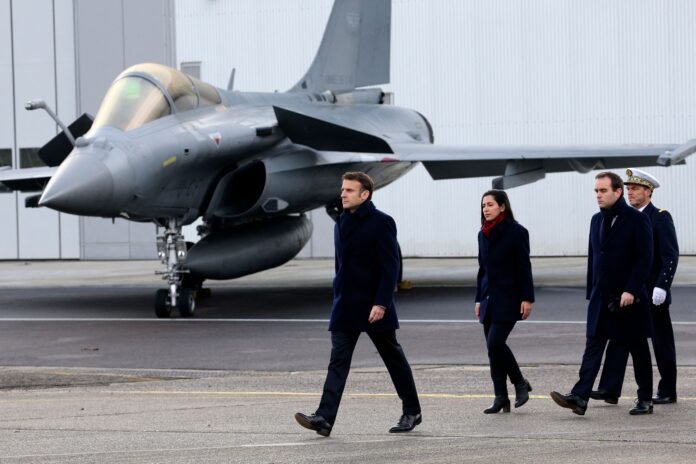
PARIS. In a milestone development for modern collaborative combat, aerospace giant Dassault Aviation and defence technology specialist Harmattan AI have announced the successful flight test of a standard Rafale F4 fighter jet actively coordinating with an uncrewed aerial vehicle (UAV). The exercise showcased a revolutionary breakthrough in electronic warfare (EW) capabilities, presenting a formidable shift in how multi-layered, heavily contested air defences can be penetrated without relying strictly on stealth airframes.
The centerpiece of the test sortie was the debut of the “Namib” payload – a state-of-the-art electronic warfare device jointly developed by Dassault and Harmattan AI. Mounted onto a lightweight autonomous tactical drone, the Namib payload was deployed to discreetly detect, identify, and geolocate electromagnetic emissions originating from ground-based air defence radar networks.

During the demonstration flight, the drone successfully mapped and calculated the coordinate data of a mock hostile radar unit located several dozen kilometres away. Crucially, the drone then securely streamed this live targeting information back to the trailing Rafale F4 platform. Leveraging its updated networked combat systems, the Rafale received the data and successfully executed a simulated precision strike on the pinpointed threat.
The newly qualified Rafale F4 standard represents a major evolutionary leap for the French aircraft, transforming it from an individually optimised multirole platform into a highly connected node within a decentralised “system of systems”.
Initiated in January 2026, the development of the Namib payload is one of the core pillars of the broader strategic partnership forged between Dassault Aviation and Harmattan AI. The alliance aims to systematically integrate advanced, machine-learning-driven autonomy into Europe’s current and next-generation air combat frameworks.
The modular design of the Namib allows it to be integrated across an array of lightweight platforms, ranging from short-range tactical quadcopters to long-endurance, fixed-wing unmanned aircraft. By pushing electronic detection capabilities onto disposable, low-cost autonomous assets operating on the dangerous frontlines of a conflict zone, the system protects high-value piloted fighters from stepping inside the fatal envelope of adversary surface-to-air missiles.

Defence analysts notes that this demonstration pushes the Rafale F4 closer to achieving true Suppression and Destruction of Enemy Air Defences (SEAD/DEAD) self-reliance. Historically, navigating highly dense Anti-Access/Area Denial (A2/AD) envelopes was considered the exclusive domain of fifth-generation stealth jets, such as the American F-35.
The seamless integration of a high-end combat platform with low-cost, smart attritable assets – a strategy known as the “high-low mix” – effectively narrows that operational gap.

“This flight demonstrates the Rafale’s real and tangible multi-domain collaborative combat capabilities,” noted Eric Trappier, Chairman and CEO of Dassault Aviation, in an official statement. He emphasised that the open architecture of the F4 standard facilitates robust communication across diverse military assets, adapting seamlessly to evolving operational demands.
As military powers look toward the 2030s, the battlefield is rapidly pivoting toward electromagnetic superiority and automated teaming. The success of the Namib payload solidifies the reality that electronic warfare is no longer confined to heavy pods carried on a fighter’s wingtips. By dispersing these sensors into the sky via autonomous swarms, the Rafale F4 and its upcoming iterations are laying the literal groundwork for the collaborative combat architectures of tomorrow.






