


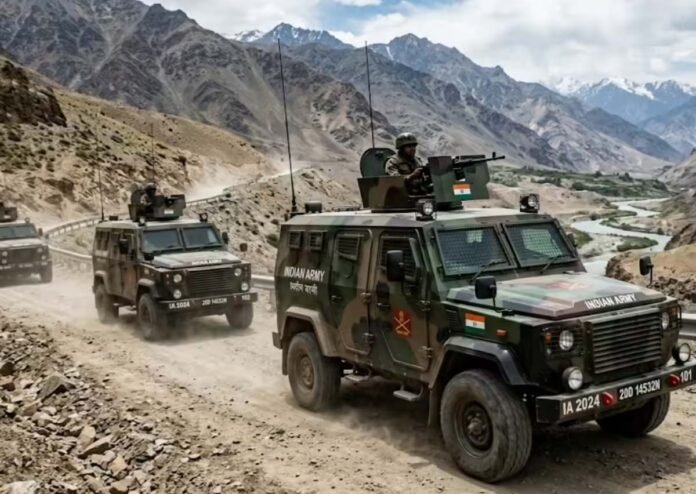
Jammu: In the higher reaches and valleys of Jammu and Kashmir and the icy stretches of Ladakh, movement is never routine. Every military convoy is a calculated risk, every patrol a test of endurance. It is here, in some of the world’s most unforgiving terrain, that the Indian Army is preparing to introduce a new layer of protection with — one that could redefine how soldiers move, fight, and survive.
The Army has initiated the process to procure 159 bullet-proof troop carriers (BPTCs) for its elite counter-insurgency force, the Rashtriya Rifles. The move is aimed at enhancing protected mobility for troops operating in volatile and high-risk environments.

A Response to Harsh Realities
For decades, soldiers deployed in insurgency-hit regions have relied on a mix of older vehicles and improvised protection. But evolving threats—ranging from ambushes to improvised explosive devices—have made it clear that mobility without protection is no longer enough.
These new carriers are being designed as fully armoured, 4×4 vehicles, capable of transporting around 30 personnel, including driver and co-driver.
More importantly, they are tailored for the specific challenges of the region. They must operate at altitudes up to 5,000 metres, endure temperatures from –10°C to +40°C, and function reliably across rugged mountains, snow-covered tracks, and narrow roads.
In essence, these are not just vehicles—they are moving shields designed for survival.

Built for Protection and Power
Each troop carrier is expected to combine ballistic protection with mobility, ensuring soldiers can move safely even in hostile zones. The vehicles will feature reinforced armour to withstand bullets and blasts, along with roof-mounted firing positions that allow troops to respond to threats without disembarking.
Despite their heavy protection, they are required to maintain operational agility—capable of speeds between 80–100 km/h on roads and 50–75 km/h off-road, with a range of up to 350 km on plains.

This balance between protection and speed is critical. In counter-insurgency operations, the ability to move quickly while staying protected can mean the difference between mission success and vulnerability.
Strengthening the Rashtriya Rifles
The Rashtriya Rifles, raised specifically for counter-insurgency operations, has long been at the forefront of maintaining stability in Jammu and Kashmir. With tens of thousands of personnel deployed, the force operates in some of the most sensitive and dangerous areas of the country.
The induction of these carriers will significantly enhance their operational capability. Units, sector headquarters, and force headquarters will all receive these vehicles, ensuring a more uniform level of protection across the force.
A Push for Indigenous Defence
One of the most important aspects of this procurement is its emphasis on domestic manufacturing. The project falls under India’s push for self-reliance in defence production, with a clear focus on sourcing from Indian vendors.
This aligns with a broader national strategy: to reduce dependence on imports while building a strong domestic defence industry. By mandating indigenous development, the Army is not just acquiring vehicles—it is investing in long-term capability.
The contract, once awarded, is expected to ensure a minimum production rate of 60 vehicles per year, enabling gradual but steady induction into service.
From Tender to Deployment
At present, the project is in its early stage, with a Request for Information (RFI) already issued. This is the first formal step in the procurement process, where the Army gathers technical and commercial inputs from potential manufacturers.
The next stages will involve detailed specifications, trials, and eventually contract signing. Only after these steps are completed, will large-scale production begin.
This means that while the need is urgent, actual deployment will take time. However, given the strategic importance of the regions involved, the process is expected to move with priority.
Why These Carriers Matter
Modern warfare—especially counter-insurgency—is as much about protection as it is about firepower. Soldiers often operate in close proximity to civilian areas, unpredictable terrain, and hidden threats. In such conditions, survivability becomes paramount.
These new troop carriers address that need directly. They reduce exposure during movement, provide a safer platform for operations, and enhance overall mission effectiveness.
They also send a broader message: that the Army is adapting to changing realities, investing in technology, and prioritising the safety of its personnel.
A Safer Road Ahead
As these vehicles move from blueprint to battlefield, they represent more than a procurement decision. They symbolise a shift in mindset—from reactive protection to proactive safety.
In the coming years, when these armoured carriers begin rolling through the valleys and mountains of northern India, they will carry more than soldiers. They will carry confidence, resilience, and a renewed assurance that those on the frontlines are better protected than ever before.
Because in the end, the strength of any force lies not just in its weapons—but in how well it safeguards those who serve.






