


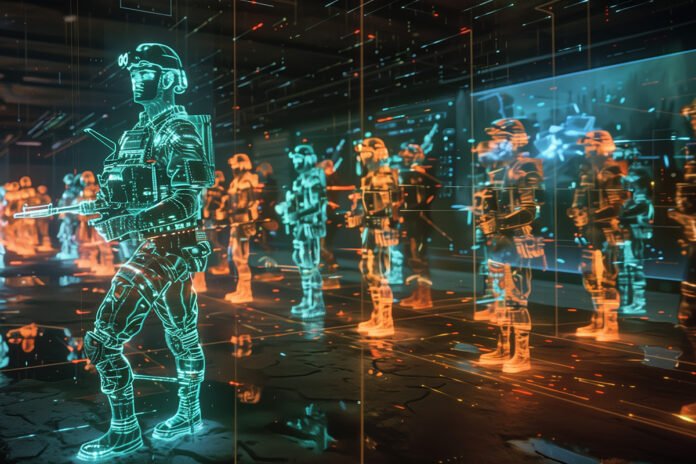
Computer wargames are often needlessly detailed and focused on technical calculations of tangibles, predominantly attrition, casualties, ammunition and logistics expenditure. This causes players to shift from operational thinking and become embroiled in managing figures. They also tend to turn into passive consumers of computer-generated outcomes rather than actively participate in dynamic planning processes and corresponding decision-making.
As these games are attrition-oriented, and do not model aspects such as cohesion, morale, or command-and-control resilience, players using these games often think in terms of attrition and not manoeuvre. For example, where a successful outflanking move in real life would reduce the enemy’s cohesion and morale, causing it to break down. Such factors are generally not reflected in computerised wargames—the outflanked enemy would continue to fight in terms of numbers, with no disadvantages, and would continue with the same chance of victory as it had before. The emergent behaviour of the player in this case would be to not think in terms of manoeuvre (which would give no added advantage), but only in terms of attacking with larger forces.

Such a mismatch between modelling and reality in computer games appears because most often games use OR&SA-oriented techniques and try to create precise simulations of combat mechanics, without modelling human leadership factors. The OR&SA genre of reasoning has made an immense contribution to overall military knowledge. However, in the case of wargaming its contribution is suboptimal, because the experts are usually quasi-military mathematicians, physicists, or statisticians, with relatively little understanding of military aspects, while their military counterparts involved in the design of wargames do not understand the complex mathematics and modelling logic used.
It has been observed that most computerised games used in armies, including in the Indian Army, yield excessively high casualties and expenditure of resources, while the tempo of operations they generate is not really sustainable in reality. Also, while aspects such as political interaction, civilian considerations, asymmetric environments, and multi-domain operations can be discursively handled in seminar wargames, they are difficult to model in computer games as quantitative data is not easily available.
Fundamentally, the above aspects, along with human variables and intangibles, make it essential to have a rational approach that is qualitative and experiential. The wide range of ambiguous aspects of the infosphere of wargaming, and especially its unpredictability, can be better handled in manual boardgames for a number of reasons. The primary reason is that, due to their limited data-handling bandwidth, manual game designing enforces an abstraction in the modelling. This means that not all but only the most crucial elements are captured in the rules and variables, which enables players to concentrate on issues relevant to their levels and not get engrossed in micro-management (as is often the case with computerised wargames). The rules of manual games are visible and based on investigative parameters. These are translated from military parameters and can be easily comprehended by players — unlike in computer simulations — leading to significant user faith in the system.
In light of the above, the ideal wargame approach for staff training would be to merge board-game mechanics with a qualitative (rather than quantitative) data handling structure (such as that designed on Qualitative Agent-Based Modelling or QABM). During a recent doctoral research project at the Amity Institute of Defence & Strategic Studies (AIDSS) with a computer-based system, manifold advantages appeared, so that a larger number of players can be involved and many more aspects could be modelled. Doing this would enable the hosting of mega-games on large operations with numerous entities and variables, and yet ensure that rules and calculations are accessible and follow comprehensibly from established military logic.

Future-ready wargames must account for leadership, morale, uncertainty and command friction, not merely casualties and attrition. Capturing these human dimensions is essential for realistic military learning
It is to the advantage of the tri-services and the affiliated DSSC that they must conjure intelligent scenarios which could present themselves with equally interesting solutions to prepare the student body to elicit certain evocative and bright solutions. This can train the intelligent human mind to grasp essentials of real plans and differentiate from those dangerous ones generated by Artificial Intelligence (AI) that pose a potential threat to actual plans generated by the staff of the tri-services. We have to develop software to safeguard against spurious plans and statistical data generated by AI, as AI would compromise operational plans seriously in critical situations, having a deleterious effect on the Joint Operations Planning Processes (JOPP).
Recommended Wargame Approach for PME in Command and Staff
It is recommended that under the aegis of the Commandant, a series of wargames, coordinated by a well-established contemporary joint wargaming approach for the tri-services, be progressively designed by the nominated OIC Wargaming Cell for use at the DSSC. It includes the SWOT analysis highlighting the strategic/operational level lessons which require absorption by the proficient middle-level leadership of the country’s Armed Forces attending the course. It could be a very exhaustive list of weapon systems and firepower equipment with the associated military resources which would require careful scrutiny and segregation to be built into the overall mosaic of the wargame.

The final conclusion and recommendations could be prudently taken up with the tri-services HQ for expeditious follow-up action and report. Arm-wise adjudication of detailed responsibility mandates organisation-equipment validation and accountability with results in a tri-service matrix and brief recommendations of the CI and the dealing SIs of the Army, Navy and IAF respectively.
Specialised modern equipment and new indigenised weapon systems, as specific to different arms, that require validation must be projected to the Wargaming Cell in advance as per the Standard Operating Procedure (SOP) for co-option in the wargame to derive maximum benefits by arriving at logical conclusions. Similarly, DRDO weapon systems and Aatmanirbhar indigenised weapon technology and related strategies must be progressed in a separate matrix to meaningfully gain from their approbation and subsequent implementation. Some of the following specific recommendations merit attention:
(a) Progressively, in an incremental manner, the current wargames/exercises can be converted into an interesting series of computerised joint integrated wargames, which can be well comprehended, integrated in the tri-service scenario, and played both in training and analytical mode. The games should also have the option of being played in Course of Action (COA) wargaming mode for progressive enrichment of the DSM where required. Such an approach will enable very comprehensive participation of all possible students attending the Staff Course. They will be performing diverse roles and responsibilities, which would be intelligently adjudicated, as specific to various organisational wings and echelons, by the respective CIs and SIs of the tri-services.
(b) Replace the dense mathematical or OR&SA-based mechanical models in these wargames with experiential models based on military planning parameters. The QABM method with heuristic solutions and a network of qualitative variables with feedback effects that replicate the complexity of the real world can be used. One inherent advantage of any ABM is that it can be easily expanded, and thus be kept up to date with evolving warfare. The network of qualitative variables is capable of capturing expanding multi-domain effects. Using a network of qualitative variables would be capable of capturing the many nuanced effects of battle, especially human and intangible factors that cannot be quantified, and the expanding multi-domain effects. The networked structure of the variables would ensure the feedback effect, introducing non-linearity in battle. This will operationalise the usually theoretical and conceptual effects of non-linearity of the battlespace where second- and third-order effects percolate, often causing unintended consequences. Such a variable structure would reveal non-linearities and unintended consequences that manifest during the course of the wargame in the debrief or the After-Action Review (AAR).
(c) Create realistic interfaces for staff work so that the selected SD procedures can be followed and proper documents created in detail. Such documents should be made readable with rule-based AI so that system orders can be generated. Realistic interfaces that replicate staff formats will provide various appointments the experience of interacting with the gaming system as though they are interacting with real interfaces and not computers. Subsequent progress of the game then must be as per these orders as translated into system orders, which would mean that poor/indifferent/incomplete staff work and SD would be penalised as they get translated into poor orders and bad execution. This will put a premium on thorough conduct and completion of staff work, one of the prime objectives of the Staff Course.
(d) ‘Model C2 and Friction’ easily with the mechanics of QABM and boardgames, so that different headquarters behave at different levels of effectiveness, based on their states and structures. Such a system would enable joint/tri-service headquarters, such as JAAOC, or the new headquarters resulting from theaterisation, to be credibly modelled in terms of efficiency, resilience, and friction, in conformity with DSSC knowledge and archived information of staffing norms. The impact of different types of headquarters and their staff organisations can thereafter be easily studied in analytical mode, so that specific analysis to identify ‘capacity building’ requirements in different levels of headquarters can be conducted.
(e) The system must be designed to log creative outcomes with decisions (which is not always possible in a complex world), deviations from orders, and game-states at crucial points, so that these can be presented comparatively during After-Action Review (AAR). Such a procedure during AAR could show at least correlations if not causality of various events during the wargame. The multiplicity of options as related to different operations of war in varied terrain configurations and threat manifestations would provide insightful knowledge of varying equipment and optimisation of combat power for leaders to exploit the best opportunities of the available tactical situations in the battlefield milieu within premium timeframes. Drone warfare has to be instrumental in the joint operation planning process and optimised in the tri-services, as proven in the ongoing wars in the Middle East and the Russian-Ukrainian war respectively. High-technology, platform-centric weapon systems and equipment have to be part of the wargame infrastructure to highlight operationally important issues related to hybridity in warfare.
The same can be supported by a series of manual boardgames with empirical rules based on existing parameters, which when played could be simple, properly controlled and even undertaken syndicate-wise. It is seen that in most megagames, a large number of student officers are sub-optimally engaged, thereby not deriving productive outcomes for most of them to learn the desired trajectory comprising important strategic lessons of joint war scenarios. Some select officers could be easily grouped into sub-syndicates recommended by the basic DS, which play various options under the ‘Devil’s Advocate’, i.e., alternate courses at various decision points in the main wargame, so that alternate plans are credibly tested. These could be compared later with the AARs.
The integration of artificial intelligence, qualitative modelling and realistic staff procedures can significantly enhance training outcomes. Such innovations can make simulations more reflective of contemporary operational realities
A Comparative Analysis
It is a well-known fact that there is wide social awareness of wargames in the developed militaries of the world, where wargaming has been a very popular hobby for generations among civilians. This generates greater awareness and translates into better creation and exploitation of wargaming in Western militaries, as a large number of officers and men are already familiar with wargaming nuances, understand their mechanics, and are aware of their potential, capabilities, and corresponding vulnerabilities and restrictions.
This is not true for India, where there is no social awareness of wargames. Simplistically, the understanding of wargames, which is first encountered in the Indian Army post-commissioning, is therefore inadequate, ambivalent, and never holistic but blinkered by the few wargames that an officer may have witnessed.
However, while junior officers must train on ground with their men, conflating such training with educating them in command roles of planning and reading-the-battle roles would only detract from ground training, leading to suboptimal use of training opportunity. Instead, the increasingly limited opportunity for field training, due to rising costs and reducing training areas, must be used for intense and relentless training in battle-drills and procedures on ground. Junior officers should be educated and trained for their command roles using other devices such as wargames. In this regard, most Western militaries have exposed their junior officers to tactical and even skirmish wargames so that they continue to brainstorm and think through various tactical situations while in barracks.
Further, due to wider proliferation of wargaming know-how in Western militaries, centralised agencies do not monopolise wargame development (as agencies such as WARDEC or the Institute of Systems Studies and Analysis — ISSA — do in India). Corresponding agencies in Western militaries only coordinate wargame design efforts amongst different organisations who design their own wargames, ensuring that they share experience and models, and avoid duplication of effort.
Takeaways
Rapid evolution of modern warfare across domains implies that a single agency such as WARDEC, staffed by comparatively few junior officers, may probably not possess the requisite experience to create ideal wargames for all joint training establishments such as the DSSC.
Here, the DSSC, which possesses significant institutionalised military expertise of a high professional order under its dynamic, erudite Commandants, Chief Instructors and Senior Instructors, and tri-services memory/information, could take a phenomenal lead. It should be nominated as the nucleus tri-service institution in the country, assisted by WARDEC. It has recently improved its classrooms to world-class standards and made them compatibly aligned to wargame online systems, enhancing the wargaming culture in the Indian Armed Forces. The DSSC can implement ‘state-of-the-art’ designs of a pragmatic series of wargames to enhance PME in joint integrated command and staff, a skill which would thereafter permeate widely across the environment. This way, wargames will be designed and used more holistically across the Indian Army, Indian Navy and Indian Air Force.
A vibrant tri-service wargaming culture can become a force multiplier for doctrine development and joint warfighting. It can also help prepare future commanders to operate effectively in increasingly complex multi-domain environments
Furthermore, through a pragmatic approach for joint training purposes, there is a need for well-experienced retired officers handling specialised subjects, or those nearing superannuation and interested in multi-domain-centric simulation and wargaming, having served in WARDEC or any significant coveted appointment at HQ ARTRAC dealing with the subject. The qualified officers could also have the correct symbiotic connection with wargaming training and concomitantly the aptitude and natural flair for the subject. It would lead to incessant improvements and upgrades in quick succession with a wider cross-section thoroughly educated on multiple options in strategic and operational areas in correct perspective. It is important that due and exponential exposure is given to students towards developing the desired niche and professional expertise to imbibe and also generate requisite interest in the ‘wargaming matrix’ for the courses conducted at different joint/military institutions.
Ignorance of permutations and combinations of various options being available to the adversary for implementation must be analysed deeply in a hybrid warfare environment. These operational contingencies must be prognosticated and discussed threadbare to arrive at innovative solutions to take timely cognisance and maintain the momentum of war-winning strategies at all levels. Critique from the users is very often constructive and could optimistically be utilised by the respective services to develop and further mature their wargame scenarios with innovative infusion of single-service or de novo jointmanship plans.
It is pertinent to quote General Norman Schwarzkopf (Retired), USA: “To be an effective leader, you must develop the manipulative streak; you have to figure out the people working for you, and give each the tasks that will take advantage of his strength.” A robust wargaming culture can become a force multiplier for professional military education, doctrinal development, and future joint warfighting capability.

Lt Gen S K Gadeock is a distinguished military leader, global strategist, and scholar who served as the Commandant of the Defence Services Staff College. A decorated veteran and former Logistics Advisor to the Botswana Defence Force, he has held numerous high-ranking appointments including Director General of the Amity Institute of Defence & Strategic Studies. Serving on the Advisory Board of Raksha Anirveda, he is a prolific writer and motivational speaker.





