


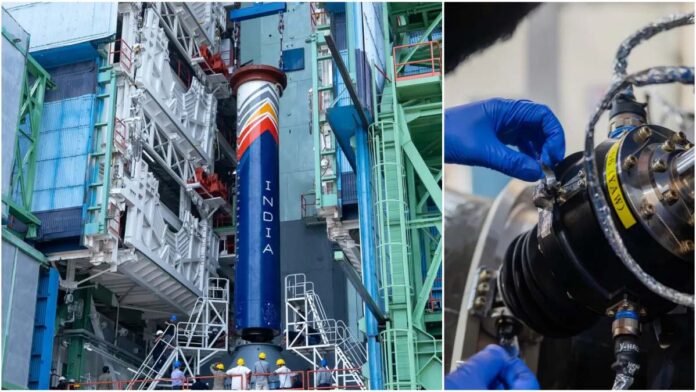
Sriharikota. India’s private space sector is on the brink of a historic milestone. Hyderabad-based space-tech startup Skyroot Aerospace has finalised the launch window for “Mission Aagaman” – the highly anticipated inaugural orbital test flight of its flagship launch vehicle, Vikram-1.
Targeted to liftoff no earlier than July 12, the launch window runs through August 4, 2026. The final countdown remains subject to the completion of launch-site assembly and testing operations at the Satish Dhawan Space Centre (SDSC-SHAR) in Sriharikota, alongside essential safety, weather and range clearances.

To commemorate this landmark event, Skyroot has introduced its official mission patch under the moniker Aagaman, a Sanskrit word translating to “Arrival.” The theme signifies the formal arrival of India’s commercial aerospace sector into the competitive global orbital launch market.
Seeking Crucial In-Flight Data
The upcoming launch marks a major leap forward from Skyroot’s successful sub-orbital flight of the Vikram-S rocket on November 18, 2022, which was the first private rocket to reach space from the Indian soil. While the 2022 mission validated the startup’s baseline technology stack, Vikram-1 represents a massive step toward establishing a high-cadence commercial launch programme.
According to Skyroot Co-founder and CEO Pawan Kumar Chandana, the primary objective of Mission Aagaman is to capture real-time, in-flight performance parametres from every integrated onboard system. Chandana emphasised that certain hyper-dynamic data points cannot be perfectly replicated during ground testing. The data harvested during ascent will validate their designs and shape future vehicle development. The mission will fly a partially commercial payload, carrying a mixed manifest of domestic and international customer satellites into a targeted 450 km orbit at a 60-degree inclination.
The Mechanics of Vikram-1
All stages of the flight-ready Vikram-1 vehicle have already been integrated and stacked at the Sriharikota launch pad. Standing at an impressive height equivalent to a seven-storey building, the rocket features several cutting-edge engineering traits:

- Advanced Materials: The entire multi-stage vehicle is constructed utilising a lightweight, high-strength all-carbon composite structure.
- Propulsion System: The rocket is powered by proprietary in-house propulsion systems, utilising high-thrust solid-fuel rocket boosters and advanced 3D-printed liquid engines.
- Payload Capacity: It is custom-built to deploy small satellites weighing up to 350 kg directly into Low Earth Orbit (LEO).
The physical rocket was previously unveiled to the public by Prime Minister Narendra Modi during the November 2025 inauguration of Skyroot’s sprawling “Infinity Campus” headquarters.
Commercial and Economic Impact
The global space industry is currently grappling with severe launch bottlenecks, forcing satellite operators to wait several months – sometimes years – to book a slot. Skyroot aims to alleviate this pressure by offering a “Cab to Space” model, which provides dedicated, precise and affordable access to orbit.

Frequent, low-cost access to space is becoming increasingly critical to scale services that modern economies rely on daily, spanning precision agriculture, maritime asset tracking, disaster management, localised communications and national defence.
Financially, India’s domestic space economy is projected to skyrocket from roughly USD 8.4 billion to an estimated USD 44 billion by 2033. Bolstering localised, sovereign private launch capabilities is widely regarded as a primary catalyst to unlock this massive ecosystem.
Backed by the Indian National Space Promotion and Authorisation Center (IN-SPACe) and utilising the technical infrastructure of the Indian Space Research Organisation (ISRO), Skyroot – India’s first space-tech unicorn – is positioned to turn these commercial space ambitions into reality.






