


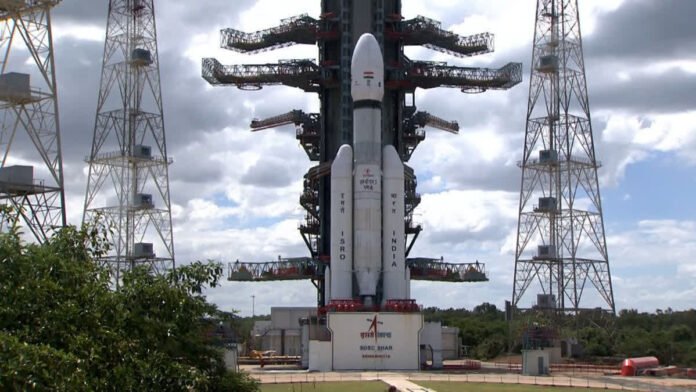
New Delhi: The Indian Space Research Organisation (ISRO) has successfully conducted the Flight Acceptance Test of the CE20 cryogenic engine for the upcoming LVM-3-M7 mission, announced ISRO. This marks another important milestone in India’s heavy-lift launch vehicle programme.
The CE20 cryogenic engine powers the upper stage of the LVM3 launch vehicle. It has been indigenously developed and is qualified to operate at thrust levels ranging from 19 to 22 tons. The engine has already demonstrated its reliability in eight successive LVM-3 missions, including Chandrayaan-2, Chandrayaan-3 and three commercial launches. It has also met the stringent human-rating qualification requirements necessary for its induction into the Gaganyaan human spaceflight programme.

To enable testing of the CE20 engine with a nozzle of full area ratio 100 under sea-level conditions, ISRO developed and validated a Nozzle Protection System. This system was tested extensively on a qualification engine through multiple trials. The implementation of NPS simplifies the complex activities associated with testing under High Altitude Test conditions, requires fewer resources and allows longer test durations.
On July 6, 2026, the flight acceptance hot test of the CE20 engine earmarked for the LVM3-M7 mission was successfully carried out at the Main Engine and Stage Test facility at the ISRO Propulsion Complex, Mahendragiri. This was the first time the NPS was used in such a test. The engine was operated at a thrust level of 19.5 tons for 45 seconds and at 22 tonnes for 25 seconds.
The test results confirmed the satisfactory performance of both the engine systems and the NPS. Following this success, the engine will be refurbished and assembled into the C32 flight stage, which is currently being integrated for the LVM3-M7 vehicle.
This achievement strengthens ISRO’s confidence in the CE20 cryogenic engine and its supporting systems, ensuring readiness for future missions. It also highlights India’s growing expertise in cryogenic propulsion technology, which is critical for deep-space exploration, human spaceflight and commercial launch services.







