


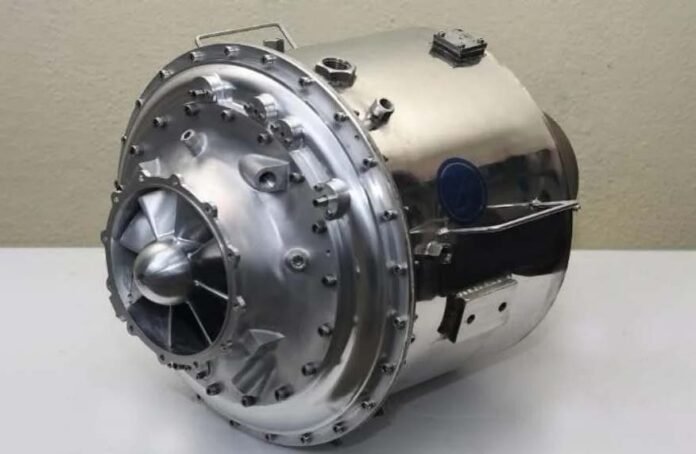
New Delhi: The National Aerospace Laboratories (NAL) in India has successfully developed an indigenously built small gas turbine engine named the NJ-100, which produces 100 kilograms-force (kgf) of thrust.
This development represents a major milestone in India’s pursuit of self-reliance (“Aatmanirbhar Bharat”) in defence technology, particularly within the aerospace and defence sector that has traditionally relied on foreign suppliers for propulsion systems for missiles and unmanned aerial vehicles (UAVs).

The NJ-100 engine is specifically engineered for critical modern military applications including long-range loitering munitions, advanced tactical UAVs, and compact cruise missiles. It addresses a significant gap in domestic manufacturing capability by providing an indigenous propulsion system optimised for modern warfare which increasingly depends on agile unmanned platforms.
Key technical features of the NJ-100 include a high thrust-to-weight ratio, compact design, and fuel efficiency, making it well suited for cost-effective, rapidly deployable assets that require both agility and long endurance.
This success builds upon earlier achievements by NAL in the small gas turbine engine space, particularly the NJ-5 engine. In 2024, the NJ-5 was flight-tested in a scaled model aircraft, validating the engine’s performance and control systems. The confidence and data gained from this trial enabled NAL to develop and bring to fruition the more powerful NJ-100 project, marking a technological progression within India’s domestic aerospace engine program.
Strategically, the NJ-100 engine is crucial for reducing India’s dependence on imported small turbojet engines, many of which currently come from Russia and other foreign entities. This reduces vulnerabilities associated with import dependency such as fluctuating costs, supply chain disruptions, and technology sanctions.

By enabling local production of critical propulsion technology, India also broadens its scope for future innovations in unmanned systems. Indigenous engine technology allows Indian engineers to develop modular, upgradeable designs to keep pace with evolving operational needs, providing a critical advantage over fixed-spec imported systems and moving India closer to true strategic autonomy in defence manufacturing.
NAL’s NJ-100 engine is a compact, efficient, and powerful gas turbine engine tailored for next-generation unmanned military applications. It is a significant step forward supporting India’s national goal to build a self-reliant defence technology ecosystem, enhancing indigenous capabilities, and reducing dependency on foreign imports while paving the way for future innovation and customisation in battlefield propulsion technologies.







