


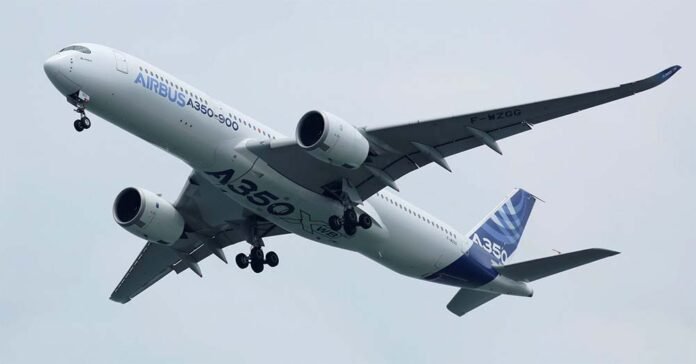
The Airbus A350XWB is one of the most modern passenger planes flying today. What makes it special is that nearly 53% of its body is built using lightweight carbon-fiber composite materials instead of the usual aluminium. This clever design helps big airlines like Delta, Qatar Airways, and Singapore Airlines burn around 25% less fuel compared to older wide-body planes. In simple words, lighter plane means less fuel, more savings, and longer flights.
In India, IndiGo does not fly any A350 yet, but it has placed a firm order for 60 Airbus A350-900 aircraft. Air India, on the other hand, already flies 6 A350-900 planes and has ordered many more, including the bigger A350-1000 model. So very soon, these advanced planes will become a common sight in Indian skies.

But here is the catch. As highlighted in a detailed report by Simple Flying, because the A350 is made from carbon fiber instead of metal, repairing it after a hard landing or major damage is far more difficult than fixing an older aluminium plane.
Why Composite Materials Are Used
The A350 follows the modern design first introduced by the Boeing 787. Older Airbus planes like the A330 and A340 were built mostly from aluminium. But the A350 uses about 53% composite materials in its main body, wings, and tail. In fact, around 70% of the whole plane is made from advanced materials, making it one of the most modern aircraft ever built.
The reason is simple. Carbon fiber is very strong yet very light. This lets engineers build a strong plane without making it heavy. A lighter plane uses up to 25% less fuel, can fly around 2,780 km farther, and can carry more passengers and cargo than the older A330. Composite materials also resist rust and cracking, two big problems that trouble old metal planes. Plus, large sections can be made in one single piece, which means fewer nuts, bolts, and joints are needed.
The Hidden Damage Problem
But every good thing has a downside. The biggest worry with composite planes is something called Barely Visible Impact Damage, or BVID. This is hidden damage inside the plane that you cannot see from outside.

When a metal aircraft takes a hard hit, it shows clear dents or cracks. The damage is easy to spot. But carbon fiber behaves differently. It can bend, return to its shape, and still hide cracks deep inside its many layers. So even if the outer surface looks perfectly fine after a hard landing or a strong hailstorm, the inner layers may have quietly separated or cracked. This hidden damage can weaken the plane without giving any warning. Maintenance teams therefore cannot simply look at the A350 and decide it is safe. They need special machines to peep inside.
The A350 follows the modern design and uses about 53% composite materials in its main body, wings, and tail. In fact, around 70% of the whole plane is made from advanced materials, making it one of the most modern aircraft ever built
Why Ultrasonic Checks Are Needed
To find this hidden damage, Airbus uses a method called ultrasonic testing. High-frequency sound waves are sent through the plane’s body. By studying how these waves bounce back from the inner layers, engineers can detect cracks, crushed material, or separated parts even when the outside looks normal.

The trouble is that this checking takes a lot of time and effort. After a hard landing, engineers often do not know exactly which part took the biggest hit. So, they must scan large areas like the lower body and the wing connection points before clearing the plane. If any damage is found, the A350 may stay grounded for several days, causing the airline to lose flights and money.
Thankfully, the A350 has smart features to soften hard landings. Its advanced landing gear absorbs much of the shock, and its carbon fiber wings bend slightly during touchdown to spread the force evenly. The plane can safely handle a landing drop speed of up to 600 feet (183 metres) per minute, which is about 3 metres every second, even at maximum weight, without needing extra checks.
Why Repairs Are So Difficult
Fixing an A350 is much harder than fixing an aluminium plane. Older planes were built from many small metal panels, so a damaged piece could simply be removed and replaced. But the A350 uses large one-piece sections, so a damaged part cannot always be swapped out easily.
The biggest worry with composite planes is something called Barely Visible Impact Damage, or BVID. This is hidden damage inside the plane that you cannot see from outside. When a metal aircraft takes a hard hit, it shows clear dents or cracks. The damage is easy to spot. But carbon fiber behaves differently. It can bend, return to its shape, and still hide cracks deep inside its many layers. Maintenance teams therefore cannot simply look at the A350 and decide it is safe. They need special machines to peep inside
Many repairs must be done directly on the plane using careful bonding and heating. Aluminium planes can be repaired in almost any hangar, but composites are very sensitive to heat and moisture. Technicians must control the temperature and humidity around the repair so the layers stick properly. They sometimes sand away the damaged layers and rebuild them one by one. Also, carbon fiber strength depends on the direction in which its fibers are arranged, so even a tiny mistake can weaken the repair. This is why even a small fuselage repair can take more than 15 hours of skilled work.
Airbus’s Three-Level Repair System
To handle this, Airbus created a three-level repair plan. The first level covers minor things like scratches and paint marks, sometimes fixed with special high-speed repair tape. The second level covers standard structural repairs using aluminium patches or bonded composite fixes by trained technicians. The third level handles major damage from hard landings, bird hits, or collisions. For these serious cases, Airbus supplies Pre-Defined Repair Solution (PDRS) kits with instructions, spare parts, and tools, and its engineers may even help the airline directly.
Airbus uses a method called ultrasonic testing. High-frequency sound waves are sent through the plane’s body. By studying how these waves bounce back from the inner layers, engineers can detect cracks, crushed material, or separated parts even when the outside looks normal
A Real Warning: The Qatar Airways Dispute
According to Simple Flying, these challenges became very real during the 2021 Qatar Airways grounding. The airline noticed cracked paint and exposure of the lightning protection layer on its A350 fleet. Regulators grounded 13 of its planes, fearing the carbon fiber body under the paint was wearing out faster than expected. This dispute proved that even surface-level problems can become big headaches in composite planes.
In the end, the A350 shows both sides of modern technology. Its carbon fiber body saves fuel and flies farther, but the same material makes repairs slow, costly, and complicated. The Boeing 787 faces the same struggles. As the world shifts to these new planes, one lesson is clear: they fly smarter, but they are far trickier to heal on the ground.

-The writer is an award-winning science communicator and a Defence, Aerospace & Geopolitical Analyst. He is the Managing Director of ADD Engineering Components India Pvt. Ltd., a subsidiary of ADD Engineering GmbH, Germany. You can reach him at: girishlinganna@gmail.com. The views expressed are personal and do not necessarily carry the views of Raksha Anirveda





