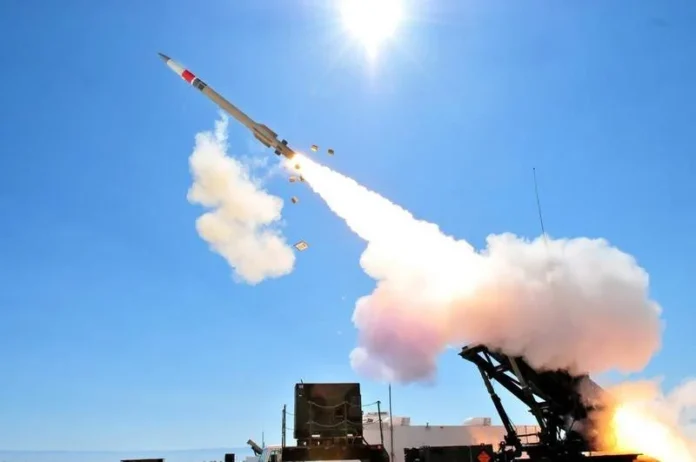
White Sands Missile Range, A Lockheed Martin PAC-3 Cost Reduction Initiative (CRI) interceptor successfully intercepted an Air-Breathing Threat (ABT) at a record distance in a test today at White Sands Missile Range, New Mexico.

The test marked the furthest distance a PAC-3 CRI missile has intercepted an ABT while integrated with the Army Integrated Air and Missile Defense (AIAMD) Battle Command System (IBCS) leveraging multiple sensors on the Integrated Fire Control Network (IFCN).
The U.S. Army-led missile defense flight test demonstrated the unique Hit-to-Kill capability of the PAC-3 family of missiles, which defends against threats through direct body-to-body contact delivering exponentially more kinetic energy on the target than can be achieved with legacy blast-fragmentation kill mechanisms. The test also reconfirmed PAC-3 CRI ability to detect, track and intercept incoming ABTs or missiles.

“PAC-3 continues to be successful against today’s evolving threats, and this most recent test validates its effectiveness at long distance while integrated into the AIAMD architecture,” said Scott Arnold, vice president and deputy of Integrated Air and Missile Defense at Lockheed Martin Missiles and Fire Control. “Today’s global security environment demands reliable solutions. We expect PAC-3 Hit-to-Kill interceptors to continue serving as an essential element in integrated, layered defense systems.”

The PAC-3 CRI and MSE are high-velocity interceptors that defend against incoming threats, including tactical ballistic missiles, cruise missiles and aircraft. Thirteen nations have procured the PAC-3 missile defense interceptor: the U.S., Germany, Kuwait, Japan, Qatar, Republic of Korea, Kingdom of Saudi Arabia, Taiwan, Romania, Poland, the Netherlands, Sweden and the United Arab Emirates.
A world leader in systems integration and development of air and missile defense systems and technologies, Lockheed Martin’s experience spans missile design and production, infrared seekers, command and control/battle management, as well as communications, precision pointing and tracking optics, radar and signal processing, and threat-representative targets for missile defense tests.