

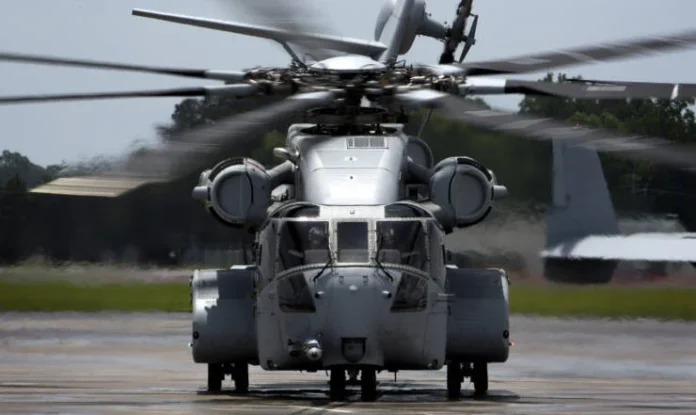
Tel Aviv. Israel air force (IAF) is asking for fast clear answers – can the Lockheed Martin CH-53K fly safely in dusty conditions? Shortly after the IAF selected the CH-53K, this heavy helicopter’s dust problem was revealed.

An official DOT&E report says that the CH-53K engine’s performance degrades bellow the accepted minimum after 21 minutes of exposure to dust.
Israeli Ministry of Defense selected Lockheed Martin’s CH-53K as the replacement for the old CH-53 now is service. The other option was Boeing CH-47.
Dust and sand are the worst enemies of helicopter engines.
When ingested by the engine, they cause compressor erosion, turbine blade glazing, turbine blade vibration & fatigue problems and Blockage of blade cooling passages.

The critical time is during brown out, when the helicopter takes off or lands in sandy areas. The rotor wash kicks up a cloud of dust or sand.
Israeli sources said that in spite of the fact that the CH-53K was evaluated for a long time, its engines sensitivity to dust was not considered as a problem.

Now, after the official report was released in the US the issue causes great concern in the IAF that plans to get a first batch of 20 helicopters.
Officially the IAF will not comment on the problem but senior experts who talked on condition of anonymity, said that the problem is “very serious “and has to be fixed completely before the CH-53K arrive in Israel.
“The IAF is operating most of the time in dusty environments and has to perform long flights in these conditions. The limitations that were mentioned in the US official report cannot be expected by the IAF.” the sources said.
One expert added that the solution must be “total and massive” before the CH-53K can be introduced into the IAF’s service.
The source explained that sand and dust ingested by the helicopter engine cause erosion and affect the performance of the engine.
The dust and sand mostly damage the engine compressor but the accumulation of sand inside the engine can also damage turbine components or clog internal air passages for specific engine models.
The source added that the IAF uses the heavy helicopters very frequently for “long range combat missions that require many landings in sandy and dusty areas.”
Lockheed Martin commented on the issue, “Sikorsky and our customer continue to operate an integrated test plan and are committed to enter Initial Operational Test & Evaluation as planned in June, support operational deployment and expand production of this all-new heavy lift helicopter.
The team is already addressing technical issues cited in the report, a majority of which have been resolved, and are confident we have solutions to address the few outstanding issues to enter into IOT&E as scheduled this year.
We understand the sand ingestion issue and, as the aircraft integrator, have assigned a dedicated team of our most experienced engineers to work alongside NAVAIR and GE to resolve this issue.”
Speaking before the international helicopter forum on February 24, Col Jack Perrin, US Marine Corps, Program Manager, CH-53K said: “We went out to Yuma Arizona in the July, August, September time frame of last year. You saw some of those pictures of the 53 coming into that sand, dusty area I’m sure you’ve seen those videos on YouTube they’ve been around for a while.”
The Col added that it was stunning to see the brown out conditions that was developed in order to make it very, very challenging.
He said that the CH-53 K was able to come in, hover, stable and land.
The high ranking officer said that during the test an external load operations was tested. “It worked extremely well. The workload was way reduced and that’s really driven because of those flight controls and that fly by wire system on the aircraft. This is one of the most stable platforms out there it really, really does well.”
The IAF is following very closely the work being done to solve the dust problem.
-The writer is an International Roving Correspondent of the publication

-The writer is an Israel-based freelance journalist. The views expressed are of the writer and do not necessarily reflect the views of Raksha Anirveda





