


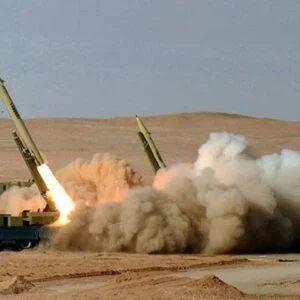
Tel Aviv: Iran has developed a launcher for its Fateh-110 ground to ground missile that is carried in a commercial container to avoid its tracking until just before launch.

The missiles and the launcher are stored in a standard civilian container used in marine shipping, and is placed on a standard truck chassis. The missile system can be spotted when the container roof is opened, and the rocket is ready for launch. When the missiles are stored inside a standard container and transported on truck chassis, the weapon system can be moved on the road without being detected. It can be transported by land, sea or air.
The Fateh-110 is a short-range, road-mobile, solid-propellant ballistic missile. It is most likely a modified version of the unguided Zelzal-2, with the addition of control and guidance systems. While the program is based in Iran, the missile is believed to incorporate components from Chinese contractors. In 2006, the US Department of Treasury accused Chinese firm Great Wall Industry and its partners of playing a lead role in the development of the Fateh missile system. In June 2017, Iran launched six Zolfaghar missiles, a longer-range variant of the Fateh, into Syria in response to attacks by Islamic State militants in Tehran.
According to the missile threat website, Iran began developing the Fateh-110 in 1995. The missile is 8.86 m long, 0.61 m in diameter, and weighs 3,450 kg. It uses a single-stage solid propellant engine and has a range of 210 km (130 miles), although it is possible that Iran will add extra boosters in order to increase its range to 400 km (249 miles). It can carry a payload of some 500 kg and is most likely intended to deliver a high explosive, chemical, or sub munitions warhead. The missile is also assumed to be nuclear / WMD capable.
The first test flight of the Fateh-110 took place in May 2001, with a second in September 2002. A third test was recorded in February 2003. A fourth test was successfully completed during the second “Noble Prophet” military exercise in November 2006. The Iranian Revolutionary Guard successfully tested the Fateh in January 2007 during an annual war game. The fifth successful test was completed in September 2007 alongside the Qadr-1 and the Shahab-3.

Additionally, unconfirmed reports suggest that at least five more tests occurred between 2008 and 2012. During its tests, the Fateh-110 was fired from a fixed launcher similar to the one used by the Russian S-75 Guideline surface-to-air missile. However, it is likely that Iran has also designed a launch vehicle to make Fateh-110 road mobile. The launch vehicles are probably converted Scud launchers, trucks, or Zelzal-2 launch vehicles.
The missile entered low-rate production in October 2002 and initial operational achievement is believed to have occurred in 2004. Syria is known to have been developing a similar short-range solid-propellant missile and to have exported a similar design to North Korea. Unconfirmed reports from 2008 suggest Hezbollah was supplied with Fateh-110 rockets by Imad Mughniyeh, a recently deceased officer in the organization who reportedly received these weapons from Iran. It is possible that these were some of the Zelzal weapons destroyed in Lebanon by Israeli forces in 2007. Numbers and production information relating to the Fateh-110 are currently uncertain, yet Iranian media sources claim that facilities have been created to mass produce the weapon.

-The writer is an International Roving Correspondent of the publication.

-The writer is an Israel-based freelance journalist. The views expressed are of the writer and do not necessarily reflect the views of Raksha Anirveda





