


In August 2025, while addressing a gathering in Florida, Pakistan’s Army Chief Field Marshal Asim Munir declared that any future conflict with India would not remain confined to traditional battlefields. He spoke of a wider contest involving multiple domains and hinted at the possibility of a larger strategic confrontation starting from the East and extending beyond conventional military engagements.
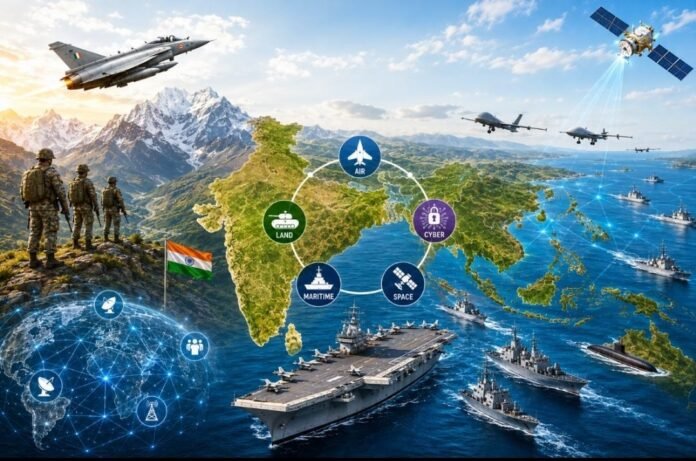
His remarks were intended as a deterrence. Yet they also reflected an uncomfortable reality confronting India. Future conflict is likely to unfold simultaneously across land, sea, air, cyber, space, information, and economic domains. It may involve Pakistan in the West, China in the North, maritime pressures in the Indian Ocean, cyber-attacks on critical infrastructure, and relentless information warfare targeting public opinion.

India is therefore not preparing for a single-front war. It is preparing for an era of interconnected conflicts. This changing character of warfare explains why one of the most important military reforms undertaken since Independence is now gathering momentum — the creation of Integrated Theatre Commands.
Often discussed as an administrative restructuring, Theatre Commands are, in reality, far more significant. They represent the military foundation of India’s strategic transition from a predominantly continental power to a nation capable of simultaneously securing its land frontiers and projecting influence across the Indo-Pacific.
In essence, Theatre Commands are the military architecture required to support India’s Eastern Vector.
A Strategic Geography that has Expanded
For much of its post-independence history, India’s security thinking was shaped by geography.

The principal military challenges emerged from the Western frontier with Pakistan and the Northern frontier with China. Consequently, defence planning, force structures, logistics networks, and operational doctrines evolved around territorial defence and continental warfare. That framework served India reasonably well during the 20th century.
The 21st century, however, presents a dramatically different strategic environment. Today, India’s interests extend far beyond its immediate borders. Energy supplies originate in the Gulf. Trade routes stretch across the Arabian Sea and the Bay of Bengal. Critical supply chains pass through the Malacca Straits. Undersea communication cables carry financial transactions and digital traffic that sustain the modern economy. Access to critical minerals increasingly depends upon maritime connectivity across the Indo-Pacific.

India’s strategic horizon now extends from East Africa to the Western Pacific. This broader vision is reflected in initiatives such as the Indo-Pacific Oceans Initiative, deeper engagement with ASEAN, growing cooperation within the QUAD, logistics agreements with friendly nations, and expanding naval partnerships across the region. Collectively, these developments indicate a profound strategic shift.
Often discussed as an administrative restructuring, Theatre Commands are far more significant. They represent the military foundation of India’s strategic transition from a predominantly continental power to a nation capable of simultaneously securing its land frontiers and projecting influence across the Indo-Pacific
India is no longer merely defending territory. It is protecting interests spread across an increasingly interconnected maritime domain.
This is the essence of the Eastern Vector.
Yet strategic aspirations require corresponding military capabilities. A nation cannot pursue an eastern strategic orientation while relying entirely upon a military structure designed for 20th-century continental wars.
The Nature of Future Conflict
The most compelling argument for Theatre Commands emerges not from organisational theory but from the changing character of war itself.
A future crisis involving India could unfold across four interconnected fronts.
The first would be the Western front: Pakistan remains a significant military challenge. While conventional wars have become less likely, limited conflicts, proxy warfare, terrorism, missile strikes, and escalation management will continue to dominate the strategic landscape.
The second would be the Northern front: China’s military modernisation, infrastructure development along the Line of Actual Control, and growing assertiveness ensure that the Himalayan frontier will remain India’s most demanding continental challenge.
The third would be the Maritime front: The Indian Ocean is rapidly emerging as one of the world’s most contested strategic spaces. Chinese naval deployments, dual-use ports, undersea surveillance systems, and expanding maritime reach have transformed the region into a critical arena of competition.
The fourth would be the Invisible front: Cyber-attacks, satellite disruption, electronic warfare, artificial intelligence-enabled operations, disinformation campaigns, and economic coercion are now integral components of modern conflict. Collectively, these can generate friction at scale, causing disproportionate operational effects.
Future wars will not occur sequentially. They will occur simultaneously.
India’s strategic horizon now extends from East Africa to the Western Pacific. This broader vision is reflected in initiatives such as the Indo-Pacific Oceans Initiative, deeper engagement with ASEAN, growing cooperation within the QUAD, logistics agreements with friendly nations, and expanding naval partnerships across the region. Collectively, these developments indicate a profound strategic shift
An adversary may seek not outright battlefield victory but strategic overload — creating multiple crises across different domains and forcing India to divide its attention, resources, and decision-making capacity.
The challenge is therefore one of integration. And integration is precisely what Theatre Commands seek to achieve.
From Service-Centric Warfare to Campaign-Centric Warfare
The traditional Indian military structure was designed around individual services.
The Army fought land battles. The Navy conducted maritime operations. The Air Force provided air power. This model was effective when wars were geographically limited and operational domains were relatively distinct. Modern warfare no longer permits such separation.
A missile launched from hundreds of kilometres away can influence a land battle. A cyber-attack can disrupt military communications. Space-based intelligence can shape naval operations. Drones can affect ground, maritime, and air campaigns simultaneously. Success increasingly depends upon jointness. Integrated Theatre Commands are designed to create this jointness.
Under the proposed structure, commanders will be responsible for specific theatres rather than individual services. They will have access to all necessary military instruments within their area of responsibility — land forces, air assets, maritime capabilities, intelligence resources, missile systems, cyber support, and space-enabled surveillance. The doctrinal shift is profound.
The Himalayan frontier will remain India’s most demanding continental challenge. However, the Indian Ocean is rapidly emerging as one of the world’s most contested strategic spaces. Chinese naval deployments, dual-use ports, undersea surveillance systems, and expanding maritime reach have transformed the region into a critical arena of competition
Services will continue to raise, train, and sustain forces. But wars will be fought by integrated theatre commanders. The distinction may appear technical. In reality, it marks one of the most consequential changes in Indian military thinking since Independence.
India is moving from service-centric warfare to campaign-centric warfare.
Why the Maritime Theatre Could Become Decisive
Among all proposed Theatre Commands, the Maritime Theatre may ultimately prove to be the most strategically significant.
This conclusion emerges directly from India’s Eastern Vector. For decades, military attention focused primarily on continental threats. Yet geography confers upon India a unique maritime advantage.
China’s economic strength depends heavily upon maritime trade. A substantial portion of its energy imports and commercial traffic traverses the Indian Ocean before passing through critical chokepoints such as the Malacca Strait. This creates vulnerabilities.
The Indian peninsula projects deep into the Indian Ocean. India’s island territories occupy strategic positions. The Andaman and Nicobar Islands overlook one of the world’s most important maritime corridors. These geographic realities create opportunities that cannot be ignored.
A future conflict with China may begin along the Himalayan frontier. However, the ability to shape outcomes could increasingly depend upon actions in the maritime domain. Sea control, sea denial, protection of shipping routes, maritime surveillance, anti-submarine warfare, and control of critical chokepoints may become central components of deterrence.
Cyber-attacks, satellite disruption, electronic warfare, artificial intelligence-enabled operations, disinformation campaigns, and economic coercion are now integral components of modern conflict. Collectively, these can generate friction at scale, causing disproportionate operational effects
The Maritime Theatre is therefore not merely a supporting command. It has the potential to become the strategic Centre of Gravity in any prolonged confrontation involving China.
Future wars with China may begin in the mountains, but could ultimately be influenced by events at sea.
The Military Pillar of the Eastern Vector
Much discussion surrounding India’s Eastern engagement focuses on diplomacy and economics.
These dimensions are undoubtedly important. Partnerships with ASEAN nations, stronger ties with Japan, Australia, and the United States, enhanced regional connectivity, resilient supply chains, and collaborative technology initiatives all contribute to India’s growing Indo-Pacific presence.
Yet history offers a consistent lesson. Strategic influence ultimately rests upon the ability to protect interests. Economic corridors require security. Trade routes require protection. Partnerships require credibility. Deterrence requires capability.
Integrated Theatre Commands provide the military framework that enables these objectives. They create the operational architecture necessary to sustain India’s presence across a wider strategic geography. They facilitate faster decision-making, more efficient force utilisation, and coordinated responses across multiple domains. Most importantly, they align the military organisation with the national strategy.
Without such alignment, the Eastern Vector risks becoming an aspirational concept. With it, strategic intent acquires operational substance.
Services will continue to raise, train, and sustain forces, but integrated theatre commanders will fight wars. India is moving from service-centric warfare to campaign-centric warfare. Among all proposed Theatre Commands, the Maritime Theatre may ultimately prove to be the most strategically significant
Beyond Headquarters: The Real Challenge
Creating Theatre Commands, however, is only the beginning.
The establishment of new headquarters does not automatically generate combat effectiveness. The deeper challenge lies in developing a genuinely integrated military ecosystem. This will require common doctrines, unified planning processes, interoperable communication systems, integrated logistics networks, joint professional military education, artificial intelligence-enabled command systems, and seamless coordination across cyber and space domains. Technology will play an increasingly important role.
The commander of the future will require real-time situational awareness across thousands of kilometres, integrating data from satellites, drones, naval platforms, ground sensors, and cyber networks. Institutional adaptation will be equally important. Jointness must become a culture rather than merely an organisational arrangement.
The success of Theatre Commands will ultimately depend less upon structures and more upon mindset.
Building the Architecture of India’s Strategic Future
The Theatre Commands debate is often framed as part of military reforms.
That interpretation understates their significance. What India is undertaking is not simply a reorganisation of command structures. It is constructing the institutional architecture for a new strategic era. The country stands at a pivotal moment in its geopolitical evolution. It remains a continental power confronting persistent challenges along its land borders. Simultaneously, it is emerging as a major maritime actor with expanding interests across the Indo-Pacific.
The Indian peninsula projects deep into the Indian Ocean, and India’s island territories occupy strategic positions. The Andaman and Nicobar Islands overlook one of the world’s most important maritime corridors. These geographic realities create opportunities that cannot be ignored
Managing both realities requires a military system capable of operating seamlessly across domains and theatres. Integrated Theatre Commands are the logical response to this challenge. They represent the bridge between geography and strategy, between ambition and capability, and between continental defence and maritime influence.
As India advances its Eastern Vector and prepares for an increasingly complex security environment, the true test will not be the creation of new commands but the creation of a military architecture capable of securing national interests from the Himalayas to the Western Pacific.
The future battlefield will be interconnected. India’s military structure must be as well.

Lt Gen Rajeev Chaudhry (Retd) writes on contemporary national and international issues, strategic implications of infrastructure development towards national power, geo-moral dimension of international relations, and leadership nuances in a changing social construct. The views expressed are of the author and do not necessarily reflect the views of Raksha Anirveda





