


When India’s defence export figures are discussed, the conversation almost always turns to platforms: missiles, patrol vessels, armoured vehicles. Rarely mentioned is a quieter category sitting underneath all of them—the systems that train the people who operate these platforms with precision. Simulation and training technology may not show up as a line item in most export headlines, yet it is a driving force behind India’s shift from “emerging power” to “real global power.” This Independence Day invites us to consider that it is not just the advanced systems required by the forces that matter, but also the capability to operate them efficiently.
Economy: The Numbers Behind the Shift
India’s defence exports touched an all-time high of ₹38,424 crore in FY 2025-26, up 62.66 per cent from the previous year’s ₹23,622 crore, with the government targeting ₹50,000 crore in exports by 2029 as part of a broader ₹3 lakh crore defence-production goal. Simulation and training systems are an increasingly visible part of that growth story, for a few concrete reasons.

Cost and safety drive demand. Live firing, tank gunnery, and flight training are expensive and risky to run repeatedly; simulators let importing militaries build proficiency without burning fuel, ammunition, or airframe hours. This makes them attractive to cost-conscious buyers, especially in Africa, Southeast Asia, and the Middle East—regions where Indian simulator makers have already placed equipment.
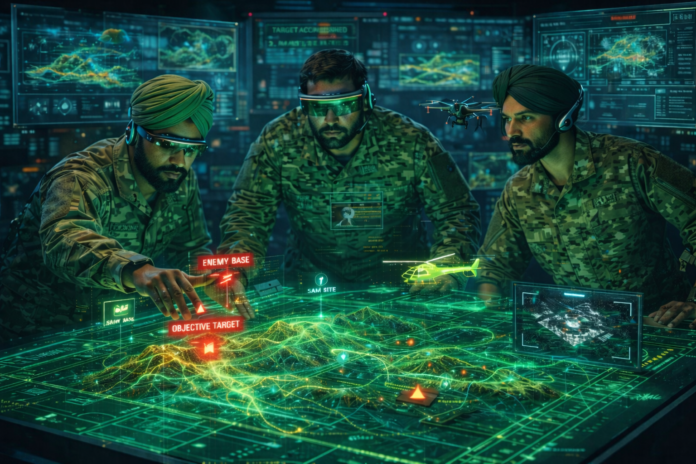
Today’s simulators are no longer crude replicas—they are parallel digital battlespaces: photorealistic environments, AI-driven adversaries, and Live-Virtual-Constructive architecture that puts live soldiers and virtual ones in the same fight
Simulators are non-lethal training aids, which makes them easier to export under India’s arms-export rules and more politically palatable for buyer countries than actual weapons platforms—a practical reason they can move faster and to a wider set of countries than combat hardware.
Beyond economics and safety, simulation also supports more sustainable defence preparedness. By reducing the need for repetitive live firing, vehicle movement and aircraft sorties, simulation lowers fuel consumption, ammunition expenditure, emissions and noise pollution associated with routine training. As sustainability becomes an increasingly important consideration for defence organisations worldwide, simulation enables militaries to maintain high training standards while using resources more efficiently and reducing environmental impact. Since defence receives the highest budget allocation, sustainability in defence will have a significant overall economic impact.
Tecknotrove Systems, a Mumbai-based defence simulator manufacturer, illustrates what this shift looks like at company scale: two decades of indigenous design, development and manufacturing of simulation technology, more than 1,500 projects delivered, and a footprint spanning 35+ countries. What is notable is not simply that Tecknotrove has been indigenously developing simulators for defence training, but that it builds them to standards that have found acceptance across international markets—a small but telling data point inside India’s larger export story.

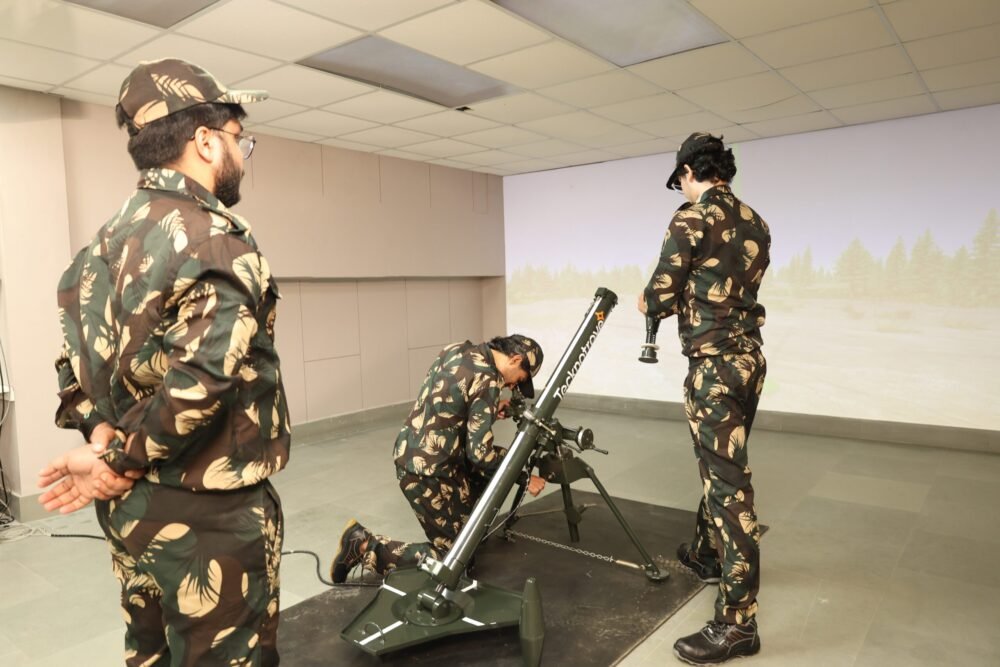
Simulation is no longer an adjunct to military readiness—it is its foundation. India’s in-house R&D, built over two decades by companies like Tecknotrove, now produces everything from small-arms trainers to full motion-platform tank simulators
That story is increasingly a private-sector one. Of the ₹38,424 crore in defence exports recorded in FY 2025-26, private industry contributed ₹17,353 crore, or roughly 45 per cent, up from ₹15,233 crore the year before—a slower rate of growth than the state-owned sector’s 151 per cent jump, but a substantial and rising base nonetheless. Simulation manufacturers sit inside that private-sector figure, alongside the missile, radar and small-arms makers that tend to dominate export headlines. The government’s own registered-exporter count grew from 128 to 145 firms over the same year, a reminder that this is not a story about one or two flagship companies, but about a widening base of Indian manufacturers finding buyers abroad.
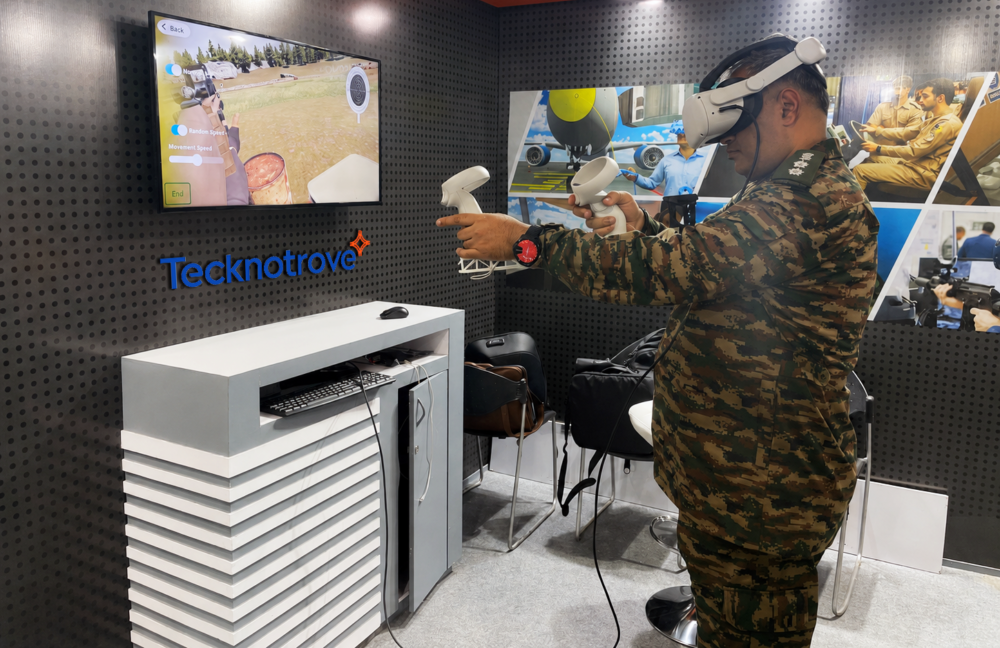

India’s strengths in software engineering, gaming technologies, visual computing and advanced digital engineering provide a natural competitive advantage in simulation and training systems. Unlike conventional defence platforms that require large-scale manufacturing infrastructure, simulation combines high-end software, systems integration and domain expertise—areas where Indian industry has consistently demonstrated global capability. As defence systems become increasingly software-defined, this convergence positions India to emerge not only as a manufacturer of defence equipment, but also as a global developer of defence technologies.
the quieter half of India’s technology sovereignty story lies in not just building the platform, but owning the digital twin that trains the people who operate it. An indigenous simulation base means India can train its forces and export that capability without depending on outside suppliers
Live training will always remain indispensable; no simulator fully replicates the unpredictability of the real thing. But simulation increasingly handles the high-frequency repetition, failure scenarios and complex mission rehearsals that would be prohibitively expensive, or simply impossible, to recreate using operational equipment alone. India’s indigenous simulation manufacturing base is one of the reasons it can shift that balance without depending on an outside supplier.
Technology: From Replica to Battlespace
Today, simulator systems are highly realistic and closer to a parallel digital battlespace: photorealistic environments, motion platforms, AI-driven adversary behaviour, and what the industry calls Live-Virtual-Constructive, or LVC, architecture—a setup that lets real troops, simulated units and computer-generated forces train together inside one synchronised exercise, effectively putting live soldiers and virtual ones in the same fight. This matters because modern conflict itself has become multi-domain, spanning land, air, sea, cyber and space at once, and no live exercise can safely or affordably rehearse that full complexity. Virtual and constructive environments are, increasingly, the only practical way to train for it, which is why simulation is being described, at forums like the DefTech Summit, less as an adjunct to military readiness and more as a foundation of it.
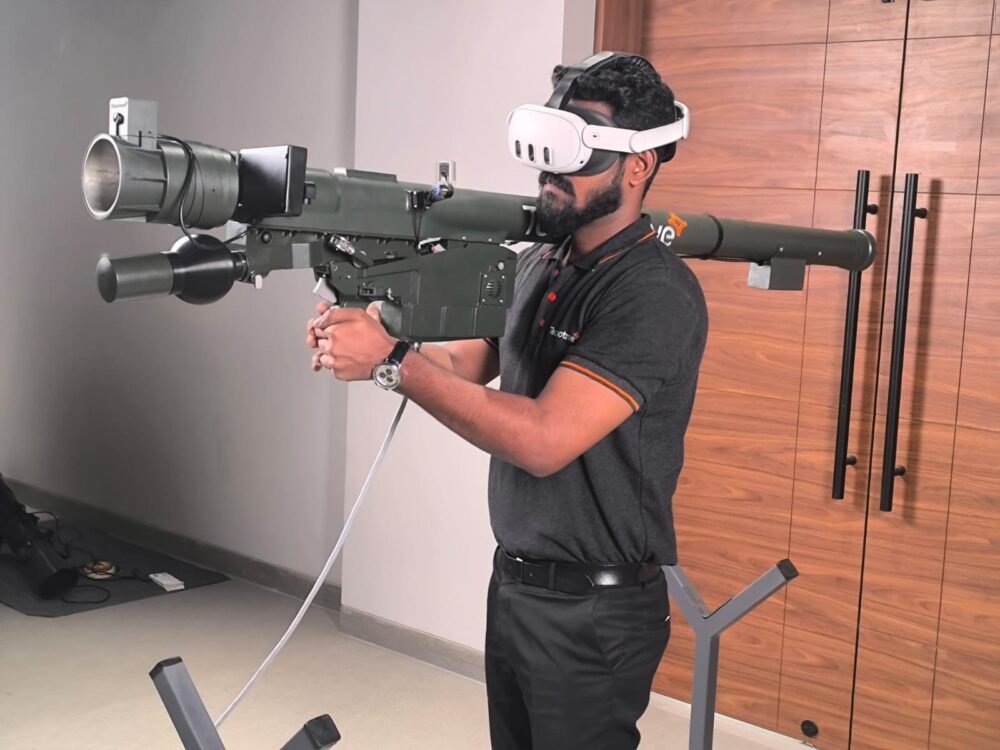
There is a sovereignty dimension here too, separate from cost. A simulator is, in effect, a working model of how a piece of military hardware behaves under stress, and owning that model, rather than licensing it from a foreign original equipment manufacturer, is a meaningful piece of strategic autonomy in its own right. It is the quieter half of India’s technology sovereignty story: not just building the platform, but owning the digital twin that trains the people who operate it. An in-house R&D base capable of developing everything from small-arms weapon trainers to full motion-platform tank simulators—of the kind Tecknotrove has built over 20 years—is what that sovereignty looks like in practice rather than in policy documents.
India’s defence exports now reach more than 80 countries, and training technology plays a distinct role in that diplomacy. It creates interoperability, institutional habits, and relationships that endure for decades
Diplomacy: Training Has a Longer Relationship Than a Sale
India’s defence exports now reach more than 80 countries, per the Ministry of Defence’s own April 2026 figures—a scale that would have been unthinkable for a country long associated with arms imports rather than exports. Training technology plays a distinct role in that diplomacy, because it creates a different kind of relationship than a hardware sale does. A missile sale ends at delivery. A training relationship doesn’t; it requires the exporting country’s engineers, instructors and support staff to stay engaged with the partner country’s institutions for years, embedding standards and habits that a one-time shipment never does. Training has always been one of the strongest instruments of military diplomacy. Equipment may establish a transaction; training builds relationships, interoperability and trust that endure for decades.
The Common Thread
Two decades ago, Indian defence training establishments were largely dependent on imported simulation systems. Today, that dependency has reversed enough that India exports the technology instead, and the ₹38,424 crore in defence exports recorded this past year, with a ₹50,000 crore target for 2029, is the visible tip of a shift that companies like Tecknotrove have spent twenty years building underneath it. What ties economy, technology and diplomacy together here is that none of it is really about simulators. It is about what a country does once it stops needing to import capability and starts being trusted to export it, and that, arguably, is a more precise test of a “real global power” than the ones usually reached for on Independence Day.
The strongest measure of independence was never only the ability to defend oneself. It is also the ability to help others build that capability. India’s invisible defence export is no longer invisible to the countries that now depend on it, and that, quietly, is a large part of what it looks like to become a real global power.

–The writer is Founder and Director of Tecknotrove Systems India Pvt Ltd. The views expressed are of the writer and do not necessarily reflect that of Raksha Anirveda





