


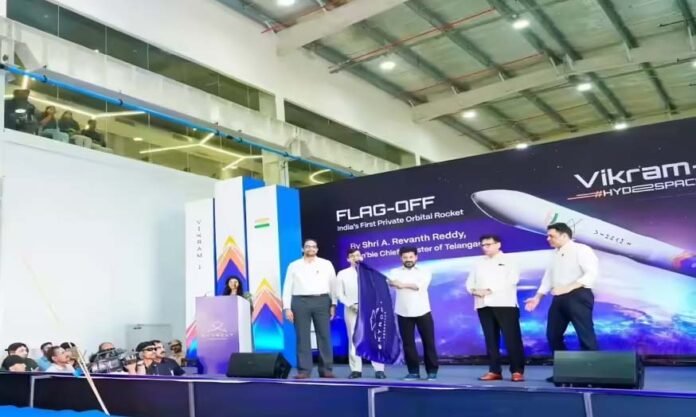
India stands at the threshold of a transformative moment in its space journey, as Hyderabad-based startup Skyroot Aerospace prepares to launch its first orbital rocket, Vikram-1. This mission is more than a technological milestone—it represents the emergence of private enterprise as a driving force in India’s space ambitions and its growing role in the global commercial space race.
The Vikram-1 rocket, currently in its final stages of integration and testing, is expected to lift off from Satish Dhawan Space Centre within weeks. According to recent reports, the mission will serve as a critical test flight aimed at validating systems, collecting flight data, and laying the groundwork for future commercial launches.

A Historic First for India’s Private Sector
Vikram-1 is poised to become India’s first privately developed orbital rocket, marking a decisive shift from a government-dominated space programme to a more inclusive ecosystem. Built over several years, the rocket reflects the rapid maturation of India’s private space tech sector following regulatory reforms that opened the field to non-government players.
The significance of this development cannot be overstated. Until recently, orbital launches in India were the exclusive domain of the Indian Space Research Organisation (ISRO). The entry of companies like Skyroot signals a new era of competition, innovation, and scalability, aligning India with global trends where private firms play a central role in space exploration and satellite deployment.
Technology and Design: Built for the Small Satellite Boom
Vikram-1 is designed as a small satellite launch vehicle capable of placing payloads of a few hundred kilograms into low-Earth orbit. This focus is strategic. The global demand for launching small satellites—used in communication, Earth observation, and scientific research—is rapidly expanding, and cost-effective, flexible launch solutions are in high demand.
The rocket incorporates advanced technologies, including carbon composite structures and precision-engineered propulsion systems. Its development has involved extensive testing, from propulsion validation to stage separation systems, ensuring reliability under real mission conditions.

Skyroot has positioned Vikram-1 as a “space taxi,” offering dedicated launch services tailored to customer needs rather than relying on shared rides aboard larger rockets. This model provides greater flexibility in orbit selection and scheduling, a key advantage in a competitive market.
From Testing to Launch: The Final Countdown
The rocket has already been transported from Hyderabad to Sriharikota, where teams are conducting final assembly, payload integration, and mission simulations. The upcoming launch will be a data-gathering exercise as much as a demonstration, with initial flights carrying partial payloads to validate performance before scaling up operations.

If successful, Skyroot aims to transition quickly from testing to regular commercial launches. The company has ambitious plans to eventually produce one rocket per month, signaling its intent to become a major player in the global launch services market.
Economic and Strategic Implications
The Vikram-1 mission comes at a time when India is seeking to expand its share of the global space economy, which is projected to grow exponentially in the coming decade. By enabling private participation, the country is tapping into entrepreneurial innovation and attracting investment into high-tech manufacturing and research.
For India, this is not just about launching satellites—it is about building an ecosystem. Startups like Skyroot are expected to create supply chains, generate employment, and foster technological advancements that extend beyond the space sector. The mission also strengthens India’s position as a competitive and cost-effective launch destination for international clients.
Challenges Ahead
Despite the optimism, the road ahead is not without challenges. Orbital launches are inherently complex, and even established players face setbacks. Vikram-1’s maiden flight will be closely watched, both for its technical performance and its implications for investor confidence in India’s private space ventures.
Moreover, competition in the small satellite launch market is intense, with global players offering similar services. To succeed, Skyroot will need to demonstrate reliability, cost efficiency, and rapid turnaround times—factors that determine long-term viability in the space industry.
A Defining Moment
The upcoming launch of Vikram-1 is more than a technological achievement; it is a symbol of India’s evolving ambitions in space. By bridging the gap between public sector’s capability and private innovation, the mission represents a bold step toward a more dynamic and globally competitive space ecosystem.
If Vikram-1 succeeds, it will not only validate Skyroot’s vision but also mark the beginning of a new chapter—one where India’s journey to the stars is powered as much by startups as by state institutions.






