


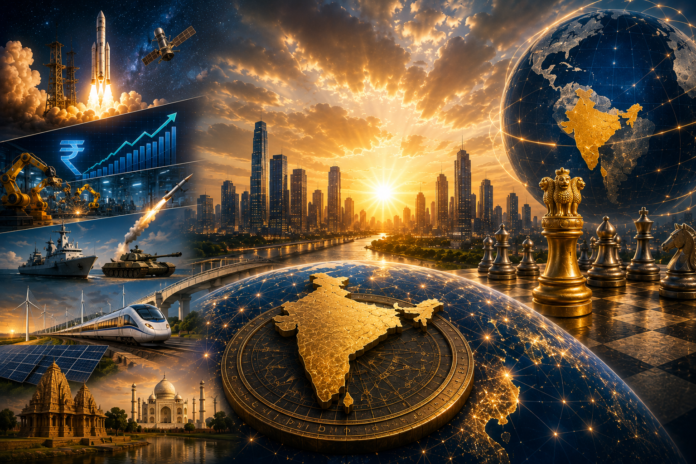
Every August, the tricolour rises over Red Fort and the nation pauses to measure how far it has come. This year, that measurement feels different. For decades, India was described in the conditional tense – an “emerging” power, a country of “potential,” a market to watch “eventually”. However, in 2026, that language is starting to sound dated. Across economics, technology, and diplomacy, India is no longer just emerging. It is arriving.
This is not a story of sudden transformation. It is the story of a decade of patient, often unglamorous groundwork – in fabrication plants, trade negotiations, digital rails and foreign ministries – compounding into something that finally looks like durable global weight.

Economy: Scale Meets Substance
The headline number is familiar by now: India remains the world’s fastest-growing major economy, with growth for 2026 running at roughly 6.5–6.6 per cent even as global output hovers under 2.7 per cent growth and elevated trade tensions.
While nominal GDP expands, converting a median age under 30 into formal employment and raising per-capita wealth remain the critical challenges ahead
What’s changed is the texture beneath that number. The IMF’s 2026 outlook places India’s nominal GDP at roughly $4.1–4.5 trillion, the sixth-largest in the world – a position achieved even after a technical GDP base-year revision that, by rights, should have flattered the figures less, not more.
Three things distinguish this growth cycle from earlier ones. First, it is overwhelmingly domestic. Resilient household consumption, sustained public capital expenditure and recent tax reform have insulated India from the worst of the tariff shocks and shipping disruptions rattling other exporting nations.
Second, remittance inflows – at a record $135 billion-plus – underscore a diaspora economy that keeps reinvesting in the homeland even as it succeeds abroad. Third, and most importantly, the growth is increasingly structural rather than cyclical: infrastructure buildout, UPI-driven digital finance and a manufacturing base diversifying away from a China-dependent global supply chain are compounding rather than fading.

None of this erases the harder arithmetic. GDP per capita, at under $3,000, remains modest by global standards, and converting a demographic dividend – a median age
under 30 – into productive formal employment for millions of new entrants every year is the defining economic test of the coming decade.

Government debt near 80 per cent of GDP is manageable but with no limitless headroom. Real global power, unlike an emerging one, is judged not on its best quarter but on whether it can keep delivering when the world isn’t cooperating. On that test, India has so far held its footing better than the most.
Moving beyond back-office code, the India Semiconductor Mission has turned into physical infrastructure with $18B+ in investment, while Mission 2.0 shifts focus directly toward domestic chip design
Technology: From Services to Silicon
For thirty years, “Indian technology” meant one thing to the world: services. Code written for someone else’s product, back offices run for someone else’s company. That single-track identity is finally breaking apart, and nowhere is the shift more visible than in semiconductors — the industry that, more than any other, decides which nations get treated as strategically indispensable rather than merely useful.
The India Semiconductor Mission, launched in 2021 as a policy aspiration with a modest outlay, has by 2026 become physical infrastructure. Micron’s assembly and test facility in Sanand went live in February; Kaynes Semicon’s OSAT plant followed in March; Tata Electronics’ joint venture with Taiwan’s PSMC is targetting first silicon from its Dholera fab before year-end.
As of mid-2026, roughly a dozen approved projects span six-plus states, backed by cumulative commitments north of ₹1.6 lakh crore, with cumulative foreign and domestic investment north of $18 billion is now anchored in Indian soil.
The government’s follow-on Semiconductor Mission 2.0, with an outlay above $13 billion, deliberately shifts focus from simply assembling chips to designing them — equipment, materials and full-stack intellectual property developed on Indian soil rather than licenced from elsewhere.
This matters strategically as much as economically. As global supply chains reorganise around a “China Plus One” logic, India has positioned itself as the credible alternative — not merely a low-cost assembly floor but, increasingly, a design and manufacturing partner trusted with sensitive technology.
That trust extends beyond chips: India’s digital public infrastructure — UPI foremost among it — now processes more digital payments annually than any other nation and has become an export product in its own right, adopted or studied by central banks and finance ministries across the Global South.
India’s UPI-driven financial rails now handle more digital payments than any other nation, evolving into a global technology model adopted across the Global South
The gap that remains is at the frontier — leading-edge sub-10nm fabrication, and the deep bench of AI research and semiconductor-manufacturing talent needed to sustain it, are still being built rather than banked. But the direction of travel, from writing code for others’ hardware to building the hardware itself, is the clearest technological marker of India’s transition from a mere participant to power.
Diplomacy: Strategic Autonomy as Statecraft
If economics supplies the weight and technology the leverage – diplomacy is where a country converts both into actual influence — and here, India’s evolution has been the most deliberate of the three.
The old non-alignment of the Cold War era has given way to what analysts now call multi-alignment: not standing apart from major powers, but maintaining simultaneous, transactional partnerships with all of them — Washington, Moscow, Brussels, Tokyo and Beijing at once — without becoming dependent on any single one.
This posture has been tested repeatedly through 2025 and into 2026: trade friction with the United States over tariffs, unresolved border tension with China, political turbulence in Bangladesh and Nepal that complicates the “Neighbourhood First” policy and a Quad relationship whose next leaders’ summit remains a live diplomatic project rather than a settled fixture.
Modern Indian diplomacy balances transactional partnerships with Washington, Moscow and Beijing simultaneously, substituting old-school non-alignment for active strategic autonomy
Strategic autonomy in this environment is not a slogan; it is daily improvisation under pressure, and India has generally managed it without the paralysis that afflicts smaller or less confident powers.
Where India has moved from reactive to proactive is in its claim to speak for the Global South.
Building on the momentum of its 2023 G20 presidency, India has continued positioning itself as the leading voice for developing-world concerns in reforming the UN Security Council, the WTO and multilateral lending institutions — while backing that rhetoric with tangible outreach.
Prime Minister Modi’s tours through Africa, the Middle East and Central Asia in the past year, alongside expanding vaccine diplomacy and infrastructure financing, reflect a foreign policy trying to convert moral authority into structural relationships, not just applause at international forums.
The unfinished business is close to home. “Neighbourhood First” cannot be a policy in name only while Dhaka, Kathmandu and Malé drift in and out of India’s orbit depending on domestic politics in each capital.
Building on its G20 momentum, India is translating moral authority into structural influence across Africa, Asia and global institutions, even as it navigates complex regional neighbourhood dynamics
A country aspiring to real global power status will ultimately be judged as much by the stability of its own region as by its standing in Washington or Brussels.
The Decade Ahead
Taken together, these three threads — an economy growing on its own domestic strength rather than borrowed momentum, a technology base moving from services to sovereignty and a diplomacy confident enough to hold multiple relationships without losing its own centre of gravity — describe a country that has stopped merely emerging.
India in 2026 is not yet a superpower by the old, narrow definition of the term: military reach, per-capita wealth and technological frontier leadership, it still lags behind the United States and China by real margins.
But “real global power” was never only about matching the old hegemons on their terms. It is about becoming a nation whose choices, on trade, on technology standards, on the shape of multilateral institutions, meaningfully change outcomes for everyone else. By that measure, India’s transition is no longer a promise for the future. It is already underway — and the next decade will decide whether the world simply watches it, or has to reckon with it.

–The writer is an internationally experienced leader in R&D and product innovator with a proven track record of building and transforming global organisations to accelerate innovation, reduce costs, and drive growth across the healthcare sector. As a thought leader in global affairs, he offers unique perspectives at the intersection of technology, healthcare, and international strategy. The views expressed are personal and do not necessarily reflect the views of Raksha Anirveda





