


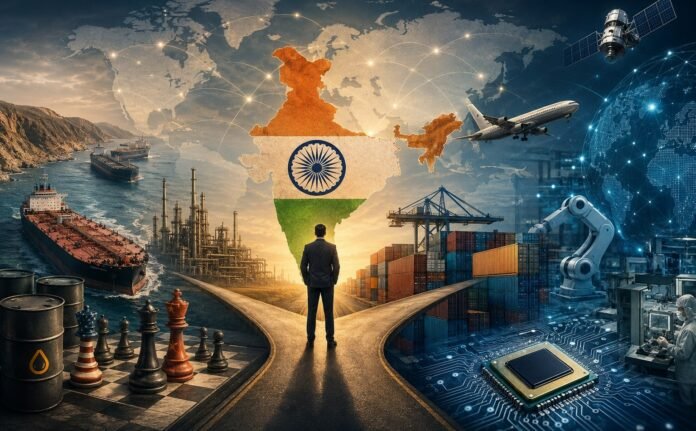
For most of the post-independence era, India was described in the conditional tense as a country of enormous potential, forever ‘emerging’, forever a market of tomorrow. That framing is beginning to look dated. Across economics, technology and diplomacy, India in the mid-2020s is behaving less like a country waiting for its moment and more like one actively converting scale into leverage. Whether this decade completes the journey from emerging power to genuine global power will depend on how well India manages three interlocking transitions at once.
Economy: Growth With a Manufacturing Spine
The headline numbers are, by any global standard, striking. Provisional data for FY2025–26 put India’s GDP growth at roughly 7.7 per cent, comfortably ahead of pre-year estimates. In comparison, the Asian Development Bank projects growth easing modestly to 6.9 per cent in FY2026 before reaccelerating to 7.3 per cent the following year. Even the more conservative IMF figures place India as the world’s fastest-growing major economy, with nominal GDP now in the range of $4.1–4.5 trillion. On current trajectories, India is expected to overtake Germany as the world’s fourth-largest economy by 2028.

What distinguishes this growth phase from earlier ones is composition. India’s post-liberalisation growth story was disproportionately a services story: IT outsourcing, business process management, and more recently Global Capability Centres, of which India now hosts more than 1,700, employing 1.9 million people. That services engine remains vital. But the newer element is a genuine attempt to build a manufacturing spine underneath it. The Production Linked Incentive scheme has reportedly crossed Rs 2 lakh crore in actualised physical investment, and the India Semiconductor Mission, once dismissed as improbable for a country with no prior chip-manufacturing base, delivered its first tangible output in February 2026, when Micron’s Assembly, Test and Packaging facility in Sanand, Gujarat began commercial production. Total semiconductor and electronics demand in India is projected to cross $80 billion by 2026 and $110 billion by 2030.
Provisional data for FY2025-26 put India’s GDP growth at roughly 7.7%. The ADB projects growth easing modestly to 6.9% in FY2026 before reaccelerating to 7.3% the following year. IMF figures place India as the world’s fastest-growing major economy, with nominal GDP now in the range of $4.1–4.5 trillion. India is expected to overtake Germany as the world’s fourth-largest economy by 2028
This matters geopolitically as much as economically. A country that only exports services can be admired; a country that manufactures chips, builds green hydrogen capacity, and anchors global supply chains has actual structural leverage over other nations’ industrial planning. Fiscal indicators reinforce the picture of a state with room to invest in this transition: net GST collections reached roughly Rs 19.35 lakh crore in FY2025–26, up 7.1 per cent year-on-year, giving New Delhi a widening revenue base to fund the infrastructure ports, freight corridors, power grids that manufacturing scale-up requires.
None of this erases India’s structural challenges. GDP per capita remains under $3,000, a stark reminder that aggregate scale and per-capita prosperity are different things, and government debt sits at a manageable but non-trivial 80.8 per cent of GDP. The demographic dividend that gives India its long-term optimism a median age under 30, a working-age population that will not peak until the 2050s is also a demanding one: it requires the creation of millions of formal jobs annually, a target India has historically struggled to hit. Growth without absorption is not the same as growth with transformation.
Technology: From Adoption to Architecture
India’s technology story has quietly shifted from adoption to architecture. The country did not simply adopt digital payments; it built the Unified Payments Interface and now processes more digital transactions annually than any other nation on earth. It did not simply digitise identity; Aadhaar became a template studied and, in modified form, exported to other developing economies. This ‘India Stack’ model open, interoperable, publicly-owned digital infrastructure is now being actively promoted as an export product, with India leading Stack adoption efforts across Africa and Southeast Asia.

India’s technology story has quietly shifted from adoption to architecture. The country did not simply adopt digital payments; it built the Unified Payments Interface and now processes more digital transactions annually than any other nation on earth. It did not simply digitise identity; Aadhaar became a template studied and, in modified form, exported to other developing economies
The semiconductor push described above is the hardware complement to this software-layer strength, and the two are increasingly designed to reinforce each other: a domestic chip base reduces India’s exposure to export controls and supply shocks, while a mature software and AI talent pool gives India a credible claim to participate in frontier AI governance rather than merely consuming AI built elsewhere. India has joined the Global Partnership on AI and successfully hosted the AI Impact Summit in February 2026, positioning itself as a bridge between the AI-governance priorities of the developed world and the AI-access priorities of the Global South a role few other nations are positioned to credibly play, given India’s simultaneous status as both a major AI talent exporter and a large, still-developing domestic market.
The unresolved question is depth. India excels at building large-scale digital public infrastructure and at IT services; it is only beginning to build genuine frontier research capacity in foundational AI models, advanced chip design, and the kind of deep-tech R&D that produces intellectual property rather than just implementation capacity. Converting ‘digital adoption at scale’ into ‘technological frontier leadership’ is the harder half of this transition, and it will require sustained investment in research institutions, not just infrastructure rollouts.

Diplomacy: Strategic Autonomy as Load-Bearing Doctrine
If economy and technology are the material basis of India’s rise, diplomacy is the doctrine that translates material power into influence, and here India’s approach has been unusually coherent for a country navigating an increasingly polarised world. New Delhi has resisted the pressure, intensified by the ‘Second Cold War’ dynamics of US-China rivalry, to pick a camp. Instead, it practises what analysts increasingly call multi-alignment: simultaneous, purpose-specific engagement with the Quad, BRICS, the SCO, the G20 and a growing list of issue-based minilaterals such as I2U2, rather than adherence to a single alliance structure.
This is not costless. A blunt warning delivered at the Raisina Dialogue by a senior US official that Washington would not repeat with India the strategic missteps it made with China and Japan captured how uncomfortable major powers can find India’s refusal to align with them fully. Trade frictions with the United States, alongside India’s continued strategic relationship with Russia and civilisational ties with Iran, illustrate that strategic autonomy generates real diplomatic cost, not just flexibility. The task for Indian diplomacy in this decade is to ensure autonomy does not curdle into isolation, a risk that regional experts have cautioned explicitly, warning that strategic autonomy should not become strategic ambiguity as US-China competition sharpens.
India has resisted the pressure, intensified by the ‘Second Cold War’ dynamics of US-China rivalry, to pick a camp. Instead, it practises what analysts increasingly call multi-alignment: simultaneous, purpose-specific engagement with the Quad, BRICS, the SCO, the G20 and a growing list of issue-based minilaterals such as I2U2, rather than adherence to a single alliance structure
Where India has been most effective is in converting its G20 presidency legacy into durable initiatives rather than one-off summit theatre. The India-Middle East-Europe Economic Corridor, announced during that presidency, is explicitly positioned as connectivity infrastructure that offers an alternative to China’s Belt and Road Initiative, even as regional conflict has slowed its implementation. Combined with sustained advocacy for reforming the UN Security Council, WTO and IMF, and continued positioning as the ‘Voice of the Global South’, India’s diplomatic playbook increasingly resembles that of an aspiring rule-shaper rather than a rule-taker.
The Common Thread
What links the economic, technological and diplomatic transitions is a single underlying wager: that scale, deployed with sufficient institutional discipline, can be converted into structural leverage rather than remaining merely impressive statistics. A $4-trillion-plus economy growing near 7 per cent gives India negotiating weight in trade talks. A billion-user digital public infrastructure gives it a template to export and a market too large for global tech platforms to ignore. A foreign policy that refuses binary alignment gives it room to extract concessions from multiple great powers simultaneously rather than depending on the goodwill of one.
The real power comes not from any single one of these vectors but from their convergence: a growing economy that funds technological investment, a technological base that reduces strategic dependence, and a diplomatic doctrine flexible enough to protect both. Emerging powers accumulate potential. Real global powers convert that potential into outcomes other nations cannot ignore. India’s task for the remainder of this decade is to prove it can do the latter, consistently, across all three fronts at once, not merely in the years when growth numbers happen to look favourable.

The writer is an independent researcher. The views expressed are of the writer and do not necessarily reflect the views of Raksha Anirveda





