


Every August, India tells itself a new version of the same story: a civilisation rediscovering its place in the world, a nation of scale finally matching its ambition. It is a story worth telling. But stories can also become a comfortable substitute for scrutiny. The more useful question this Independence Day is not how far India has come in the last decade, since that ground is well covered. It is whether the country has the institutional stamina to convert a decade of promise into a decade of delivery.
I write this not as an economist or a diplomat. Having spent years building indigenous defence technologies alongside researchers, engineers and the armed forces, I have witnessed how policy translates into capability, and where it still falls short. That vantage point offers a useful, if narrow, window into a larger question: can India sustain reform, innovation and strategic clarity long enough to become a consequential power, rather than merely an emerging one?

Economy: The Size Debate Masks the Structure Problem
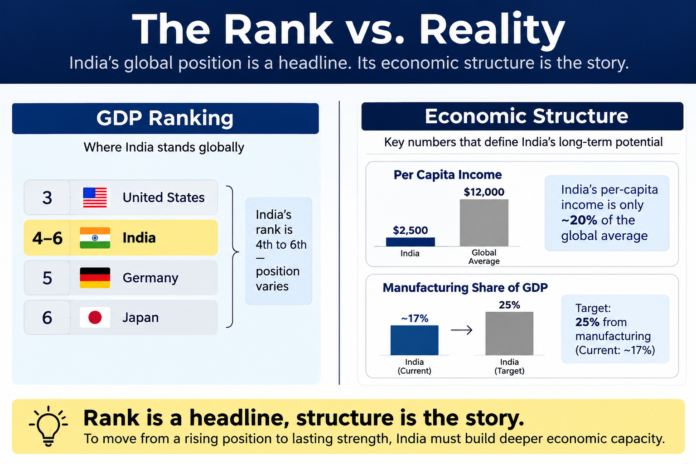
India spent much of the past year celebrating its arrival as the world’s fourth-largest economy, only to watch that ranking being contested. Depending on which agency’s numbers are used, and which exchange rate applies, India sits anywhere between fourth and sixth place globally in nominal GDP terms. That difference is driven as much by rupee depreciation and a statistical base-year revision as by any change in the underlying economy. What has not changed is that India remains the fastest-growing major economy, expanding at over 6% even as the US, China, Japan and the Eurozone all grow at a slower rate.
That is genuinely significant. But rank is a headline; structure is the story. India’s economy is large because its population is large. Per capita income remains under $2,000, a fraction of what fourth-place status would suggest in any other context. Manufacturing’s share of GDP has been stubbornly stuck around 17% for a decade, well short of the 25% target that successive governments have set. And the country still needs to create work for millions of young people entering the labour force every year, at a moment when AI and automation are compressing the very entry-level jobs that used to absorb them.
None of this diminishes what has been achieved. The last decade delivered working digital public infrastructure, a formalising economy, and genuine global investor interest. But the next decade’s economic test is different from the last one’s. It is no longer about proving India can grow. It is about proving India can grow in a way that employs its people, deepens its manufacturing base, and holds its ground through global shocks, whether tariff shifts, supply-chain realignments or currency volatility, without pausing the reform agenda every time growth dips.
India is the fastest-growing major economy, expanding at over 6% even as the US, China, Japan and the Eurozone all grow slowly. That is genuinely significant. But rank is a headline; structure is the story. India’s economy is large because its population is large. Per capita income remains under $2,000, a fraction of what fourth-place status would suggest in any other context
Technology: From Service Provider to Sovereign Capability
If the economic story is about scale, the technology story is about depth. Here, the shift over the past decade has been more structural than anywhere else. India built its global reputation as an IT services and outsourcing hub. It is now, visibly, building something else: a deep-tech base capable of producing its own hardware, algorithms and platforms rather than only servicing someone else’s.

Deep technology is no longer only a matter of commercial competitiveness. It is a matter of strategic sovereignty. Nations that cannot design their own AI systems, sensors, advanced materials and autonomous platforms will increasingly find themselves dependent on others, not just for economic resilience but for national security itself. That is the deeper stake behind India’s push into deep-tech, and it is why this shift matters well beyond any single sector.
Defence is a useful lens because the numbers here are unusually well tracked. Indigenous defence production touched an all-time high of over ₹1.78 lakh crore in FY26, more than double what it was five years earlier. Defence exports, which stood at a modest ₹686 crore a decade ago, closed FY26 near ₹38,424 crore, with Indian-made systems now reaching over 80 countries. Programmes like iDEX, the Innovations for Defence Excellence platform, have engaged more than 675 startups and MSMEs and signed over 550 design-and-development contracts. Newer initiatives such as ADITI are backing deep-tech ventures with grants of up to ₹25 crore for technologies once assumed to be beyond domestic reach.

At Big Bang Boom Solutions, our journey from a small research-driven startup in Chennai to developing indigenous systems for the Indian Armed Forces reflects this larger transformation. What began as an effort to solve a specific problem, detecting and neutralising hostile drones, has grown into work on counter-UAS defence, battlefield situational awareness and camouflage technologies, contributing to indigenous capability development for the forces and for partner nations. None of that would have been possible even eight years ago, when defence R&D and manufacturing were almost entirely the preserve of large public-sector players. What changed was not just funding. It was a policy architecture that began treating startups as co-developers rather than vendors.
The gap that still needs closing is not the gap between idea and prototype. India has proven it can generate both. It is the gap between prototype and procurement, where certification timelines, testing bottlenecks and working-capital constraints continue to slow the journey from innovation to induction at scale.
The broader lesson extends well past defence. The same deep-tech capability, in AI, autonomous systems, advanced materials and quantum communications, that startups are building for the armed forces increasingly finds its way into space, logistics, healthcare and critical infrastructure. Technology is not a separate pillar of India’s rise. It is the connective tissue between the economic and diplomatic ones, because a nation’s ability to produce its own critical technology is now inseparable from its ability to negotiate as an equal on the world stage.
India’s technology story is about depth. Here, the shift over the past decade has been more structural than anywhere else. India built its global reputation as an IT services and outsourcing hub. It is now, visibly, building something else: a deep-tech base capable of producing its own hardware, algorithms and platforms rather than only servicing someone else’s
Building deep-tech in India has taught me something the last decade’s headline numbers rarely capture. This kind of innovation does not reward speed alone. It rewards patience, a sustained research culture, and policy that stays consistent long enough for a hard technical problem to actually get solved. That, more than any single scheme or subsidy, is what the next decade needs to protect.
Diplomacy: Strategic Autonomy in a Fracturing World
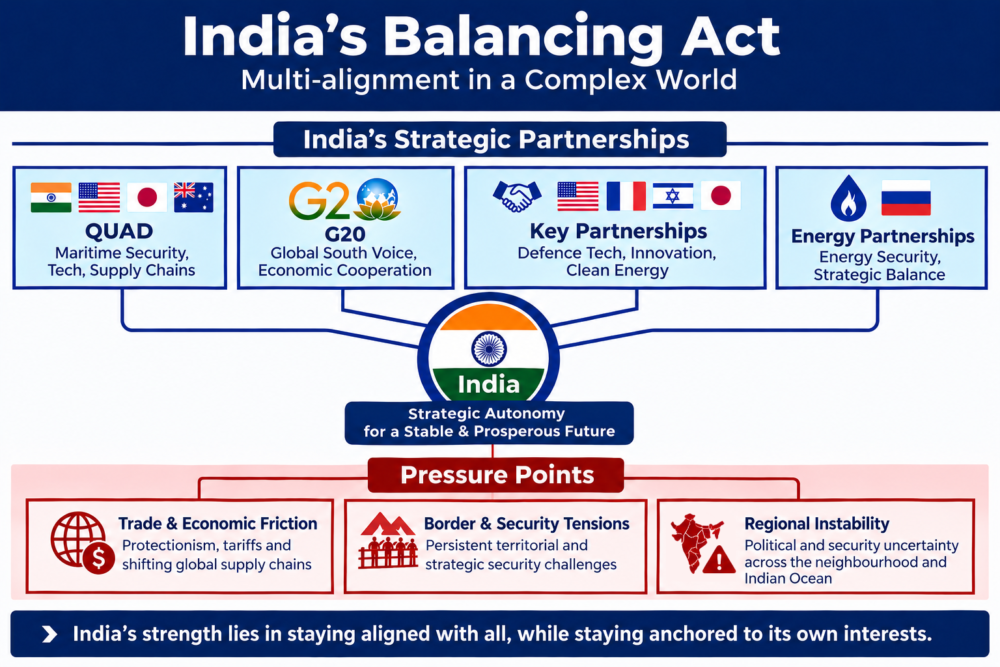
The diplomatic pillar may be the hardest of the three to assess, precisely because it depends on choices outside India’s control. The past decade saw India deepen its Quad partnership, host the G20, and expand defence and technology cooperation with the US, France, Israel and Japan, while continuing to buy Russian energy and maintain its own posture on Ukraine. That balancing act drew criticism from multiple directions, and largely, India held it.
That balancing act will be tested harder in the decade ahead. Trade friction with the United States, an unresolved and still-tense border with China, an unstable neighbourhood stretching from Bangladesh to Myanmar, and a global order that is visibly fragmenting into competing blocs all mean India cannot assume that strategic autonomy will keep working simply because it worked before. Every major power India deals with is itself recalibrating. That means India’s diplomatic capital will need to be actively renewed each year, not simply inherited from the last one.
India’s defence production touched an all-time high of over Rs 1.78 lakh crore in FY26, more than double what it was five years earlier. Defence exports, which stood at a modest Rs 686 crore a decade ago, closed FY26 near Rs 38,424 crore, with Indian-made systems now reaching over 80 countries
India’s ability to export trusted technologies, from digital public infrastructure to indigenous defence systems, will increasingly shape its diplomatic influence. Countries in Africa, Southeast Asia and Eastern Europe that are wary of over-dependence on either Washington or Beijing are looking for credible, non-aligned technology and manufacturing partners. That is a genuine, still-underused Indian advantage, and one that connects directly back to the technological depth described above. Diplomacy increasingly follows technological trust, not the other way around.
What Could Go Wrong
It would be dishonest to end on momentum alone. Three risks stand out. First, reform fatigue. India’s history shows that ambitious agendas, from labour codes to land reform to agricultural marketing, tend to stall the moment they meet political resistance. A decade of incremental follow-through matters more than any single announcement. Second, the execution gap. Policy architecture such as iDEX, PLI, the Positive Indigenisation Lists and Startup India has been built faster than the administrative capacity to execute it. Certification delays and procurement bottlenecks remain the most common complaint across India’s startup ecosystem, defence and otherwise. Third, external shocks. A decade that includes further tariff disputes, a sharper Taiwan crisis, or renewed border tension with China could easily divert bandwidth and capital away from long-term reform towards short-term crisis management.
The past decade saw India deepen its Quad partnership, host the G20, and expand defence and technology cooperation with the US, France, Israel and Japan, while continuing to buy Russian energy and maintain its own posture on Ukraine. That balancing act drew criticism from multiple directions, and largely, India held it. The balancing act will be tested harder in the decade ahead
None of these risks are unique to India, and none are unmanageable. But they are the honest answer to the question this feature poses: whether the coming decade will be a smooth run. It will not be. What will determine the outcome is whether India’s institutions, in government, in industry, and in the startup ecosystem I work in every day, can keep reforming through the friction rather than only during the calm.
The Decade that Decides
Viksit Bharat 2047 is not a single milestone; it is a compounding bet on two decades of consistent choices. The 2026-2036 decade is the one in which that bet either compounds or breaks. India has real assets going into it: a demographic dividend still years from its peak, a technology base finally producing its own IP rather than only servicing someone else’s, and a diplomatic standing earned rather than assumed.
Whether that adds up to India becoming a real global power, or a large but still-emerging one, will not be decided by any single budget, election or summit. It will be decided by whether India can do the less glamorous work: closing the prototype-to-procurement gap, lifting manufacturing’s share of GDP, and renewing diplomatic capital year after year, with the same discipline it has shown in building the foundations. The story India tells about itself next August will depend far less on what happened in the last decade, and far more on what it chooses to finish in this one.

The writer is Co-Founder and Chief Technology Officer of Big Bang Boom Solutions, a Chennai-based deep-tech company developing indigenous technologies across defence, homeland security and strategic sectors. His work focuses on advancing India's self-reliance in critical technologies through innovation, research and industry collaboration





