


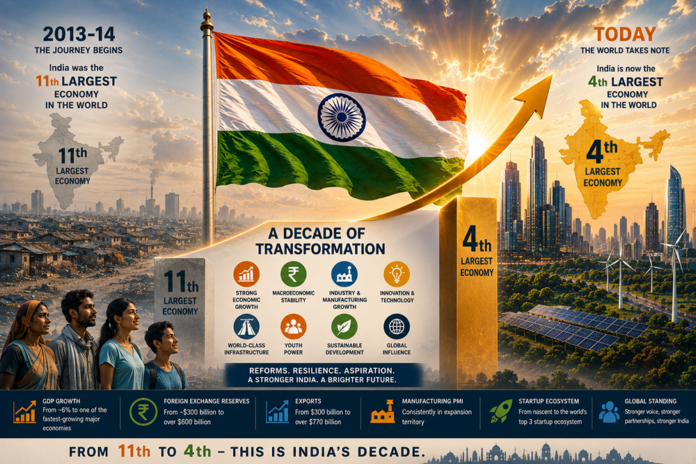
Adecade ago, India was grouped among the “Fragile Five” emerging markets, battered by inflation and a weak rupee. That narrative has been rewritten. India’s nominal GDP has roughly tripled from ₹106.57 lakh crore in 2014-15 to ₹331.03 lakh crore in 2024-25, with the country becoming the fourth-largest global economy in 2025.
According to IMF data cited by NITI Aayog, India’s GDP has doubled in the past decade, growing 105 per cent from $2.1 trillion in 2015 to $4.3 trillion in 2025 – outpacing the growth rates of the United States and China over the same period. The economy has also climbed steadily through the global rankings: it overtook France to become the world’s sixth-biggest economy in 2017, then surpassed the UK in 2022 and is now closing in on Japan and Germany.

Economy: From Fragile Five to Fourth Largest
Trade and investment figures tell a similar story of scale. Total exports rose 76 per cent over the decade to reach $825 billion in 2024-25, led by engineering goods, electronics and pharmaceuticals, while services exports more than doubled from $158 billion to $387 billion and cumulative FDI inflows touched $1.05 trillion.
Growth momentum has held up too: real GDP for FY 2025-26 is estimated at 7.6 per cent growth, with nominal GDP projected to cross $3.9 trillion, driven largely by resilient domestic demand and macroeconomic stability. India today also hosts 126 unicorn startups, with six new ones added in 2025 alone, a marker of how deep its entrepreneurial base has become.
From “Fragile Five” to the world’s fourth-largest economy – India’s last decade has been one of the fastest ascents in modern economic history. But has scale become strength, or just size?
Yet, the picture is not one of unbroken triumph. The merchandise trade deficit widened sharply in Q3 FY 2025-26 to $93.6 billion, even as the services surplus improved to $57.5 billion, underlining a persistent dependence on services to offset a stubborn goods-trade gap. And as commentators note, per-capita income – around $2,813 in 2026 – remains a fraction of that in advanced economies, a reminder that macro scale has not yet translated into broader prosperity.
Technology: The Digital Public Infrastructure Revolution
If economics has been India’s headline story, technology has been its quiet revolution. The Unified Payments Interface, launched in 2016, is the clearest example. A decade on, UPI transactions grew from around 2 crores in FY 2016-17 to more than 24,000 crores in FY 2025-26, and the platform now accounts for roughly 81 per cent of India’s domestic digital payments and nearly 49 per cent of all real-time digital transactions worldwide.

This is not merely a domestic achievement – it has become an instrument of statecraft. India’s Digital Public Infrastructure has been formally engaged by 23 nations through cooperation agreements, effectively exporting a governance model built on identity, payments and data exchange.
Connectivity has scaled just as fast. India now has over 102.86 crore internet connections and 99.56 crore broadband subscribers, with 5G covering 99.9 per cent of districts, while the cost of a gigabyte of mobile data has fallen from around ₹270 in 2014 to just ₹8-10 – arguably the world’s cheapest data market. Hard infrastructure has followed: BharatNet has connected 2.18 lakh gram panchayats to high-speed broadband, pushing digital access to the last mile of rural India.

In 2016, UPI processed a few crore transactions a year. Today it handles over 24,000 crores – nearly half of all real-time digital payments on Earth. This is the story of how India turned a domestic payments app into a tool of global statecraft
Manufacturing capability has grown alongside connectivity. Electronics manufacturing has grown into an industry worth roughly ₹13 lakh crore and is now India’s third-largest export category, with the country emerging as the world’s second-largest mobile phone manufacturer.
Semiconductors – long India’s Achilles’ heel – are finally moving from ambition to execution: 12 semiconductor projects have been approved, marking a real step toward domestic commercial chip manufacturing, while SEMICON India 2025 drew over 350 exhibiting companies from 48 countries and 13 signed MoUs.
On the frontier of space technology, India’s 2023 Chandrayaan-3 mission made it the first nation to land near the lunar south pole, cementing ISRO’s reputation for low-cost, high-precision engineering.
Diplomacy: From Non-Alignment to Omni-Alignment
India’s diplomatic transformation has been the most visible marker of its power shift. The 2023 G20 presidency was widely treated as a coming-of-age moment: it coincided with India becoming the fourth country to land on the moon, overtaking China as the world’s most populous nation and surpassing the UK as the fifth-largest economy, prompting comparisons to China’s 2008 Beijing Olympics as a statement of arrival.
New Delhi used the platform judiciously – India’s G20 presidency emphasised human-centric globalisation, digital public infrastructure and the voice of the Global South and included securing permanent African Union membership in the G20 and launching the Global Biofuels Alliance.
G20 host, Quad member, BRICS partner, top Russian oil buyer – all in the same breath. India’s foreign policy has moved from non-alignment to what analysts call “omni-alignment”
This has evolved into a broader posture some analysts now call “omni-alignment.” India is shifting from classic non-alignment to a plurilateral model – simultaneously engaging the G7, G20, BRICS, SCO, Quad, Commonwealth and NAM to maximise leverage and preserve strategic choice.
This balancing act was tested severely in 2025: a terrorist attack in Kashmir in April was followed by a four-day India-Pakistan conflict in May and Washington’s claim of having brokered the ceasefire strained India-US ties even as US-Pakistan relations deepened.
Yet, India continued purchasing Russian oil despite American tariff pressure, maintained its own ceasefire narrative and attended both BRICS and Quad meetings in the same month – evidence, supporters argue, of strategic autonomy being defended rather than abandoned.
Has India Become a Regional Power?
Whether India has consolidated as a regional power is more contested than its rise as an economic or technological force. India’s economic and military weight relative to South Asia is undeniable – it dwarfs every neighbour combined, anchors institutions like BIMSTEC and has extended influence through the International Solar Alliance and infrastructure diplomacy.
Yet, its immediate neighbourhood remains its most difficult terrain. Pakistan continues to impose recurring security costs through what analysts describe as proxy conflict, as seen in the 2025 clash, while China’s continued military presence along the Line of Actual Control constrains Indian resources and limits its freedom of manoeuvre in South Asia.
India dwarfs its neighbours economically and militarily – but Pakistan still bleeds it through proxy conflict, China still watches from the LAC and Beijing’s money is quietly winning over Nepal, Sri Lanka and Bangladesh. Is India really South Asia’s hegemon, or just its biggest player?
Domestic capacity gaps – including roughly 50 million pending court cases and a 21 per cent police vacancy rate – illustrate that India’s state capacity has not yet caught up with its regional ambitions.
India today functions as the dominant power in South Asia by most conventional measures, but not yet as an uncontested regional hegemon in the way the US shapes North America -Chinese economic and strategic penetration of Nepal, Sri Lanka and Bangladesh means India’s regional primacy is real but incomplete, a work in progress rather than a finished achievement.
Ultimately, across economy, technology and diplomacy, India’s decade-long trajectory shows a nation that has moved decisively beyond “emerging power” status without yet fully arriving at a uncontested global power position.
The gap between India’s per-capita income of roughly $2,600 and the United States’ $80,000 signals that global heft has outpaced domestic development. What India has achieved is real: scale, speed and growing agenda-setting capacity. What remains unfinished is depth – converting scale into broad prosperity and regional presence into regional primacy.

-The writer is a New Delhi-based senior commentator on international and strategic affairs, environmental issues, an interfaith practitioner, and a media consultant. The views expressed are personal and do not necessarily carry the views of Raksha Anirveda





