


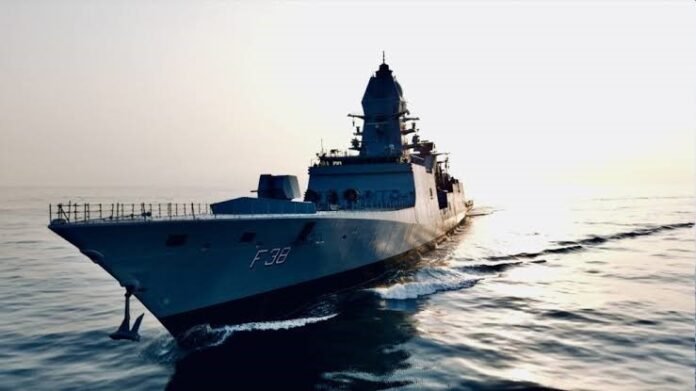
Visakhapatnam. The Indian Navy today, July 11, commissioned INS Mahendragiri (F38), the sixth and last ship of the indigenous Nilgiri-class stealth frigates built under Project 17A, marking the completion of a programme that has anchored India’s push toward self-reliant warship building.
Built by Mazagon Dock Shipbuilders Limited in Mumbai and designed in-house by the Navy’s Warship Design Bureau, Mahendragiri was delivered to the Navy on April 30 this year and is named after the Mahendragiri mountain range in the Eastern Ghats of Odisha, a nod the Navy says reflects resilience, strength and unwavering resolve. The frigate carries the motto “Mighty–Majestic–Matchless” and is the first Indian naval vessel to bear the name.

The ceremony came a day after Rajnath Singh addressed naval personnel at a Barakhana in Visakhapatnam on the eve of the commissioning, where he described the Indian Ocean Region as “our courtyard” and said securing it was India’s responsibility. He noted that more than 90 per cent of India’s trade by volume moves by sea, tying maritime security directly to the country’s economic growth, energy security and protection of its island territories. He also pointed to rising geopolitical competition and a growing presence of extra-regional powers in the region as reasons for heightened naval vigilance.
Singh used the occasion to underline the government’s commitment to modernising the armed forces, telling soldiers that warfare’s character was evolving and that future conflicts might take unforeseen forms, including confrontations without formal declarations of war. He said the government would spare no effort in equipping forces with world-class weaponry and technology, while stressing that it was ultimately the people wielding such weapons, not the hardware alone, who determined outcomes in war. Chief of the Naval Staff Admiral Krishna Swaminathan and Eastern Naval Command chief Vice Admiral Sanjay Bhalla were among senior officers present.
INS Mahendragiri is built for the full spectrum of naval operations – anti-air, anti-surface and anti-submarine warfare – and is equipped with an advanced suite of indigenous and imported weapons and sensors, including surface-to-surface and surface-to-air missile systems, electronic warfare capabilities, comprehensive anti-submarine systems and an integrated combat management system.
Beyond combat roles, the frigate is designed for maritime security patrols, power projection, humanitarian assistance and disaster relief, search and rescue, and sustained deployments. Officials say the ship carries advanced stealth features that reduce its radar signature, along with a high degree of automation and enhanced survivability systems, and is built for high-speed operations with strong endurance.

The Navy has highlighted that the frigate’s construction drew on a wide network of Indian industry, including numerous micro, small and medium enterprises, with more than 75 per cent indigenous content by some estimates – part of the broader Aatmanirbhar Bharat push in defence manufacturing.
INS Mahendragiri’s commissioning caps a rapid succession of inductions under Project 17A. Lead ship INS Nilgiri joined the fleet in January 2025, followed by INS Udaygiri and INS Himgiri in August 2025, INS Taragiri in April this year, and INS Dunagiri – commissioned in Kolkata on June 21 in the presence of Prime Minister Narendra Modi alongside two other naval platforms.

With all six ships of this batch now in service, the Navy gains a more capable successor to the older Shivalik-class frigates, featuring upgraded weapons, sensors and platform management systems.
Officials describe INS Mahendragiri as a “force multiplier” that will strengthen India’s presence in the Indo-Pacific and reinforce its position as a preferred security partner in the Indian Ocean Region, even as the Navy signals it will continue investing in indigenous shipbuilding to meet an increasingly complex regional security environment.






